




- Published on: 2026-08-28 23:03:00
How to Evaluate a Trading Strategy Before Using It
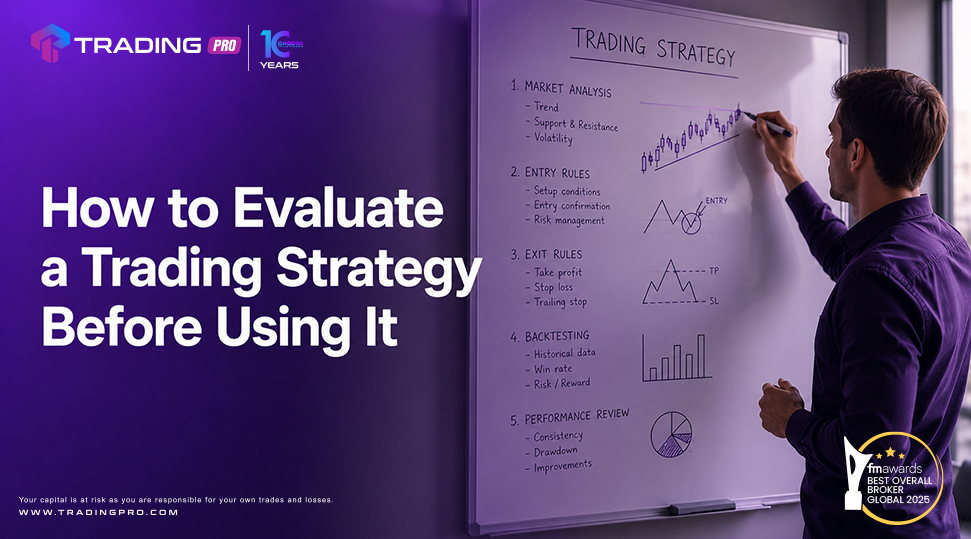
Finding a trading strategy online is easy. Determining whether that strategy actually fits your objectives, risk tolerance, and preferred market is much more difficult.
Traders are exposed to countless strategies through educational websites, social media, trading communities, and online platforms. Some focus on technical indicators, while others rely on price action, fundamental analysis, or a combination of different approaches.
For traders in the MENA region, learning how to evaluate a strategy before relying on it can be an important part of developing a more structured trading process.
What Makes a Trading Strategy?
A trading strategy is a defined set of rules used to guide trading decisions.
A complete strategy should provide a framework for questions such as:
-
When should a trader consider entering?
-
When should they exit?
-
How much risk should they take?
-
Which markets or instruments does the strategy target?
-
What market conditions does it work best in?
-
When should the strategy not be used?
Without clear rules, it becomes difficult to evaluate whether the strategy is actually working.
Start With the Strategy’s Rules
Entry Conditions
The first step is understanding exactly what triggers a potential trade.
For example, a strategy might require a particular price pattern, technical indicator signal, or combination of market conditions.
If the entry rules are vague, different traders may interpret the same strategy differently.
Exit Conditions
A strategy should also explain when a position should be closed.
This may involve a predefined target, a stop-loss, a change in market conditions, or another specific signal.
Knowing the exit rules before entering can help reduce emotional decision-making.
Consider Risk Before Potential Returns
One of the most important parts of evaluating a strategy is understanding its risk.
A strategy should not be judged only by how much it can potentially make.
Traders should also consider:
-
Potential loss per trade
-
Frequency of losing trades
-
Position size
-
Market volatility
-
Maximum exposure
-
Risk-to-reward considerations
A strategy that appears attractive because of high potential returns may not be suitable if the associated risk is too high.
Test the Strategy
Before relying heavily on a strategy, traders can study how it performs under different market conditions.
Historical Testing
Historical market data can be used to examine how a strategy would have behaved in previous conditions.
This can help traders identify potential strengths and weaknesses.
However, historical performance does not guarantee future results.
Markets change, and a strategy that performed well during one period may behave differently in another.
Demo Practice
Using a demo environment can provide another way to become familiar with how a strategy works without immediately committing real capital.
This can help traders understand the practical side of following their rules and managing positions.
Evaluate Different Market Conditions
A strategy may perform differently depending on the market environment.
Trending Markets
Some strategies are designed to take advantage of strong directional movements.
They may perform differently when the market moves sideways.
Range-Bound Markets
Other strategies may be designed around prices moving between identifiable levels.
These approaches may become less effective when the market develops a strong trend.
Understanding these differences can help traders determine when a strategy may be appropriate and when they should stay out of the market.
Why This Matters for MENA Traders
MENA traders may follow financial instruments affected by a combination of regional and international developments.
Oil prices, global interest rates, inflation, geopolitical developments, and economic data can all contribute to changing market conditions.
A strategy should therefore be evaluated in the context of the market it is intended to trade.
A method that works under one set of conditions should not automatically be assumed to work across every instrument or market.
Keep Track of Performance
A strategy cannot be evaluated properly without tracking its results.
Traders can record information such as:
-
Number of trades
-
Winning and losing trades
-
Average gain
-
Average loss
-
Maximum drawdown
-
Market conditions
-
Whether the rules were followed
Keeping consistent records makes it easier to identify whether the strategy itself needs adjustment or whether execution is the main issue.
Review More Than the Win Rate
A high win rate does not automatically mean a strategy is effective.
A strategy could produce many small winning trades but occasionally experience a large loss.
For this reason, traders should consider overall performance and risk rather than focusing on a single statistic.
Avoid Constantly Changing Strategies
Another common problem is changing strategies after a small number of unsuccessful trades.
Every strategy will experience losing periods.
Constantly switching from one method to another can make it difficult to determine whether a strategy actually works because it was never given enough time or consistent execution to evaluate properly.
A structured review process is generally more useful than changing direction after every loss.
How TradingPRO Can Support Strategy Development
TradingPRO provides trading tools and educational resources that can help traders develop their understanding of financial markets.
For MENA traders, these resources can be combined with independent research, strategy testing, and disciplined risk management when evaluating different trading approaches.
The purpose of education is not to find a strategy that guarantees results. Instead, it is to help traders understand the methods they use and make more informed decisions about how those methods fit their objectives.
Conclusion
Evaluating a trading strategy requires more than looking at its potential returns or a few successful examples.
Traders should understand the strategy’s rules, assess its risk, study its performance under different market conditions, and keep consistent records before deciding whether it fits their approach.
For MENA traders, considering regional and global market conditions can add another useful layer to this evaluation process.
A strong trading strategy is not necessarily the most complicated one. It is one that the trader understands, can apply consistently, and can evaluate realistically within an appropriate risk-management framework.
Jot something down
Start Your Trading Journey with TradingPRO
Ready to take the next step in your trading journey? Visit TradingPRO to register your account and connect with TradingPRO across our social media channels.


