




- Published on: 2026-11-20 12:39:59
Withdrawing Profits From a Broker: Taxes and Eligibility

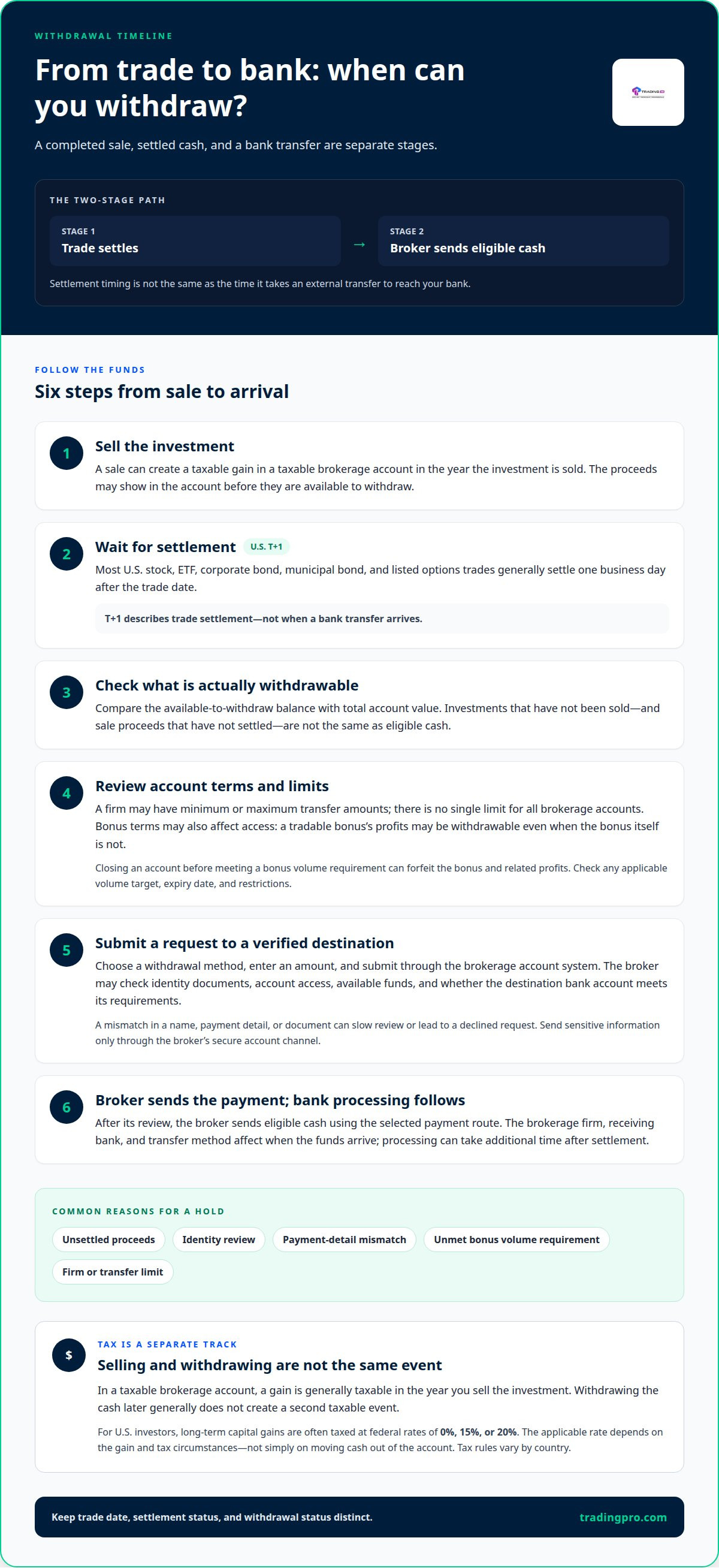
Withdrawing profits from a broker can feel like the moment a tax bill arrives, but in a taxable brokerage account, a gain is generally taxable in the year you sell the investment. Withdrawing the cash later generally doesn’t create a second taxable event. The sale and the withdrawal are separate steps, and that distinction matters.
It’s understandable to expect access to your money as soon as a trade closes. In practice, withdrawal eligibility can depend on whether the proceeds have settled and whether account conditions, such as bonus terms, apply. Tax rules vary by country, so your location and account type shape the answer.
This guide explains when brokerage profits may be taxable, how holding periods affect U.S. capital gains, and what to review when bonus terms could restrict a withdrawal. You’ll also learn when settled proceeds become available and why the transfer itself can take additional time. Use these distinctions to understand what’s available to withdraw and what may count for tax purposes.
Key Takeaways
- Separate the tax treatment of an investment sale from the movement of cash out of your account.
- Learn what account conditions and bonus requirements support may review before approving a withdrawal.
- Understand why a completed trade may not make its proceeds immediately available to transfer.
- See how withdrawal requests move through a brokerage account and what can affect their processing.
- Identify common reasons a withdrawal may be delayed, restricted, or declined.
How broker support confirms withdrawal eligibility
Broker support can confirm whether an account meets its trading, balance, identity, and payment conditions for a withdrawal. In the United States, verify a firm’s regulatory status by matching its legal name and registration details against official regulator records. Use the account’s secure support channel and avoid unsolicited payment links.
Support can assess account access, available funds, and any restrictions before processing a request. This review concerns withdrawal eligibility, not whether a trading gain creates a tax liability.
Checking withdrawal limits
A withdrawal limit is a firm’s minimum or maximum amount for a transfer, and its terms determine how much can be requested at once. Brokerage firms set their own limits, so there is no single amount that applies to all accounts.
Support can explain whether a limit applies to the account, transfer method, or a particular request. For example, a request above the firm’s per-transfer cap could require separate withdrawals, while one below a minimum could be rejected. Find out which limit applies before planning around a specific sum.
Understanding withdrawal delays and restrictions
A delay or restriction means the broker has not released the requested funds, often because a required review or account condition remains incomplete. Support can identify the specific hold, such as unsettled proceeds, an identity review, a payment-detail mismatch, or an unmet bonus volume requirement.
Bonus terms deserve particular attention. Profits from a tradable bonus may be withdrawable even when the bonus itself is not. Closing an account before meeting its volume requirement can forfeit the bonus and related profits. Support can explain the applicable volume target, expiry date, and account restrictions so you understand how a withdrawal request affects the promotion.
How brokers complete identity verification and bank-linking for withdrawals
Identity verification connects the account holder’s details to the brokerage account, while bank-linking identifies the destination for the funds. Support can explain the required documents and secure bank-connection process. Requested details may include identity and address records or evidence that the bank account belongs to the customer.
The broker reviews the submitted information and checks that the withdrawal destination meets its payment requirements. If a name, account detail, or document differs from the account record, the review can take longer or the request may be declined. Send sensitive information only through the broker’s secure account channel, not in response to an unsolicited message.
Tax treatment is separate from this operational review. For U.S. investors, the Internal Revenue Service says long-term capital gains are often taxed at federal rates of 0%, 15%, or 20%. The applicable rate concerns the gain and tax circumstances, not simply the act of transferring cash out of a brokerage account. Support can clarify access and account terms, but withdrawal approval does not establish a trader’s tax position.
Trade settlement and when proceeds become available to withdraw
Settlement completes the exchange of cash and securities after a trade. Until that process finishes, sale proceeds may appear in an account without being available for withdrawal.
Understanding trade settlement and fund availability
Trade settlement is the point when a transaction’s cash and securities are formally exchanged, and it matters because a sale and a withdrawable balance aren’t always simultaneous. According to the U.S. Securities and Exchange Commission, most U.S. stock, ETF, corporate bond, municipal bond, and listed options trades generally settle one business day after the trade date under the T+1 settlement cycle.
Settlement starts from the trade date, not when the cash reaches a bank account. A stock sale, for example, can be complete as a trade while its proceeds are still awaiting settlement. The account may show the amount, but the available-to-withdraw balance can remain lower until the transaction settles.
After settlement, withdrawal timing depends on the brokerage firm, bank, and transfer method. A transfer request therefore involves two distinct stages: the trade settles, then the broker sends eligible cash through the chosen payment route. A bank transfer may take additional processing time after the proceeds become withdrawable. T+1 describes settlement, not the arrival time of an external transfer.
Settlement doesn’t determine whether a sale is taxable. In a taxable brokerage account, the sale can create a taxable gain in the year it occurs, while moving settled cash out is a separate step. Keep the trade date, settlement status, and withdrawal status distinct when reviewing an account statement.
How a broker processes withdrawals from a brokerage account
A withdrawal turns an eligible cash balance into a payment sent to a verified destination. The distinction matters because the amount shown as account value can include investments that haven’t been sold or sale proceeds that haven’t settled.
The broker’s process typically follows the account’s available balance and the payment details associated with it. The account holder selects a withdrawal method, enters an amount, and submits the request through the brokerage account system. The broker then reviews and sends the payment according to its process. The receiving bank and transfer method affect when funds arrive.
Before submitting, distinguish cash available to withdraw from total account value. An account holding securities worth more than its cash balance, for example, doesn’t make the full portfolio value available as cash. Selling an investment creates proceeds, but the applicable settlement cycle must finish first. A pending transfer also isn’t a completed payment.
For traders planning their next move, choose a TradingPRO trading account that fits their approach.
How does a broker process a withdrawal from a brokerage account?
A broker processes a withdrawal by receiving a request, reviewing its details, and directing eligible cash to a payment destination. This separates choosing an amount from confirming that the transfer has been sent.
From withdrawal request to payment
The process begins when the account holder makes a request through the brokerage account. The request identifies the amount and destination method, such as a linked bank account. The broker records those details so the payment can be matched to the correct account and request.
- Select the amount. The account holder chooses an amount within the cash available to withdraw. For example, a partial withdrawal leaves some cash in the brokerage account, while a request for the full available cash balance seeks to move it all.
- Choose the destination. The request uses a payment destination associated with the account. A bank transfer and another supported payment method may follow different processing routes, so the selected option affects the transfer path.
- Review the request. The broker checks the requested amount, destination details, and account status. A mismatch between the request and account records can pause processing until the details are resolved.
- Submit and track. After submission, the brokerage system records a confirmation or status. That record helps distinguish a request still under review from a payment the broker has sent.
Accuracy matters when making the request. Incomplete destination details or an amount beyond available cash may prevent a withdrawal request from being processed as submitted. Requesting more than the cash balance differs from requesting a partial transfer, even when investments make the account’s total value higher.
Once the broker releases a payment, the receiving bank or payment service handles the next stage. The brokerage status and bank balance therefore describe different points in the transfer. A “sent” or “processed” status means the payment has moved from the broker’s side, not that the funds have appeared in the destination account.
Keep the transaction record with the account statement. The amount, date, destination, and status help reconcile the withdrawal against a bank deposit. If the deposit differs from the requested amount, those records can show whether the difference began with the brokerage request or during payment processing.
A withdrawal moves cash, not ownership of unsold investments. A portfolio can still contain securities after a partial cash transfer. The broker’s confirmation identifies the amount sent, while the remaining account statement shows the assets and cash left behind.
Are there minimum or maximum withdrawal limits at brokerage firms?
Brokerage firms may apply minimum or maximum withdrawal limits, but the rules depend on the firm, account terms, and transfer method. There isn’t one universal limit for every brokerage account. That distinction matters when you plan a transfer: a request can be eligible in principle yet fall outside the limits for its chosen payment route.
Think of the limit as a boundary on a withdrawal request, not a measure of your portfolio’s value. An account may hold investments worth more than its available cash, and a withdrawal can draw only on cash the brokerage makes eligible. Requesting all available cash, for example, differs from transferring the full account value, which may include unsold securities.
Limits can take different forms. A brokerage may set a minimum per request, a maximum per transfer, or a cap tied to a particular method. Account terms may also distinguish between a single request and multiple requests over a period. Read the account and transfer terms together, because the amount allowed for one route may not apply to another.
- Minimum amount: A request below the firm’s threshold may not be accepted through that method.
- Per-transfer maximum: A larger eligible balance may need more than one request if a route limits each transfer.
- Available-cash boundary: A request cannot exceed the cash available for withdrawal, even if the account contains unsold investments.
- Account terms: Restrictions linked to the account or a promotion may affect how much can be withdrawn without changing other terms.
Use a clear sequence to assess a planned withdrawal. First, identify the amount available to withdraw rather than relying on total account value. Next, identify the transfer method and its applicable minimum or maximum. Then compare the requested amount with both figures. If it exceeds a per-transfer maximum, splitting the request may be possible only if the firm’s terms allow it. Don’t assume separate requests bypass a limit.
A trader who wants to move only part of an eligible cash balance, for example, should distinguish that request from a full account closure. The first is a partial transfer; the second may involve account-specific requirements or restrictions beyond the transfer limit. Support can explain which rule applies and whether another permitted transfer route has different terms.
Before submitting, confirm the limit for the selected method and the cash amount currently available. Comparing them helps prevent a rejected request and clarifies whether the issue is the request size, payment route, or an account restriction. Keep the submitted amount and transaction status for your records.
Why might a broker delay, reject, or restrict a withdrawal?
A broker may pause or decline a withdrawal when a required account condition remains unresolved. The reason usually falls into a few practical categories: funds aren’t available, account details need review, the destination conflicts with payment requirements, or bonus terms limit access. Identify the condition before resubmitting, because a new request won’t resolve an unchanged issue.
Unsettled proceeds can delay access after a sale. A brokerage balance may display sale proceeds before they become eligible for withdrawal. A trader who requests those funds before settlement, for example, may see the request held or rejected. The key distinction is between the account’s displayed value and its available-to-withdraw cash balance.
Identity or payment mismatches can stop a request while the broker reviews account records. A difference between the account holder’s name and the bank account name, incomplete identity details, or incorrect destination information can prevent the transfer. If a withdrawal request uses a bank account that doesn’t match the verified payment details, for example, the broker may require a correction before releasing the funds.
- Bonus volume not met: A promotion may require specified trading volume before withdrawal. Closing the account early can forfeit the bonus and related profits.
- Bonus expiry or account restrictions: The terms may set an expiry date or limit eligibility by account type. A request made outside those conditions can affect bonus funds or associated profits.
- Request amount exceeds available cash: An account’s total value may include unsold investments. A request above available cash can’t be processed as submitted.
- Transfer details need correction: An inaccurate destination or incomplete request can prevent the broker from matching the payment to the account.
Distinguish a delay from a rejection. A delay means a review or condition remains open, such as pending identity checks or unsettled sale proceeds. A rejection means the request was declined as submitted, often because its amount, destination, or account status failed a requirement. A restriction can apply to only part of the balance, particularly when bonus terms distinguish eligible profits from bonus funds.
Use the account’s withdrawal status to locate the cause. Match the request amount against available cash, review account notifications, and compare the destination details with the linked payment information. If bonus funds are involved, review the volume requirement, expiry date, and account-type terms before submitting another request. These checks target the specific issue instead of repeating the same submission.
For a trading account suited to your approach, start your account registration.
TradingPRO
TradingPRO offers traders a choice of account environments suited to different trading approaches. Its Rookie, Micro, Pro, and Scalp Accounts provide options for readers considering how their setup fits their goals. Clear account terms matter when planning future withdrawals, especially if account conditions or bonus requirements may affect eligibility.
Use the distinctions in this guide to separate taxable gains, settled cash, and funds available to transfer. If you’re reviewing your account options or planning your next trading step, contact TradingPRO.
Plan your next move with clarity
Make liquidity part of your trading plan, not an afterthought. Before opening or adjusting a position, consider how much capital you may want to keep accessible and what you intend to do with future proceeds. This can help align trading decisions with your cash-flow needs, without treating an account balance as money ready to spend.
Keep clear records of your trades and withdrawals, and separate account operations from tax planning. For business owners managing capital allocations and business expenses alongside trading, professional advisors such as POP Business offer practical guidance on structuring finances and assets. If your approach or financial needs change, reconsider how much flexibility you want from your trading setup. A considered plan makes withdrawing profits from a broker easier to place within your wider financial decisions.
For guidance on your next trading step, contact TradingPRO about your withdrawal questions. Move forward with a plan that fits your goals.
Frequently Asked Questions
Do you pay taxes when you withdraw from a brokerage account?
Withdrawing profits from a broker generally doesn’t create a separate tax event simply because cash moves to your bank. A less obvious tax issue can arise if you sell an investment at a loss: the Internal Revenue Service wash-sale rule may apply if you buy the same or a substantially identical security within 30 days before or after that sale. That can affect how the loss is treated for tax purposes.
How long do broker withdrawals take in the United States?
There isn’t one withdrawal timeline for every U.S. brokerage account. Progress depends on the broker, the receiving bank, and the selected method. When withdrawing profits from a broker, use the transaction status to see whether the request has been submitted or processed, then check the destination account for the deposit. A submitted request alone doesn’t confirm receipt.
How does a broker process cash withdrawals after investments are sold, and what are the settlement times?
A broker first needs the sale proceeds to settle before treating them as available cash for withdrawal. The U.S. Securities and Exchange Commission says most stock, ETF, corporate bond, municipal bond, and listed options trades settle under T+1. The cycle took effect on May 28, 2024. After settlement, the broker sends eligible funds using the chosen transfer method, and the bank handles receipt.
What taxes apply when withdrawing profits from a taxable brokerage account?
When withdrawing profits from a broker, tax records and sale details matter more than the cash transfer itself. U.S. brokerage tax forms are often available by mid-February, though timing can vary and corrected forms may follow. Compare the form with your trade records, especially if you sold investments at a loss or had a wash-sale transaction. Those records help explain reported activity when preparing a return.
What withdrawal methods do U.S. brokers support, and what are the fees?
A broker may support transfers to a linked bank account or another supported payment method. Processing routes vary by method.


