




- Published on: 2022-09-15 15:00:00
What Is Web3? A Trader's Guide to the Blockchain Economy and Its Opportunities
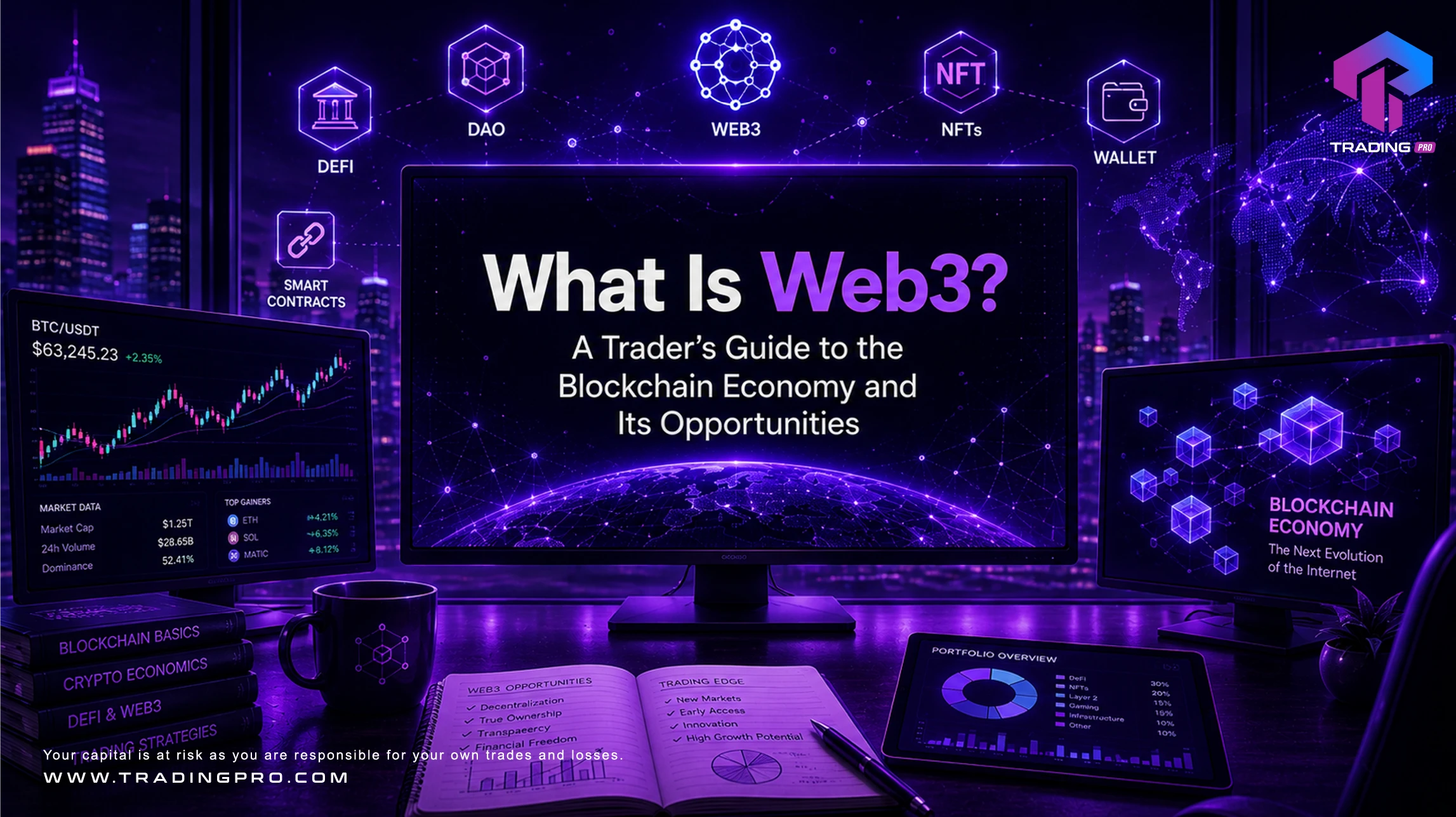
Few terms in the technology and cryptocurrency space have generated more discussion — and more confusion — than Web3. Venture capitalists have poured tens of billions of dollars into Web3 projects. Established technology companies have scrambled to develop Web3 strategies. Critics have dismissed it as marketing hype. Through it all, most people — including many crypto traders — have a vague rather than precise understanding of what Web3 actually is and why it matters.
This guide cuts through the noise. We explain what Web3 means, how it relates to the blockchain technology underlying cryptocurrencies, what practical applications are emerging, and most importantly for traders — what opportunities the Web3 economy creates and how to approach them intelligently. Whether you are curious about the concept or looking to trade Web3-related assets more effectively, this is your starting point.
The Evolution of the Web: Web1, Web2, and Web3
Web1: Read-Only (1990s-Early 2000s)
The first generation of the commercial internet — Web1 — was primarily a read-only experience. Users could browse static websites and consume information, but interactivity was extremely limited. Websites were owned and published by businesses and institutions; most users were passive consumers of content they had no ability to contribute to or participate in economically.
Web2: Read-Write (Mid 2000s-Present)
Web2 transformed the internet into a participatory platform. Social media, user-generated content, e-commerce, and cloud-based applications allowed ordinary users to create, share, and interact at scale. Facebook, Google, YouTube, Amazon, and Twitter became the dominant infrastructure of this era.
But Web2 came with a fundamental trade-off: the platforms that enabled user participation captured the economic value that participation created. When you post content on Instagram, the engagement and attention value flows to Meta, not to you. When you build a business on Amazon's marketplace, Amazon controls the terms, the data, and the relationship with your customers. Users contribute the content and data; platforms capture the value. Web2 is participatory but not ownership-based.
Web3: Read-Write-Own (Emerging)
Web3 represents a third paradigm: an internet where users can not only create and participate, but genuinely own digital assets and have direct economic stake in the platforms they use. This ownership is enabled by blockchain technology, which provides a decentralised, tamper-proof ledger for recording ownership of digital assets without requiring a centralised authority to maintain those records.
In practical terms, Web3 means: owning your in-game items as NFTs that exist independently of any specific game; earning tokens for contributing content or liquidity to a protocol rather than having that value captured by a platform; participating in governance of the platforms you use through token-based voting; and interacting with financial services through smart contracts rather than traditional institutions.
The Core Technologies Enabling Web3
Blockchain
Blockchain is the foundational technology of Web3. It is a decentralised ledger that records transactions across a network of computers in a way that makes the records transparent, permanent, and extremely difficult to alter. Ethereum is the most important blockchain for Web3 applications, providing the programmable smart contract infrastructure on which most Web3 protocols are built.
Smart Contracts
Smart contracts are self-executing programs on a blockchain that automatically enforce the rules of an agreement. They are the building blocks of Web3 applications — enabling decentralised exchanges, lending protocols, NFT marketplaces, and governance systems to operate without central authorities.
Tokens and NFTs
Tokens are the economic units of Web3. Fungible tokens (like ETH, USDC, or governance tokens) are interchangeable with each other and are used as currencies, governance rights, and incentive mechanisms. Non-Fungible Tokens (NFTs) represent unique, verifiable ownership of specific digital assets — digital art, music, in-game items, virtual real estate, event tickets, or anything else that benefits from provable digital ownership.
Decentralised Autonomous Organisations (DAOs)
DAOs are blockchain-based organisational structures governed by token holders through on-chain voting. Rather than having a CEO or board of directors make decisions, a DAO distributes governance rights to token holders who vote on proposals ranging from treasury allocation to product development priorities. DAOs represent Web3's attempt to create user-owned organisations rather than company-owned platforms.
The Major Web3 Sectors and Their Trading Implications
DeFi (Decentralised Finance)
DeFi is the most developed and economically significant sector of Web3, with hundreds of billions of dollars in total value locked across lending, trading, and yield generation protocols. DeFi tokens — the governance and utility tokens of major protocols like Uniswap, Aave, Compound, and Curve — represent one of the most active trading categories in the crypto market. Their prices are driven by protocol revenue, total value locked, governance decisions, and broader risk sentiment.
NFTs and Digital Ownership
The NFT market experienced an extraordinary boom in 2021 and subsequent sharp correction in 2022, illustrating the speculative volatility that characterises early-stage Web3 sectors. Blue-chip NFT collections like CryptoPunks and Bored Ape Yacht Club maintain significant market caps and cultural cachet, while the broader NFT market has undergone significant price discovery. Trading NFT-adjacent tokens — the native tokens of NFT marketplaces and platforms — offers more liquid exposure to this sector than directly trading NFTs themselves.
Gaming and the Metaverse
Web3 gaming — sometimes called GameFi — attempts to create game economies where players genuinely own their in-game assets as NFTs and can earn tokens with real-world value through gameplay. The play-to-earn model, pioneered by Axie Infinity, generated extraordinary enthusiasm before experiencing severe economic challenges that highlighted the difficulty of sustaining token-based game economies. The metaverse concept — persistent, immersive virtual worlds with blockchain-based economies — remains a major long-term theme despite current bear market conditions.
Layer 1 and Layer 2 Infrastructure
The blockchain infrastructure layer — Layer 1 networks like Ethereum, Solana, Avalanche, and Polkadot, and Layer 2 scaling solutions like Arbitrum, Optimism, and Polygon — represents the foundational plumbing of the Web3 economy. Native tokens of these networks are among the most liquid and actively traded Web3 assets, with prices driven by network activity, developer adoption, and the overall growth of the ecosystem built on top of them.
Evaluating Web3 Trading Opportunities
Web3 presents a unique evaluation challenge because many projects are pre-revenue or even pre-product at the time their tokens become publicly tradeable. Standard fundamental metrics like P/E ratios are often inapplicable. Instead, Web3 traders typically focus on:
-
Total Value Locked (TVL) — for DeFi protocols, TVL measures the capital deposited and is the primary indicator of protocol utility and adoption
-
Daily Active Users and Transaction Volume — measures of real-world usage that indicate whether a protocol is being adopted beyond speculation
-
Developer Activity — active development (measured through GitHub commits and developer counts) signals a project with technical momentum and a committed team
-
Token Distribution and Vesting Schedules — understanding who holds tokens and when locked tokens unlock is critical for assessing supply-side selling pressure
-
Protocol Revenue — the most sustainable Web3 projects generate real revenue from fees, which can be used to buy back tokens or reward stakers, creating fundamental value flows
Trading Web3 Assets with TradingPRO
-
Ethereum CFDs — as the foundational layer of most Web3 activity, ETH is the single most important Web3 asset and is directly tradeable as a CFD on TradingPRO
-
Major altcoin CFDs — access trading in Solana, Cardano, and other leading Web3 infrastructure tokens with competitive pricing and deep liquidity
-
Risk management for high-volatility assets — Web3 tokens can be extraordinarily volatile; TradingPRO's guaranteed stops and conservative position sizing tools help manage this volatility professionally
-
Market analysis and crypto research — stay informed on Web3 developments, protocol launches, and ecosystem growth through TradingPRO's regular crypto market commentary
Conclusion: Web3 Is Early, Volatile, and Worth Understanding
Web3 is a genuine technological shift with the potential to restructure how value is created, owned, and exchanged on the internet. It is also early, speculative, and riddled with projects that will not survive the inevitable shakeout between genuine innovation and hype. The traders who navigate it most successfully will be those who develop the analytical tools to distinguish between them — evaluating real usage metrics, sustainable token economics, and genuine technical innovation rather than chasing social media narratives.
The opportunity in Web3 is real. So is the risk. Approach it with the same disciplined risk management you apply to any other high-volatility asset class, and you will be better positioned than the majority of market participants. TradingPRO gives you access to the most liquid Web3 assets with professional-grade risk management. Open your account today.
Access Web3 and Crypto Markets with TradingPRO


