



- Published on: 2022-06-27 16:09:00
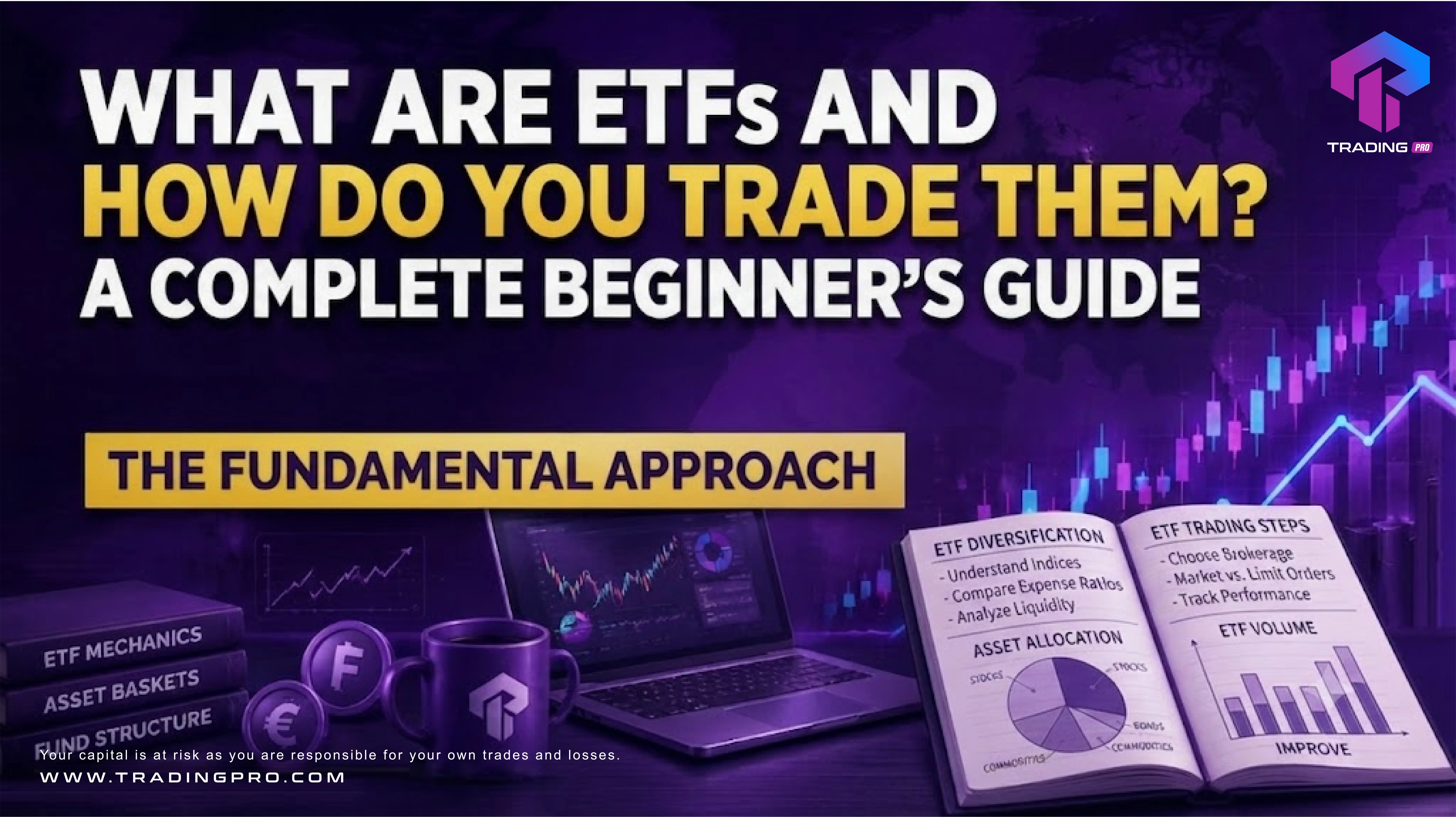
What Are ETFs and How Do You Trade Them? A Complete Beginner's Guide
Exchange Traded Funds — ETFs — have become one of the most popular and widely used investment vehicles in the world, attracting trillions of dollars in assets from retail investors and institutions alike. Yet despite their mainstream status, many beginning traders and investors are not entirely clear on what ETFs actually are, how they differ from stocks and mutual funds, or how to use them effectively. This guide gives you a complete, practical introduction.
By the end of this article, you will understand exactly what an ETF is, the different types available, why they have become so popular, how to evaluate them, and how TradingPRO gives you efficient access to ETF trading. Whether you are building a long-term investment portfolio, looking for diversified market exposure, or simply want to understand one of the most important financial instruments of the modern era, this guide has you covered.
What Is an ETF?
An Exchange Traded Fund is a collection of securities — stocks, bonds, commodities, or a combination — bundled together into a single tradeable instrument that trades on a stock exchange just like an individual stock. When you buy a share of an ETF, you are effectively buying a proportional slice of all the securities held within that fund.
For example, the SPDR S&P 500 ETF (ticker: SPY) holds shares in all 500 companies that make up the S&P 500 index, weighted proportionally. When you buy one share of SPY, you instantly own a tiny piece of Apple, Microsoft, Amazon, Tesla, and 496 other companies — in a single transaction, for the cost of one share.
This combination of broad diversification, low cost, and the simplicity of trading like a stock is what has made ETFs one of the most transformative investment innovations of recent decades.
ETFs vs Stocks vs Mutual Funds
ETFs vs Stocks: A single stock represents ownership in one company; an ETF represents ownership in a basket of securities. ETFs provide instant diversification that would otherwise require buying dozens or hundreds of individual stocks. Like stocks, ETFs trade on exchanges throughout the day at market prices.
ETFs vs Mutual Funds: Both pool investor money to hold a basket of securities, but mutual funds only price and trade once per day after markets close, while ETFs trade continuously throughout the day like stocks. ETFs typically have lower management fees than actively managed mutual funds and are generally more tax-efficient.
The Main Types of ETFs
Index ETFs
Index ETFs track a specific market index — the S&P 500, NASDAQ 100, FTSE 100, or any number of more specialised indices. Their goal is to replicate the performance of the index as closely as possible rather than to outperform it. Because they are passively managed (no fund manager actively selecting stocks), their fees are extremely low compared to actively managed alternatives.
Index ETFs have been the primary driver of the ETF industry's growth. Decades of data showing that the majority of actively managed funds underperform their benchmark indices over the long term has driven enormous capital flows into low-cost passive index ETFs.
Sector ETFs
Sector ETFs focus on a specific industry or sector — technology, healthcare, energy, financials, consumer staples, and so on. They allow investors to express a view on a particular sector's prospects without the idiosyncratic risk of picking individual stocks within that sector. For example, instead of betting on one pharmaceutical company, you might buy a healthcare sector ETF that holds all major healthcare companies.
Commodity ETFs
Commodity ETFs provide exposure to raw materials like gold, oil, silver, or agricultural products. Gold ETFs like GLD and IAU have become enormously popular as convenient ways to gain gold price exposure without the complexity and cost of holding physical metal. Energy ETFs provide oil and gas price exposure without the need to trade futures contracts directly.
Bond ETFs
Bond ETFs hold portfolios of fixed-income securities — government bonds, corporate bonds, or a mix. They provide the income characteristics of bonds with the liquidity and simplicity of stock-like trading. In an environment of rising interest rates, understanding the interest rate sensitivity (duration) of bond ETFs is particularly important.
Thematic ETFs
Thematic ETFs focus on specific investment themes or trends rather than traditional sectors or indices. Clean energy ETFs, artificial intelligence ETFs, cybersecurity ETFs, and cannabis ETFs are all examples. These can offer targeted exposure to emerging trends but often carry higher fees and more concentrated risk than broader index ETFs.
Why ETFs Have Become So Popular
-
Instant diversification — a single ETF purchase can provide exposure to hundreds or thousands of securities, dramatically reducing single-stock risk without requiring a large portfolio
-
Low cost — the expense ratios (annual management fees) of index ETFs are among the lowest of any investment vehicle, often below 0.1% per year for major index ETFs
-
Transparency — most ETFs disclose their holdings daily, allowing investors to always know exactly what they own
-
Liquidity — major ETFs trade millions of shares per day with tight bid-ask spreads, allowing investors to enter and exit positions easily at fair prices
-
Flexibility — ETFs can be bought and sold at any point during market hours, unlike mutual funds which only settle at end-of-day prices
-
Tax efficiency — the structure of ETFs typically generates fewer taxable events than actively managed mutual funds, making them more efficient from a tax perspective in many jurisdictions
How to Evaluate an ETF Before Investing
-
Underlying index or strategy — understand exactly what the ETF is tracking or what strategy it implements. Two ETFs that both claim to track 'technology stocks' may hold very different portfolios with very different risk profiles.
-
Expense ratio — lower is generally better for passive index ETFs. Even small differences in fees compound significantly over time. Actively managed ETFs command higher fees — evaluate whether the strategy justifies the additional cost.
-
Assets under management (AUM) — larger AUM generally indicates greater liquidity and lower tracking error. Be cautious with very small, illiquid ETFs where bid-ask spreads can be wide and price discovery less reliable.
-
Tracking error — for index ETFs, check how closely the fund has historically tracked its underlying index. A consistently high tracking error suggests inefficiency in the fund's management.
-
Dividend policy — some ETFs distribute dividends from their underlying holdings; others reinvest them. Understand which approach the ETF takes and how it fits your income or growth objectives.
Using ETFs in a Trading Strategy
Beyond long-term investing, ETFs are also widely used by active traders for shorter-term directional positions. Sector ETFs allow traders to take a view on an entire industry without single-stock selection risk. Inverse ETFs (which rise when their underlying index falls) can be used as hedging instruments. Leveraged ETFs (which amplify index returns by 2x or 3x) allow aggressive directional bets, though they carry significantly higher risk and are subject to volatility decay that makes them unsuitable for longer-term holding.
For active traders, ETFs also provide a clean way to trade macro themes: if you have a view that US technology stocks will underperform European industrials over the next quarter, you can express that view through the relevant sector ETFs without the complexity of building individual stock portfolios on both sides.
Access ETF Markets with TradingPRO
-
ETF CFDs — trade major US and European ETFs as CFDs on TradingPRO, gaining price exposure without the need for a traditional brokerage account or custody arrangement
-
Long and Short Positions — profit from ETF price movements in either direction, allowing you to trade both bullish and bearish macro views with equal ease
-
Tight Spreads — access competitive pricing on major ETF CFDs, keeping transaction costs low for both active traders and longer-term position holders
-
Full Market Context — combine ETF trading with TradingPRO's integrated news, economic calendar, and market analysis tools to make fully informed ETF trading decisions
Conclusion: Versatile, Accessible, and Worth Understanding
ETFs are one of the most versatile financial instruments available to modern investors and traders. Whether you are a long-term investor building a diversified portfolio at minimal cost, or an active trader looking for efficient, liquid vehicles to express macro and sector views, ETFs deserve a place in your investment toolkit.
The key is understanding what you are buying: the underlying exposure, the costs, the liquidity, and how the ETF fits your overall strategy and risk management framework. With that understanding in place, ETFs become a genuinely powerful building block for any financial strategy. TradingPRO gives you efficient, flexible access to ETF price movements — open your account today and start putting them to work.
Trade ETFs and More with TradingPRO


