




- Published on: 2022-08-30 15:05:00
Trading the Japanese Yen: BoJ Policy, Yield Curve Control, and Safe-Haven Dynamics
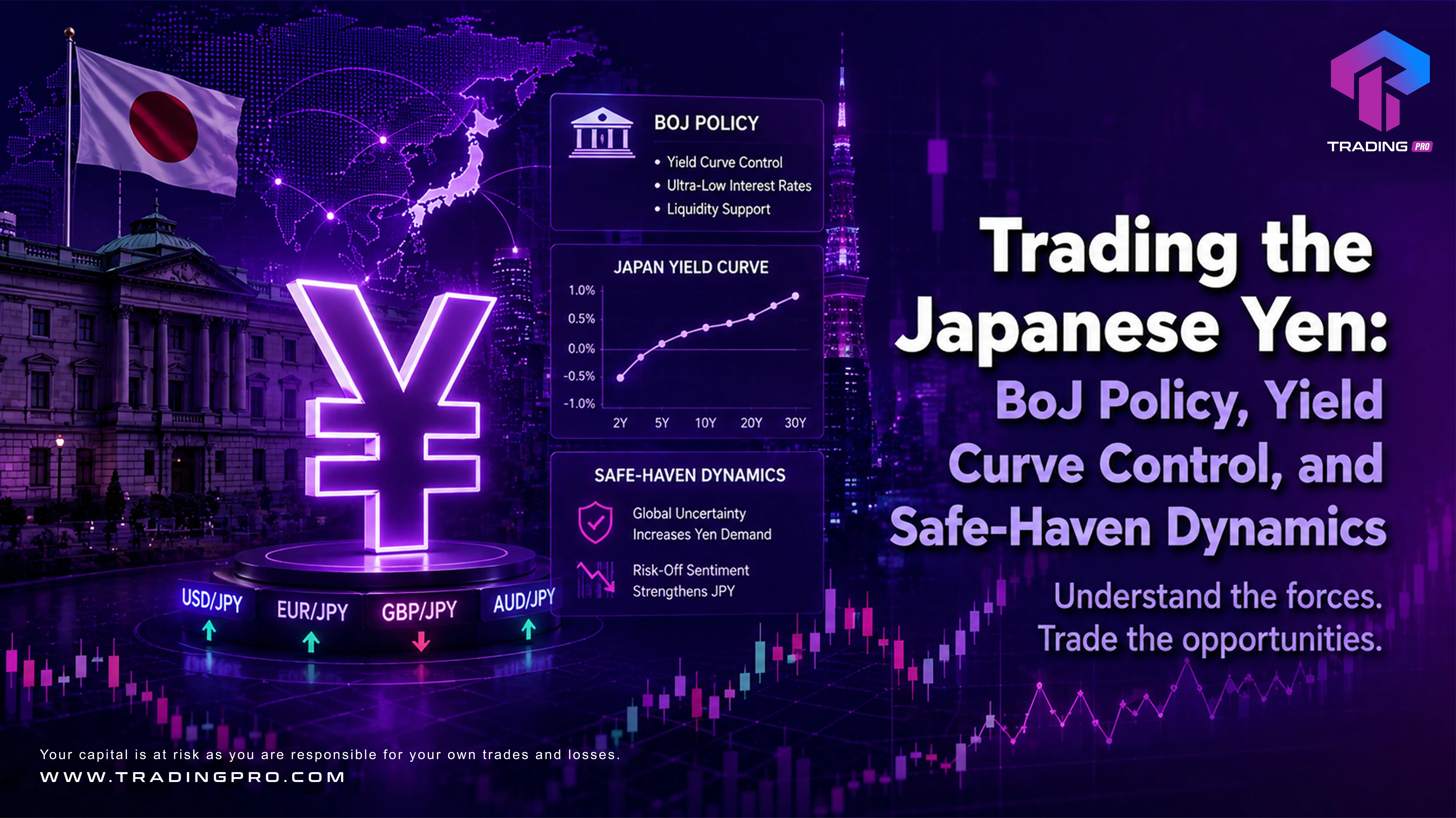
The Japanese Yen is one of the most fascinating and distinctive currencies in all of global forex markets. It defies simple analysis because it operates under a unique combination of influences that set it apart from virtually every other major currency: the Bank of Japan's extraordinary yield curve control policy that caps long-term interest rates near zero, the Yen's deep-rooted role as the world's preferred safe-haven currency, decades of ultra-loose monetary policy that have created one of the world's most popular funding currencies for carry trades, and Japan's status as the world's largest creditor nation with trillions of dollars in overseas investment that creates complex repatriation dynamics.
Understanding the Yen requires understanding all of these forces simultaneously. This advanced guide breaks down each of them in depth and explains how they translate into tradeable opportunities across JPY pairs — particularly USD/JPY, which in 2022 has produced some of the largest and most sustained moves seen in any major currency pair in years.
The Bank of Japan's Unique Policy Framework
While the rest of the world's major central banks — the Federal Reserve, the European Central Bank, the Bank of England — have spent 2022 aggressively raising interest rates to combat inflation, the Bank of Japan has maintained its ultra-accommodative monetary policy stance essentially unchanged. This is not an oversight or inertia. It is a deliberate policy decision rooted in Japan's unique economic context: decades of deflationary pressure or near-zero inflation that the BoJ has been trying to overcome, a massive government debt burden that makes higher interest rates politically and fiscally extremely costly, and an economic structure that is more sensitive to deflation than to inflation.
Yield Curve Control (YCC)
The BoJ's most distinctive policy tool is Yield Curve Control, introduced in 2016. Under YCC, the BoJ commits to keeping the 10-year Japanese Government Bond (JGB) yield within a defined band around zero (currently +/- 0.25%) by buying whatever quantity of JGBs is necessary to prevent the yield from breaching the ceiling. This is an extraordinary commitment — it effectively puts the BoJ in the position of purchasing unlimited quantities of government bonds to defend an interest rate cap.
The implications for the Yen are profound. While US Treasury yields have risen sharply as the Fed tightens, Japanese 10-year yields are capped near zero. This creates an ever-widening interest rate differential between USD and JPY assets — the primary fundamental force driving USD/JPY to multi-decade highs through 2022. Capital flows out of JPY-denominated assets into USD-denominated assets chasing higher yields, creating consistent selling pressure on the Yen.
When Does YCC Change?
The critical question for Yen traders is when and under what conditions the BoJ might adjust its YCC framework — because any adjustment toward allowing higher JGB yields would immediately reduce the USD/JPY yield differential and could trigger a significant Yen appreciation (USD/JPY decline). Watching for any communication from BoJ Governor Kuroda or other officials about potential YCC adjustments is one of the most important monitoring tasks for traders in JPY pairs.
Factors that could prompt a YCC adjustment include: Japanese inflation rising sustainably and meaningfully above the BoJ's 2% target; significant depreciation of the Yen causing imported inflation concerns that override the BoJ's deflationary fears; or a change in BoJ leadership (Governor Kuroda's term expires in April 2023) bringing a different policy perspective.
The Yen as a Safe-Haven Currency
The Japanese Yen's safe-haven status is one of its most consistent and well-documented characteristics. During periods of global financial stress, geopolitical crisis, or broad risk aversion, the Yen tends to appreciate sharply — sometimes dramatically — as capital flows into JPY assets for safety.
This safe-haven behaviour has several roots: Japan's status as the world's largest net creditor nation means Japanese investors hold enormous overseas investment portfolios that they tend to repatriate (selling foreign assets and buying JPY) during periods of global stress; the Yen's deep liquidity and the BoJ's backstop role makes it a reliable safe harbour; and decades of carry trade funding in JPY means that risk-off episodes trigger carry trade unwinding, which involves buying back JPY to repay the borrowed JPY used to fund the carry positions.
This creates an interesting dynamic for Yen traders: in normal or risk-on conditions, the Yen's ultra-low yields make it a perennial underperformer (particularly in the context of aggressive Fed tightening). But during risk-off episodes, the Yen can surge dramatically as all of the above factors kick in simultaneously, making it one of the fastest and sharpest-moving assets in global markets during periods of market stress.
USD/JPY: The Rate Differential Trade of 2022
USD/JPY has been one of the defining trades of 2022. The pair rose from below 115 at the start of the year to above 135 — a move of more than 20 figures — driven almost entirely by the widening interest rate differential between the Fed's aggressive tightening cycle and the BoJ's unyielding commitment to ultra-accommodative policy. This is a textbook macro trade: long the currency of the tightening central bank, short the currency of the accommodation-committed central bank.
Key Technical Levels for USD/JPY
USD/JPY's multi-decade move has taken it through a series of historically significant technical levels. Levels around 125-126 represented multi-year highs from 2015; the 130 level was a major psychological and technical barrier; 135 and above represents territory not seen since the late 1990s. Each of these levels attracted significant attention from the Bank of Japan, which has verbally intervened on multiple occasions to warn about excessive Yen weakness and signal concern about the speed of the move.
Japanese verbal intervention is an important risk factor for USD/JPY bulls. While the BoJ cannot directly raise rates without abandoning YCC, Japanese authorities can intervene directly in currency markets by buying Yen — as they did in September 1998 and September 2010. The risk of intervention increases as USD/JPY moves to more extreme levels and the speed of the depreciation accelerates.
Other Key JPY Pairs
EUR/JPY: A popular pair that combines the interest rate differential dynamics of USD/JPY with the specific characteristics of the Euro. EUR/JPY tends to be more volatile than USD/JPY and is sensitive to both ECB policy developments and broader risk sentiment.
GBP/JPY: One of the most volatile major cross pairs, nicknamed 'the Dragon' by traders for its sharp and unpredictable moves. GBP/JPY combines the volatility of Sterling with Yen's risk-off surges, creating extraordinary trading opportunities — and extraordinary risks — during volatile market periods.
AUD/JPY: A classic risk barometer pair. Because AUD is a risk-sensitive commodity currency and JPY is the premier safe-haven, AUD/JPY rises during risk-on environments and falls sharply during risk-off episodes. Many traders monitor AUD/JPY as an indicator of broader market risk appetite.
Risk Management for JPY Pairs
-
Respect intervention risk — always maintain stops on USD/JPY and other JPY shorts that account for the possibility of sudden verbal or actual currency intervention. A BoJ intervention can cause a 300-500 pip move in minutes.
-
Monitor risk sentiment indicators — the Yen's safe-haven role means JPY pairs are uniquely sensitive to broad market risk sentiment. Sudden spikes in the VIX or credit spreads can cause rapid JPY appreciation that overrides the underlying carry dynamics temporarily.
-
Watch BoJ communications carefully — any signal of potential YCC adjustment is a major event for all JPY pairs. Set up news alerts for BoJ officials and monitor the Japanese financial news closely.
-
Be aware of end-of-quarter and fiscal year-end repatriation — Japanese institutional investors repatriate overseas income at fiscal year-end (March) and quarter-ends, creating systematic JPY demand that can temporarily run against the prevailing trend.
Trading JPY Pairs with TradingPRO
-
Access to all major JPY crosses — trade USD/JPY, EUR/JPY, GBP/JPY, AUD/JPY and other JPY pairs with tight spreads and deep liquidity
-
Real-time BoJ news and central bank calendar — never miss a BoJ meeting, official statement, or intervention warning with TradingPRO's integrated news and economic calendar
-
Advanced risk management for volatile pairs — guaranteed stops are particularly valuable for JPY pairs given the asymmetric risk of sudden intervention-driven spikes
-
Multi-timeframe charting — analyse USD/JPY across weekly, daily, and intraday timeframes to manage both the macro trend and tactical entry and exit timing
Conclusion: The Yen Rewards Those Who Understand It
The Japanese Yen is not a simple currency to trade. Its behaviour is shaped by a unique combination of central bank policy, decades of carry trade positioning, safe-haven flows, and intervention risk that requires a more nuanced analytical framework than most other major currencies. But for traders willing to invest in understanding these dynamics, the Yen consistently offers some of the most clearly defined macro trade opportunities in all of forex — as 2022 has demonstrated in particularly vivid fashion.
TradingPRO gives you the access, tools, and analytical support to trade JPY pairs professionally. Open your account today and start engaging with one of the most uniquely interesting currencies in global markets.
Trade JPY Pairs with Professional Tools on TradingPRO


