




- Published on: 2026-10-08 01:19:44
Trading as a Business Plan Template: Build a Smarter Trading Plan

What if your trading plan measured discipline before profit? A trading as a business plan template should do more than set an income target. It should define what you trade, when you act, how you manage exposure, and what you review after each decision.
Generic business templates often miss the details that shape trading decisions. Markets change, and no plan can promise returns. You need a framework that turns your approach into clear, measurable rules without assuming every trade will work.
Use this practical structure to define your trading business, set process-based goals, establish risk limits, and build a repeatable routine. You’ll also learn how to keep useful records, review performance, and assess tools and account features against your approach. TradingPRO offers Rookie, Micro, Pro, and Scalp accounts, along with Social Trading and Copy Trading. A written plan helps you identify what you need from a trading environment while keeping your own risk limits and oversight at the center.
Key Takeaways
- Use a trading as a business plan template to set adaptable rules for your approach, routine, risk, records, and reviews.
- Set process-based goals and clear risk limits instead of building your plan around assumed profits.
- Match an account environment to your decision frequency, monitoring needs, and documented requirements, not to expectations of better results.
- Put your plan to work in stages: draft it, test the rules in a suitable practice environment, record outcomes, review, and revise.
- Evaluate account options such as Rookie, Micro, Pro, and Scalp against your plan. Social or copy trading still calls for personal risk limits and oversight.
What Does Trading as a Business Mean in a Trading Plan?
Trading as a business means treating market activity as a process you can define, track, and improve. A trading as a business plan template is an operating document for decisions: what you trade, what conditions must be present before you enter, how you control exposure, and how you record and review each decision. It isn’t a forecast of guaranteed income. It helps make your actions more deliberate.
A trading plan turns objectives into repeatable market decisions. Instead of writing “I want to trade better,” specify which setups you’ll consider, what would invalidate an entry, and when you’ll stop trading for the day. The plan gives you a reference point before emotions or a fast-moving market tempt you to improvise.
Trading plan versus conventional business plan
A conventional business plan can provide a useful foundation. Its objectives, operating procedures, and financial assumptions translate well to personal trading. The general structure of a Business Plan on Wikipedia offers context, but a trader’s plan needs different core sections. Replace products, customers, and sales channels with markets, trading methods, entry criteria, and trade controls.
A retailer may plan inventory and customer acquisition. An individual trader instead documents the conditions for considering a trade, the maximum acceptable exposure, and the records needed to assess decisions later. Financial assumptions should describe planning parameters, such as available trading capital and personal limits, not promised returns. Trading as a business also doesn’t automatically mean forming a registered company. Registration, tax status, and legal structure depend on individual circumstances, so they aren’t universal steps in a trading plan.
Who benefits from a written trading business plan?
Beginners benefit from rules they can consult before acting. Writing down entry conditions and risk boundaries can help reduce impulsive decisions, especially when a tempting setup falls outside the approach they chose. A plan won’t remove uncertainty, but it can make waiting as deliberate as trading.
Developing traders can use the plan as a review standard. Compare your intended routine with your records: Did you trade the markets and setups you selected? Did you follow your stated controls? Where did your actions drift from the plan? These comparisons help distinguish execution issues from assumptions that need further testing.
Focus on decisions you can observe and evaluate. Set objectives around process, such as following defined entry rules or completing a regular review, rather than assuming a particular profit. A written plan organizes how you operate; it can’t guarantee performance or eliminate market risk. Treat it as a working guide, and update it when careful review shows that a procedure needs refinement.
What to Include in a Trading as a Business Plan Template
A useful trading as a business plan template is a set of adaptable prompts, not a fixed formula or promise of results. It turns your objectives into decisions you can follow and assess. OpenStax describes a business plan as a roadmap; for an individual trader, that roadmap should focus on markets, methods, controls, and routine rather than products and customers.
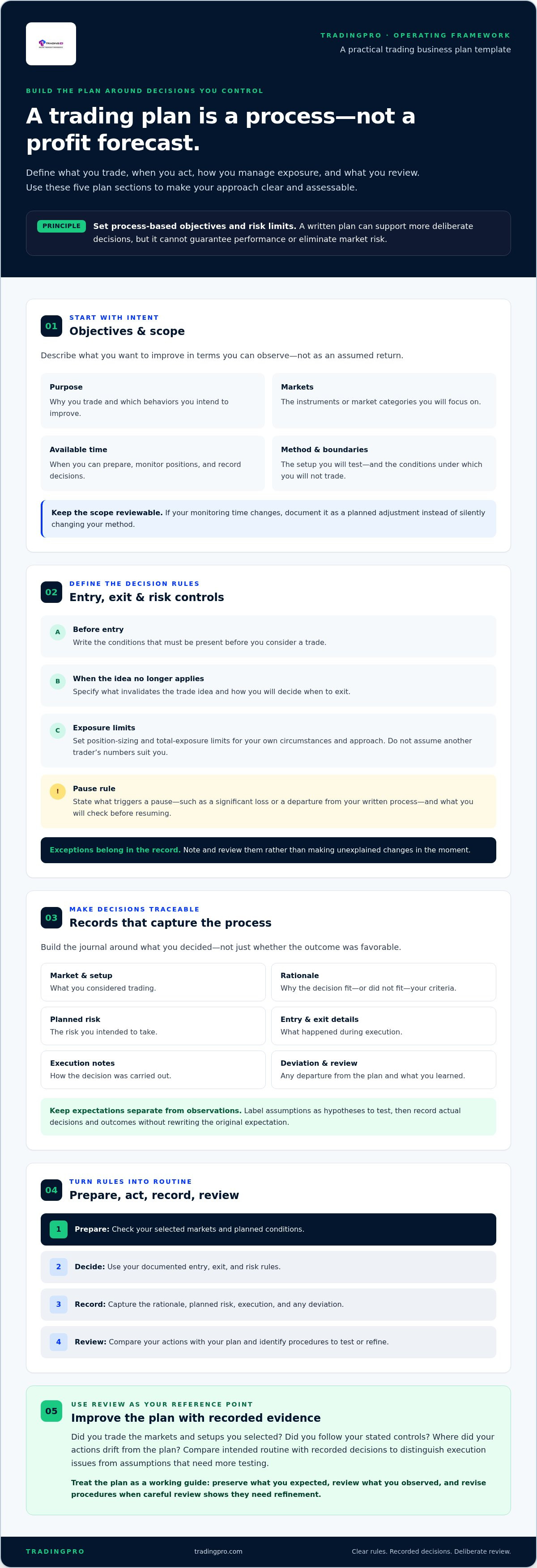
Separate expectations from observations. Label assumptions about your approach as hypotheses to test, then record actual decisions and outcomes without rewriting the original expectation. This gives each review a clear comparison point and keeps the plan grounded in what you recorded.
Set objectives, scope, and trading approach
Start with purpose and process. State why you trade, what you want to improve, and which behaviors you can measure without assuming a particular return. For example, you might aim to follow documented entry criteria and complete a review after each session. Then define the scope of the plan:
- Markets: Which instruments or market categories will you focus on?
- Time: When can you prepare, monitor positions, and record decisions?
- Method: What type of setup or decision process will you test?
- Boundaries: Which conditions mean you won’t trade?
Keep the scope narrow enough to review. If your available monitoring time changes, document it as a planned adjustment instead of silently changing your method.
Document entry, exit, and risk rules
Risk rules are pre-set limits on exposure and decision-making. Write down the conditions that must be present before entry, the signal that invalidates the idea, and how you’ll decide when to exit. Include a field for exceptions. Record and review each one rather than making unexplained exceptions in the moment.
Define position sizing and total exposure limits according to your circumstances and approach. Don’t copy another trader’s numbers as if they automatically suit you. Add a pause rule, too. Specify when you’ll stop placing trades and review your actions, such as after a significant loss or a departure from your written process. State what triggers the pause and what you’ll check before resuming.
Plan records, tools, and operating routine
Build your records around decisions, not just outcomes. A concise journal entry can capture the market and setup, rationale, planned risk, entry and exit details, execution notes, any deviation, and the review outcome. Note whether the trade followed the plan. A favorable result alone doesn’t show that the decision was sound.
Map the work into a routine: prepare by checking your selected markets and planned conditions, monitor within your stated availability, record each decision promptly, then review on a schedule. Start with tools that support this workflow, such as a way to view relevant market information and maintain records. Treat extra indicators, alerts, and platform features as optional until you can explain how each supports a specific requirement in your plan.
When comparing trading environments against your written requirements, you can review a TradingPRO account registration as a next step. Keep your rules in charge; tools and account environments should support the plan, not replace it.
Which Trading Approach and Account Fit the Plan?
Your approach sets the pace of your trading day. Before choosing an account environment, compare how often you’ll make decisions, how much time you can give monitoring, and what oversight your method requires. A solo trader can use a concise operating plan without building a company structure just to organize personal market decisions.
| Approach | Decision frequency | Time and monitoring | Planning focus |
|---|---|---|---|
| Active trading | Frequent | Often requires focused, ongoing attention during planned sessions | Clear entry, exit, and pause rules |
| Longer-horizon trading | Less frequent | May involve fewer intraday decisions, but still needs scheduled reviews | Position oversight and conditions for reassessing the trade |
| Social or copy trading | Depends on the activity being followed | Requires monitoring both the approach and your own exposure | Personal limits, oversight, and criteria for continuing or stopping |
This is a planning comparison, not a ranking. A method that looks manageable on paper may not suit your schedule or decision discipline in practice. Use a trading as a business plan template to record your intended approach, then compare its demands with the time and attention you can realistically commit.
Match the approach to time, experience, and oversight
Frequent decisions can demand close attention and quick execution. Consider whether your available trading window supports that pace. A longer-horizon approach may involve fewer checks during the day, but it still needs defined review points and clear reasons to reassess a position. Neither style eliminates market risk.
Social or copy trading adds another layer: you follow another market participant’s activity, but your own exposure and decisions still need oversight. Define what you’ll monitor and when you’ll pause or stop following an approach. Choose a method you can understand and supervise, not simply one that appears convenient.
Use account choice to support, not replace, the plan
Account choice should follow your documented requirements. Consider your intended style, experience, and the environment you need to carry out your plan. TradingPRO offers Rookie, Micro, Pro, and Scalp accounts. Evaluate them against your requirements rather than treating an account as a shortcut to better results or a substitute for risk controls.
If your plan points you toward a Rookie environment, review the Rookie Account overview as part of your comparison. Assess the available account options against your intended approach, then keep decisions anchored to your plan. An account environment can support execution, but it can’t create an edge, ensure performance, or remove market risk.
How to Put the Trading Business Plan Into Practice
A plan becomes useful when it shapes a repeatable cycle, not when it sits untouched in a document. Treat your first draft as a working version: test whether each rule is clear, collect records, then revise when you have a reason grounded in what you observed. Keep assumptions separate from verified records so a belief about how a method should work isn’t mistaken for evidence that it does.
Complete and test the first draft
Before relying on your rules in live trading, fill every field with a specific action or boundary. Replace “watch the market closely” with the time you’ll monitor and the conditions you’ll act on. Check that each planned decision has a corresponding rule, including when to stand aside or pause. Then follow this workflow:
- 1. Draft: Write your market scope, approach, routine, entry and exit criteria, risk limits, and review process.
- 2. Test: Apply the rules in a suitable practice environment. Note unclear instructions, missed signals, and decisions that are difficult to execute as written.
- 3. Record: Log each practice decision, including the rationale, planned exposure, execution, and any departure from the rules.
- 4. Review: Compare what you intended to do with what you actually did. Look for gaps in the instructions as well as inconsistencies in execution.
- 5. Revise: Update a defined part of the plan, document why it changed, and keep the previous version for comparison.
Practice observations can show whether your process is clear and workable. They aren’t proof of future performance. Label them as practice records, and don’t turn a favorable observation into a guarantee or an assumption about live results.
Review results and revise with evidence
Choose a review schedule you can maintain, such as after a set of practice sessions or at a regular calendar interval. Ask the same questions each time: Did your actions match the plan? Which rules were unclear? Did a decision follow the process but still produce an unwanted outcome? That distinction matters. A process deviation calls for examining execution; an unwanted outcome despite following the plan calls for reviewing assumptions, not automatically blaming discipline.
Keep the evidence trail clear. Mark assumptions as planned or untested, and journal entries as observed. If your availability, market focus, or method changes, note what changed and why. Where practical, revise one defined element at a time so you can assess the effect of that adjustment instead of changing several rules at once.
When your framework is ready and a TradingPRO account fits your documented requirements, begin your TradingPRO account registration. Continue using your plan to guide decisions, with market risk in view as you move from preparation to execution.
Turn Your Trading Plan Into a Clear Next Step
Your plan can guide your next decision: define your approach, set your limits, choose an account environment that fits your documented needs, then review your records. A trading as a business plan template is most useful when it helps you compare practical requirements, not when it pushes you toward a particular account or trading style.
Translate plan requirements into account criteria
Before comparing accounts, write down your approach, how often you expect to make decisions, how much monitoring you can commit to, and what you need from your trading environment. Keep the list tied to your routine and experience. These criteria give you a clear basis for comparing account options without assuming a particular tier will improve results.
- Approach: Identify the style you plan to follow and its execution needs.
- Monitoring: Note when you can actively observe and manage trades.
- Decision pace: Define whether your plan involves frequent decisions or less frequent reviews.
- Requirements: Record the account environment features that matter to your process.
Use those requirements to evaluate TradingPRO’s Rookie, Micro, Pro, and Scalp account tiers. Compare the account environments with your written criteria and keep your own limits at the center. No account tier is automatically suitable for every trader.
Keep ownership of decisions and review
Social Trading and Copy Trading are distinct approaches, but following another participant doesn’t remove your responsibility to set personal risk limits. Decide what you’ll monitor, how you’ll assess whether the approach still fits your plan, and what conditions would lead you to pause or stop. Record those decisions as you would with any other trading method.
Make the fit reviewable. Note how your chosen approach aligns with your schedule, decision pace, and risk boundaries. Then use your records to check whether your actions continue to match those requirements. If they don’t, revisit the plan before changing account environments or adding complexity.
Take the next step with a clear framework in hand. Register with TradingPRO when you’re ready to compare an account environment with your documented needs. Registration doesn’t guarantee suitability or trading results, and market risk remains. Let your plan lead, keep your records current, and make each adjustment deliberately.
Make Your Next Trading Decision Deliberate
Your plan isn’t a promise about what the market will do. It’s a commitment to how you’ll respond. Keep it active: return to it before changing your approach, and let your records, not a rush of confidence or frustration, guide your next adjustment.
A trading as a business plan template gives you a structure to adapt as your experience grows. Use it to assess whether your trading environment still supports your priorities while keeping risk and personal judgment in view. No account or approach can guarantee results, so make each next step with clear expectations.
When you’re ready to put your plan into action, create your TradingPRO account. Move forward with purpose, stay disciplined, and keep building a process you can evaluate.
Frequently Asked Questions
Do I need to register a company to trade as a business?
No, creating a trading plan doesn’t automatically require you to register a company. Trading personally and operating through a registered entity are different arrangements, and requirements can depend on where you live and your circumstances. Before making a legal or tax decision, check official guidance for your jurisdiction or speak with a qualified professional. Keep your plan focused on trading operations unless you’ve determined a formal structure is relevant to you.
Can a beginner use a trading business plan template?
Yes. A beginner can use a trading as a business plan template to make a learning process more deliberate, even before trading live. Start by writing what you want to learn, which market conditions you’re studying, and what would count as following your practice rules. For example, note whether you waited for your chosen setup instead of entering from fear of missing out. Treat early notes as learning records, not proof of future performance.
How much capital do I need to start trading as a business?
There isn’t one capital figure that suits every trader, and a plan shouldn’t assume that a larger balance creates an advantage. First identify funds you can afford to put at risk, then consider how your intended position sizing and loss limits would work with that amount. Account conditions and the products you plan to trade can also affect what’s practical. Don’t base a starting figure on hoped-for returns or money needed for essential expenses.
Can a trading plan guarantee consistent profits?
No. A trading plan can help you apply rules consistently, but it can’t control market movements or guarantee profit. Separate the quality of your decision process from the result of an individual trade: a rule-following trade can lose, and a rule-breaking trade can happen to win. Review a series of recorded decisions before drawing conclusions, and don’t treat a short run of favorable outcomes as proof that a method will keep working.
What records should an individual trader keep?
Keep records that let you reconstruct what you decided and why. For each trade, note the date, market, setup, entry and exit rationale, planned exposure, execution details, and whether you followed your rules. Add a brief post-trade observation, such as “entered before confirmation” or “followed exit rule.” Preserve dated versions of your plan too, so you can tell which rules applied at the time instead of judging past decisions by today’s version.
Is copy trading a substitute for having my own trading plan?
No. Copy trading changes how trading decisions are sourced, but you still need personal limits and a way to monitor the activity. Before using it, decide how much exposure fits your circumstances, what changes would prompt a review, and what conditions would make you stop following an approach. Record those criteria and assess them independently. Another participant’s past or current activity can’t guarantee that future trades will suit your needs or produce a particular result.
How often should I update my trading business plan?
Set a regular review point and revisit the plan sooner if a meaningful change occurs, such as a shift in your schedule, market focus, or ability to monitor trades. Don’t rewrite rules after every isolated win or loss. Instead, compare your records with the plan, identify a specific issue, and document the reason for any revision. Keep prior versions and dates so you can evaluate whether a change addressed the problem you intended to solve.


