




- Published on: 2024-12-10 18:06:00
Taking the Next Step: Your First Trading Tools
Successful trading relies on more than just luck; it requires the right tools and strategies. This guide presents the essential tools that new traders use to analyze markets, manage risk, and make informed decisions.
With your demo account ready and a grasp of pips and leverage, you are prepared to learn how successful traders operate: by blending analysis with strong risk management techniques.
Why Combining Analysis and Risk Management Is Crucial
Many new traders focus only on predicting price direction, but even the best analysis can be undone by poor risk management. By combining both, you give yourself the best chance to grow your account steadily and avoid large losses.
Analysis helps you find good trading opportunities
Risk management protects your capital when the market behaves unexpectedly.
By combining both, you give yourself the best chance to grow your account steadily and avoid large losses. This is the difference between gambling and professional trading.
1. The Two Ways to Read the Market
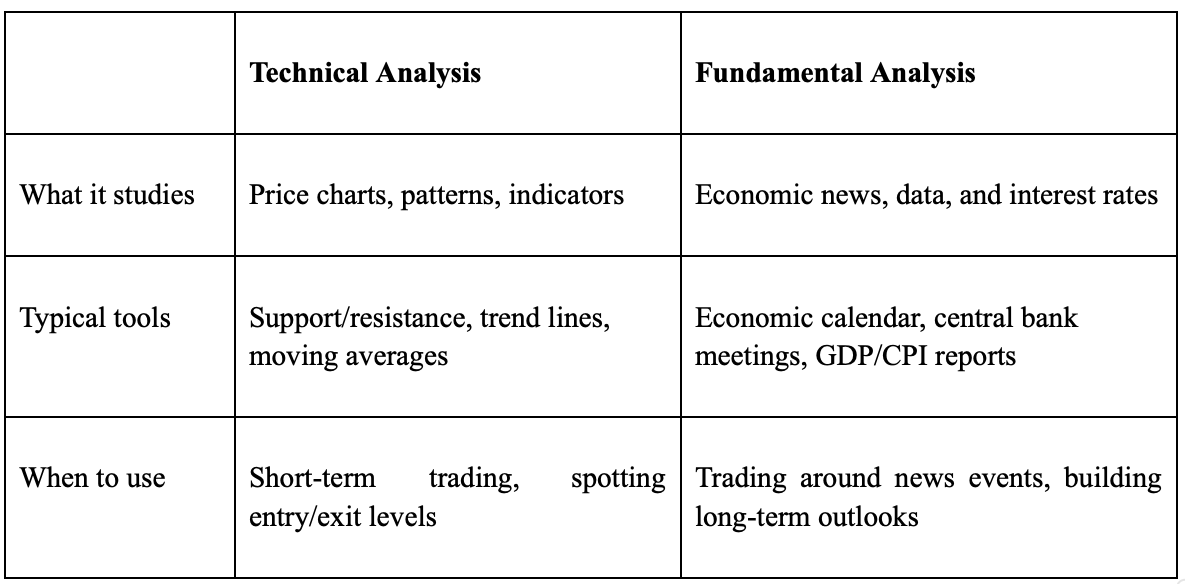
Before making a trade, you should have a clear reason for your decision. Traders typically use two main methods to predict the direction of a currency pair:
Understanding Chart Types
Most traders prefer candlestick charts because they display price movements and patterns more clearly than simple line charts. Begin with candlesticks to identify trends, as well as support and resistance levels.
Your trading platform provides several chart types for visualizing price movements:
- Line Chart: The simplest option, showing only closing prices. It's suitable for beginners but lacks detailed information.
- Bar Chart: Displays open, high, low, and close prices, offering greater insight into price volatility.
- Candlestick Chart (Recommended): Shows the same data as bar charts, but uses color-coded “candles” for easier identification of patterns, trends, and reversals.
Start with candlestick charts they make it easier to identify support, resistance, and market sentiment.
Technical Analysis: Reading the Charts
This is the most common approach for beginners. Technical Analysis focuses on examining charts to spot patterns, trends, and significant price levels. The main principle is that analyzing past price movements can provide insights into future price behavior.
- Key Tool: Support and Resistance
- Support refers to a price level on a chart where a currency pair has consistently stopped declining and rebounded upward, essentially acting as a "floor." You can identify support by finding areas where the price has reversed and moved upward multiple times.
- Resistance is a price level where a currency pair usually stops rising and "reverses" downward. Think of it as a "ceiling." Traders often look to sell near resistance levels.
- Key Tool: Trend Lines
- A trend line is a simple line you draw on your chart by connecting at least two recent swing lows (for an uptrend) or swing highs (for a downtrend). Swing lows are points where the price stopped falling and started rising; swing highs are where the price stopped rising and started falling.
- When the market generally moves upward, it is called an uptrend (bullish). When it moves downward, it is known as a downtrend (bearish). One of the simplest strategies for beginners is to trade in the direction of the trend, a method known as Trend Trading.
Fundamental Analysis: Reading the News
Fundamental analysis involves examining economic events, news, and reports to assess a currency's true value.
- Central Banks: Decisions made by central banks, such as the US Federal Reserve or the European Central Bank, regarding interest rates have the greatest impact on the market. Generally, higher interest rates strengthen a currency.
- Economic Reports: Key reports, such as:
- Employment Data (Non-Farm Payrolls): Shows how many jobs were added or lost in the U.S. (excluding farm work).
- Inflation Figures (CPI): Measures how quickly prices are rising for everyday goods and services.
- GDP (Gross Domestic Product): Measures the total value of everything produced in a country and signals economic growth or decline.
- These reports can cause big moves in currency prices.
- Beginner Tip: Check an Economic Calendar, a tool provided on most broker websites or trading platforms that lists upcoming economic news and reports, along with their expected impact. This helps you avoid trading during highly volatile periods caused by major news events.
Essential Platform Tools
Your trading platform offers all the essential features for effective trading:
- Demo Account: Practice trading in real-time market conditions without risking your own money.
- Order Types:
- Market Orders are executed instantly at the current market price.
- Limit Orders allow you to set your desired entry or exit price.
- Charting Tools: Draw trend lines, identify support and resistance levels, and use indicators such as RSI or moving averages to analyze market trends.
Explore these features on your TradingPRO MT4 or MT5 platform to build confidence before trading live.
2. Risk Management: The Most Important Rule
For beginners, the top priority is not to chase large profits, but to protect your capital from significant losses. Risk management consists of strategies designed to safeguard your funds.
1. Always Use a Stop Loss (SL)
A Stop Loss (SL) is an instruction you add to your trade that will automatically close your position if the market moves against you by a specific amount. It acts as your safety net.
- Rule: Never open a trade without setting a Stop Loss.
- Goal: To cap your potential loss on each trade.
2. The 1% Rule (Position Sizing)
This is the cornerstone of risk management, guiding how much you should put at risk per trade.
- The Rule: Never risk more than 1% (or a maximum of 2%) of your total trading account on a single trade.
- Example: With a $1,000 account, your maximum loss for each trade should be limited to $10 (1% of $1,000).
- To follow the 1% rule, use a position size calculator (available on most broker platforms or online). Enter your account balance, the number of pips to your stop loss, and the percentage you want to risk. The calculator will tell you the correct lot size to use so you never risk more than your chosen amount.
3. Know Your Risk/Reward Ratio
The Risk/Reward Ratio compares how much you are willing to risk against the potential gain.
- Goal: Target setups where your possible profit is greater than your possible loss, such as a ratio of 1:2 or 1:3.
- For example, if you set your stop loss 10 pips away from your entry price, set your take profit at least 20 pips away. This way, if you win, your gain will be twice as much as your potential loss.
Common Beginner Mistakes and How to Avoid Them
Common Mistakes to Avoid:
- Trading without a stop loss
- Risking too much on one trade
- Ignoring the economic calendar
- Chasing losses after a losing trade
Stay disciplined by following your checklist and risk rules every time.
Keep a Trading Journal
Record every trade you make, even in demo mode.
Write down your entry and exit points, reason for the trade, and lessons learned.
Reviewing your journal helps you identify patterns, correct mistakes, and improve faster.
Quick Checklist: Applying Your First Trading Tools
- Before each trade, decide if you’ll use technical or fundamental analysis (or both).
- Mark support and resistance levels and draw trend lines on your chart.
- Check the economic calendar for major news events.
- Always set a stop loss before entering a trade.
- Use a position size calculator to keep your risk to 1% (or 2%) per trade.
- Make sure your potential reward is at least twice your risk.
- Practice these steps in your demo account until you are confident.
A Final Word: Practice and Patience
Remember, every professional trader started as a beginner. Mastery takes time, patience, and consistent practice.
The more you apply these tools and rules, the more confident and skilled you’ll become.
Stay disciplined, keep learning, and don’t rush into live trading until you’re ready.
Start your journey today with a TradingPRO demo account, your first step toward confident, informed, and responsible trading.


