




- Published on: 2022-07-28 10:23:00
Short Selling Explained: How to Profit When Markets Fall
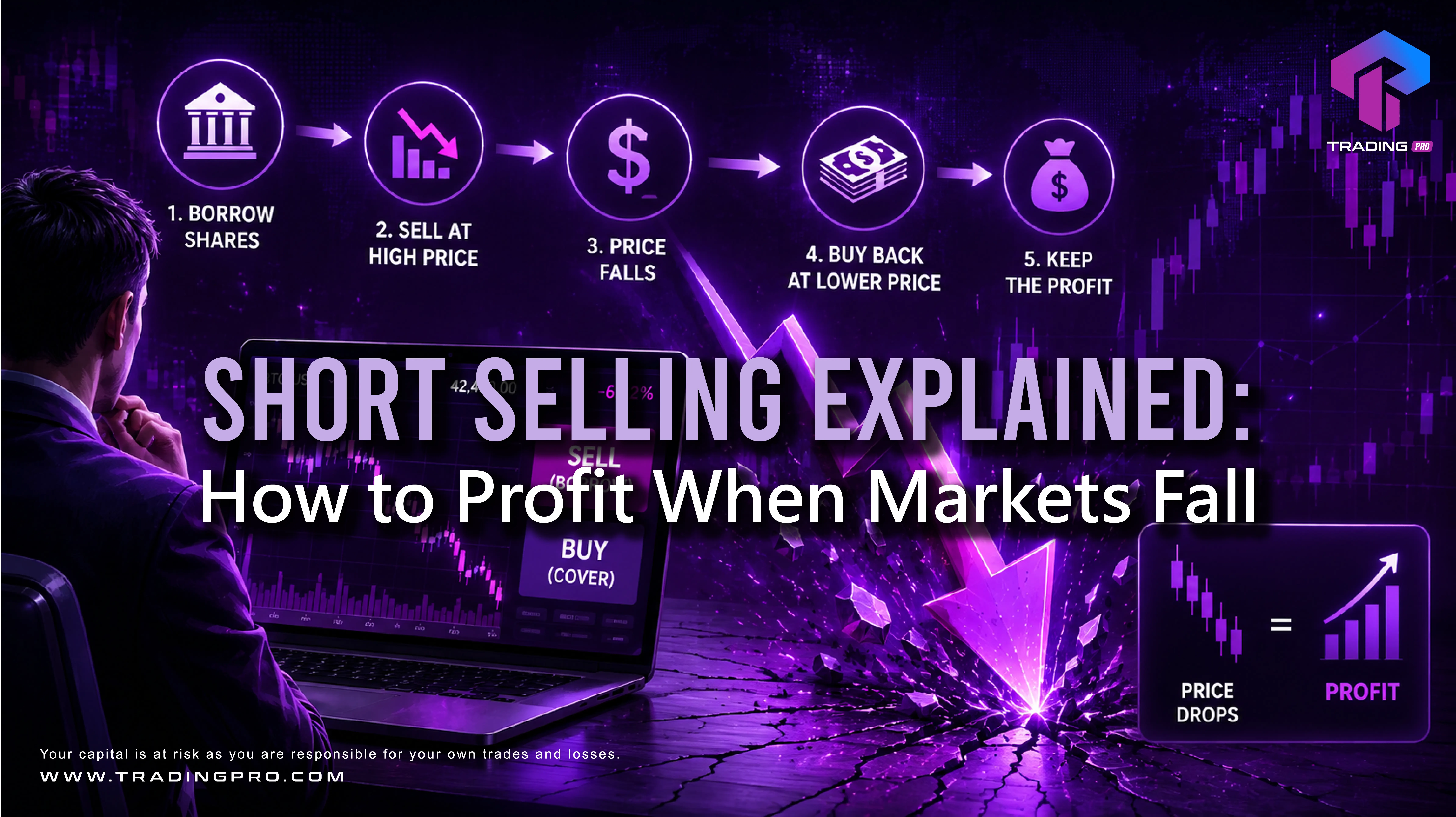
Most people's intuitive understanding of investing involves buying something you believe will increase in value and selling it later at a profit. This buy-low, sell-high framework is straightforward and natural. But what if you believe an asset is going to decrease in value? Are you simply stuck on the sidelines, watching prices fall while your portfolio suffers?
Not at all — and this is where short selling comes in. Short selling is the practice of selling an asset you do not currently own, with the intention of buying it back later at a lower price and pocketing the difference. It is one of the most powerful and most misunderstood tools available to traders, and through the CFD trading that TradingPRO offers, it is far more accessible than most beginning traders realise. This guide gives you a complete, honest breakdown of how short selling works, its legitimate uses, and its risks.
The Basic Mechanics of Short Selling
In traditional short selling of shares, the process involves three steps: borrow the shares from a broker or existing shareholder, sell the borrowed shares at the current market price, then buy them back later (hopefully at a lower price) to return them to the lender. The profit is the difference between the price you sold at and the price you bought back at, minus borrowing costs and commissions.
For example: you borrow 100 shares of a company currently trading at $50 and sell them for $5,000. Two weeks later, the price has fallen to $35. You buy 100 shares for $3,500 and return them to the lender. Your profit is $1,500 minus borrowing costs. If instead the price rose to $65, you would have to buy back at $6,500, realising a $1,500 loss.
In CFD trading through TradingPRO, short selling is dramatically simpler. You do not need to borrow shares, arrange custody, or deal with the complexities of traditional short selling infrastructure. You simply click 'Sell' to open a short CFD position, and the profit or loss is automatically calculated based on the price movement from your entry to your exit.
Why Short Selling Matters
Profiting in Bear Markets
The most obvious application of short selling is the ability to profit from declining asset prices. During bear markets — when indices, sectors, or individual stocks are in sustained downtrends — short sellers can generate positive returns while long-only investors are suffering losses. This is not merely theoretical: some of the most famous trades in financial history have been short positions, from George Soros' short of the British Pound in 1992 to the mortgage-related short positions that generated enormous profits during the 2008 financial crisis.
Hedging Existing Long Positions
Short selling is also widely used as a hedging tool rather than a purely speculative one. If you hold a portfolio of long stock positions and are concerned about a near-term market decline — perhaps ahead of an important economic data release or during a period of elevated geopolitical risk — you can open short positions on a broad market index CFD to offset potential losses on your long portfolio without having to close your long-term holdings.
Market Efficiency and Price Discovery
Short sellers play an important and often underappreciated role in financial market efficiency. By selling overvalued assets and researching companies with problematic financials or business models, short sellers help ensure that prices reflect reality more accurately and can sometimes expose frauds and accounting irregularities before they become more widely known. The market functions better with active short selling than without it.
Short Selling Strategies
Shorting Overvalued Stocks
One of the most classic short selling strategies involves identifying stocks that are trading at valuations that appear disconnected from their underlying fundamentals — high price-to-earnings ratios unsupported by genuine growth, revenue growth that is slowing while the valuation still reflects peak optimism, or business models facing structural competitive challenges that the market has not yet fully priced in. The thesis is that the valuation will eventually compress toward a more reasonable level, generating profit for the short position.
Shorting Technical Breakdowns
Technical traders approach short selling through chart analysis: identifying stocks or indices that are breaking down from key support levels, crossing below major moving averages, forming bearish chart patterns (head and shoulders tops, double tops, descending triangles), or showing signs of trend exhaustion at significant resistance levels. The technical short setup provides a defined entry, stop-loss, and target just as bullish technical setups do.
Short Selling in Sector Downturns
When macroeconomic conditions are unfavourable for a specific sector — rising interest rates for high-growth technology stocks, falling oil prices for energy companies, rising credit defaults for financial stocks — an entire sector can enter a sustained downtrend. Shorting sector ETFs or the weakest individual stocks within an affected sector allows traders to capitalise on these macro-driven sectoral headwinds without needing to identify a single specific stock.
The Risks of Short Selling: Understanding the Asymmetry
Short selling has a fundamentally asymmetric risk profile compared to buying long positions, and understanding this asymmetry is essential before engaging in any short selling strategy.
When you buy a stock long, your maximum possible loss is 100% of the amount you invested — the stock can fall to zero but no further. Your potential gain is theoretically unlimited, as there is no mathematical ceiling on how high a stock can rise.
When you short a stock, this asymmetry reverses. Your maximum possible gain is 100% (the stock falls to zero). Your potential loss is theoretically unlimited — there is no ceiling on how high a stock can rise, and in a short position, every point of upward price movement generates a loss. A stock that rises 500% after you short it generates a 500% loss on your position.
This is not a reason to avoid short selling — it is a reason to use strict stop-losses on short positions, size them conservatively, and never hold a naked short without a defined exit strategy. CFD short selling on TradingPRO with pre-set stop-loss orders eliminates the theoretical unlimited loss risk by ensuring positions are automatically closed at a predetermined level.
Short Squeezes
A short squeeze occurs when a heavily shorted stock rises sharply in price, forcing short sellers to buy back their positions to limit losses. This buying pressure from short covering accelerates the upward price move, triggering further stop-outs and creating a feedback loop that can cause extraordinary rapid price increases in a heavily shorted stock. The GameStop episode of early 2021 is the most famous recent example, where a coordinated retail buying campaign triggered a massive short squeeze against institutional short sellers.
Short squeezes are a real risk for traders holding significant short positions in heavily shorted stocks, particularly smaller companies where the free float is limited. Monitoring short interest data and maintaining disciplined stop-loss placement are the primary defences.
How to Short Sell with TradingPRO CFDs
-
Select your instrument — choose the stock, index, commodity, or crypto you want to short from TradingPRO's full range of markets
-
Click Sell — opening a sell CFD position automatically creates a short exposure. Your profit increases as the price falls; your loss increases as the price rises.
-
Set your stop-loss — always set a stop-loss above your entry price when shorting. This caps your maximum loss and protects against short squeezes and unexpected reversals.
-
Set your take-profit target — identify the technical level where you expect price to find support and set your take-profit there, locking in your anticipated gain automatically
-
Monitor and manage — review open short positions against the evolving fundamental and technical picture, adjusting your trailing stop to lock in profits as the trade moves in your favour
Risk Management Rules Specific to Short Selling
-
Always use stop-losses — non-negotiable for short positions given the theoretically unlimited loss potential. Every short trade must have a clearly defined maximum loss before entry.
-
Size positions conservatively — apply the same 1-2% maximum account risk per trade rule to short positions as to longs. The elevated risk asymmetry of shorting makes conservative sizing even more important.
-
Avoid shorting strong uptrends — one of the most common and expensive mistakes in short selling is trying to short a stock or market that is in a powerful uptrend simply because it 'looks expensive'. Markets can remain overvalued far longer than most traders expect, and fighting a strong trend from the short side is one of the fastest ways to generate losses.
-
Be aware of event risk — earnings announcements, FDA approvals, acquisition news, or other positive catalysts can cause violent short squeezes. Reduce or close short positions ahead of major company-specific events where positive surprises are possible.
Conclusion: A Powerful Tool for Traders Who Understand It
Short selling is not the dangerous, market-destabilising practice it is sometimes portrayed as. Used with discipline and a clear understanding of its risk profile, it is one of the most valuable tools a trader has — the ability to profit from falling prices, hedge long exposure, and generate returns in bear markets that would otherwise see purely long portfolios suffer significant losses.
Through TradingPRO's CFD platform, short selling is simple, efficient, and supported by the risk management tools — particularly guaranteed stop-loss orders — that make it manageable even for traders who are new to the concept. Open your account today and access the full range of market opportunities, regardless of which direction prices are moving.


