




- Published on: 2022-08-09 15:01:00
Sector Rotation Strategy: How to Follow the Money Through Market Cycles
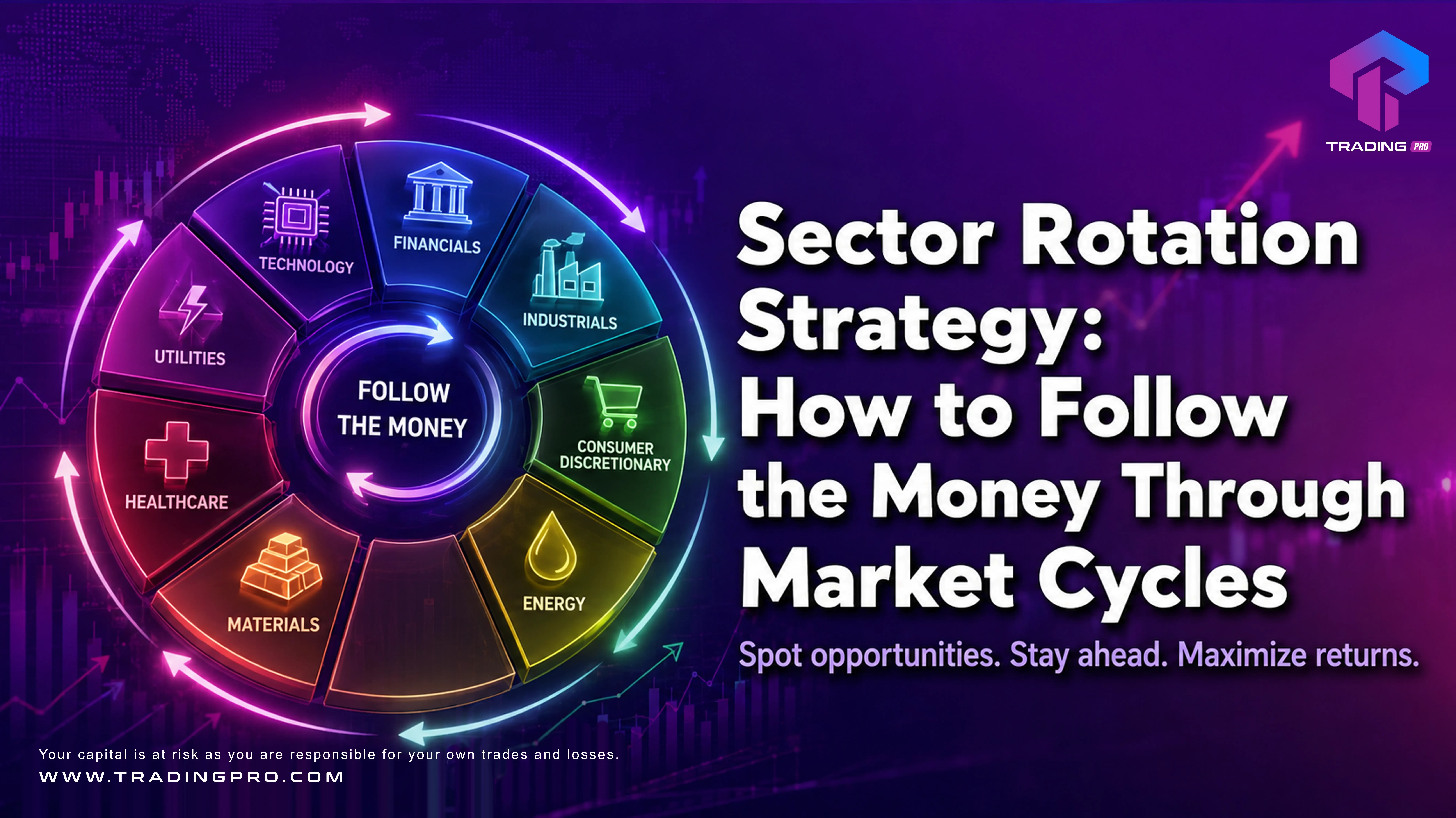
Professional fund managers do not treat all stocks as interchangeable. They understand that different sectors of the economy perform differently depending on where the economy is in its cycle — and they adjust their portfolio exposure accordingly, rotating capital from sectors that are losing their tailwind into sectors that are gaining momentum. This practice, known as sector rotation, is one of the most powerful macro-driven frameworks available to equity traders and investors.
Understanding sector rotation gives you a top-down lens for equity market participation that goes beyond picking individual stocks. It tells you which areas of the market are most likely to attract institutional capital in the current environment — and where that capital is likely to flow next as conditions change. This guide breaks down the sector rotation model in depth, explains the drivers behind each phase, and shows you how to use this framework to position your equity trading more effectively on TradingPRO.
The Economic Cycle and Its Phases
The sector rotation model is built on the observation that the economy moves through a recognisable cycle of expansion, peak, contraction, and recovery — and that different types of businesses thrive and struggle at different stages of this cycle. Understanding which phase the economy is currently in — and which phase is approaching — is the foundation of effective sector rotation.
Early Expansion: Economic growth is accelerating from a low base. Credit conditions are easy, consumer confidence is recovering, and corporate earnings are beginning to improve. Interest rates are typically still low but may be starting to rise. This phase tends to be the most broadly bullish for equities.
Mid-Cycle Expansion: The economy is in full swing. Growth is solid, employment is high, and corporate profitability is strong. Central banks are typically in a tightening cycle. Equity markets continue higher but with more selective leadership.
Late Cycle / Peak: Growth is slowing from its peak pace. Inflation is elevated, interest rates are high, credit is tightening, and corporate margins begin to face pressure. Equity market gains become more narrow and volatile.
Contraction / Recession: Economic output is declining. Unemployment rises, consumer spending falls, and corporate earnings contract. Central banks typically begin cutting rates to stimulate recovery. Equities broadly decline, though defensive sectors hold up relatively better.
Early Recovery: The economy stabilises and begins to recover from the trough. Central bank stimulus is fully deployed. Consumer confidence starts to rebuild. This is the inflection point where the cycle starts again.
Which Sectors Lead Each Phase
Early Expansion: Cyclicals Take the Lead
Coming out of a recession, the sectors that suffered most during the downturn tend to bounce back most aggressively as conditions improve. Consumer Discretionary (retail, autos, leisure) benefits from recovering consumer confidence and pent-up demand. Financials recover as loan books stabilise and credit markets normalise. Industrials benefit from recovering business investment and infrastructure spending.
Technology also tends to perform strongly in early expansion as growth optimism returns and investors are willing to pay premium valuations for high-growth assets. This broad-based recovery phase tends to be the most rewarding for diversified equity exposure, as multiple sectors participate simultaneously.
Mid-Cycle: Technology and Industrials Dominate
In the mid-cycle phase, Technology and Industrial sectors typically show the strongest relative performance. Technology benefits from strong corporate earnings, high business investment in digital infrastructure, and the premium valuations that a healthy growth environment supports. Industrials benefit from strong manufacturing activity, supply chain investment, and capital expenditure cycles.
Energy also frequently performs well in the mid-cycle phase as robust economic activity drives strong commodity demand. The Financial sector continues to benefit from healthy credit conditions, though the steepening yield curve that characterises this phase particularly supports bank profitability through wider net interest margins.
Late Cycle: Energy and Materials Shine
As the economy approaches its peak, inflationary pressures typically build and commodity prices rise, making Energy and Materials the standout performers in the late cycle phase. These sectors benefit directly from rising commodity prices and often show the strongest relative performance precisely when the broader equity market is becoming more volatile and uncertain.
Healthcare also tends to hold up relatively well in the late cycle, as demand for healthcare services is relatively inelastic to economic conditions and the sector is perceived as a defensive haven as economic momentum slows. Consumer Staples (food, beverages, household goods) similarly attracts capital as investors rotate from cyclical to more defensive positioning.
Contraction / Recession: Defensives Are the Shelter
During economic contractions, the sectors that outperform on a relative basis are those whose revenues are least sensitive to economic conditions. Consumer Staples — companies selling everyday necessities — maintain relatively stable demand regardless of economic health. Utilities generate predictable regulated revenues and pay reliable dividends that become more attractive as growth assets face headwinds. Healthcare demand is structurally inelastic.
It is important to note that 'outperformance' in a recession context often means falling less than the broader market rather than generating positive absolute returns. In severe bear markets, all sectors decline — but defensives preserve capital better than cyclicals.
Leading Indicators for Sector Rotation Timing
Identifying which phase of the economic cycle is current (and which is approaching) requires monitoring a range of leading economic indicators:
-
Yield Curve Shape — the spread between short-term and long-term Treasury yields is one of the most reliable economic cycle indicators. A steepening yield curve (long rates rising faster than short rates) typically signals early expansion; an inverted yield curve (short rates above long rates) has historically preceded recessions with remarkable consistency.
-
ISM Manufacturing PMI — a reading above 50 indicates expanding manufacturing activity; below 50 indicates contraction. The direction and rate of change in PMI provides early signals of cycle phase transitions.
-
Credit Spreads — the difference between corporate bond yields and equivalent Treasury yields. Widening credit spreads signal deteriorating credit conditions and rising recession risk; tightening spreads indicate improving financial conditions.
-
Consumer Confidence Surveys — measure household optimism about economic prospects, which directly influences consumer spending behaviour and the outlook for consumer-facing sectors.
-
Fed Policy Trajectory — the Federal Reserve's rate cycle is one of the most reliable cycle phase indicators. Rate cuts signal economic concern and typically align with recession/early recovery phases; aggressive rate hiking cycles align with late-cycle/peak dynamics.
Implementing Sector Rotation Through ETFs
Sector ETFs are the most practical and efficient vehicle for implementing a sector rotation strategy, providing diversified exposure to an entire sector without the single-stock selection risk of picking individual companies. The SPDR Sector ETF series (XLF for Financials, XLE for Energy, XLK for Technology, XLV for Healthcare, XLU for Utilities, XLP for Consumer Staples, XLY for Consumer Discretionary, XLI for Industrials, XLB for Materials) provides clean, liquid exposure to all eleven GICS sectors.
A sector rotation approach does not require dramatic portfolio overhauls. Even modest tilts — overweighting sectors with strong cycle tailwinds by 5-10% relative to market-cap weight, while underweighting those facing headwinds — can significantly improve risk-adjusted returns over time compared to a static market-weight approach.
Sector Rotation in the 2022 Environment
The 2022 market environment has provided a textbook illustration of late-cycle sector rotation dynamics. The combination of elevated inflation, aggressive Fed tightening, and slowing economic growth created exactly the conditions under which Energy and Materials outperform while high-growth Technology faces significant multiple compression. The relative performance of Energy (XLE up significantly year-to-date) versus Technology (QQQ down significantly) has been one of the defining equity market themes of the year, precisely consistent with what the sector rotation model would have predicted.
As the cycle progresses toward potential recession in late 2022 or 2023, the model suggests watching for rotation into defensive sectors — Consumer Staples, Healthcare, and Utilities — as the next logical institutional positioning shift.
Trading Sector Rotation with TradingPRO
-
Global equity and index access — trade sector-specific indices and individual sector leaders across US, European, and Asian markets from a single TradingPRO account
-
Long and short capability — not only rotate into outperforming sectors but also short underperforming sectors to express full relative value rotation trades
-
Macro research and economic calendar — stay ahead of the cycle phase indicators that drive sector rotation with TradingPRO's integrated economic calendar and daily market commentary
-
Risk management tools — use stop-losses and position sizing discipline to manage the macro uncertainty that can sometimes cause sector rotation timing to be off by several months
Conclusion: Think in Themes, Not Just Tickers
Sector rotation is ultimately about thinking in macro themes rather than individual stock picks — asking which parts of the economy are best positioned given current and anticipated conditions, then expressing that view through the most liquid and risk-efficient instruments available. This top-down framework, layered on top of bottom-up stock selection or technical entry timing, is how some of the world's most successful investment managers consistently generate alpha over long periods.
TradingPRO gives you broad market access and analytical tools to implement sector rotation thinking in your own trading and investment approach. Open your account today and start positioning with the cycle rather than against it.
Trade Sectors and Global Equities with TradingPRO


