




- Published on: 2026-08-06 17:13:12
Reviewing My Trading Performance Weekly: The Elite 30-Minute Framework for 2026

90% of retail investors underperform market benchmarks because they treat trading like a hobby rather than an elite operation. You've likely felt the frustration of stagnant account growth despite hours spent staring at charts, or the sinking feeling of being lost when the market opens on Monday morning. It's exhausting to repeat the same emotional errors while your journal gathers digital dust. You know that reviewing my trading performance weekly is the bridge to professional execution, but raw data without a framework is just noise.
You deserve a strategy that respects your time and accelerates your results. This guide delivers the Elite 30-Minute Framework for 2026, a high-impact routine designed to transform your raw trade data into a precise, actionable strategy for the week ahead. We'll strip away the overwhelm to identify your behavioral leaks and provide the data-backed adjustments needed to scale your position sizes with absolute confidence. From optimizing your Scalp Account execution speed to graduating into a Pro Account, you're about to master the ritual that separates the top 1% from the rest of the pack.
Key Takeaways
- Mastering the art of reviewing my trading performance weekly transforms raw data into an elite execution engine for every Monday open.
- Prioritize Profit Factor and Expectancy over simple win rates to identify the true efficiency of your strategy.
- Expose hidden behavioral leaks such as the "Tiredness Trap" and revenge trading patterns that undermine your account growth.
- Audit your Social Trading portfolio by monitoring slippage and ensuring copied strategies still maintain their historical edge.
- Implement the "One Rule" strategy to build a precise Monday morning playbook that focuses on process targets instead of P&L.
The Performance Audit: Why Weekly Reviews Separate Pros from Rookies
Professional trading is not defined by the speed of your execution. It is defined by the depth of your deconstruction. Most traders spend their weekends escaping the charts, but elite performers treat this time as a high-stakes audit. A Weekly Performance Audit is a systematic comparison of your execution against your written plan. It is the only way to determine if your results were the product of skill or merely a temporary gift from the market. Reviewing my trading performance weekly is the single most effective way to compress years of learning into a few high-octane months.
The feedback loop is your greatest competitive advantage. Research indicates that 90% of retail investors underperform market benchmarks because they lack a structured recalibration process. When you commit to a rigorous review, 12 weeks of data-driven analysis provides more growth than a full year of unguided experience. This process builds institutional stability. It allows you to distinguish between "Market Noise," which is random variance you cannot control, and "Systematic Error," which represents a repeatable flaw in your strategy. Precision wins. Guesswork loses.
The 30-Minute High-Impact Framework
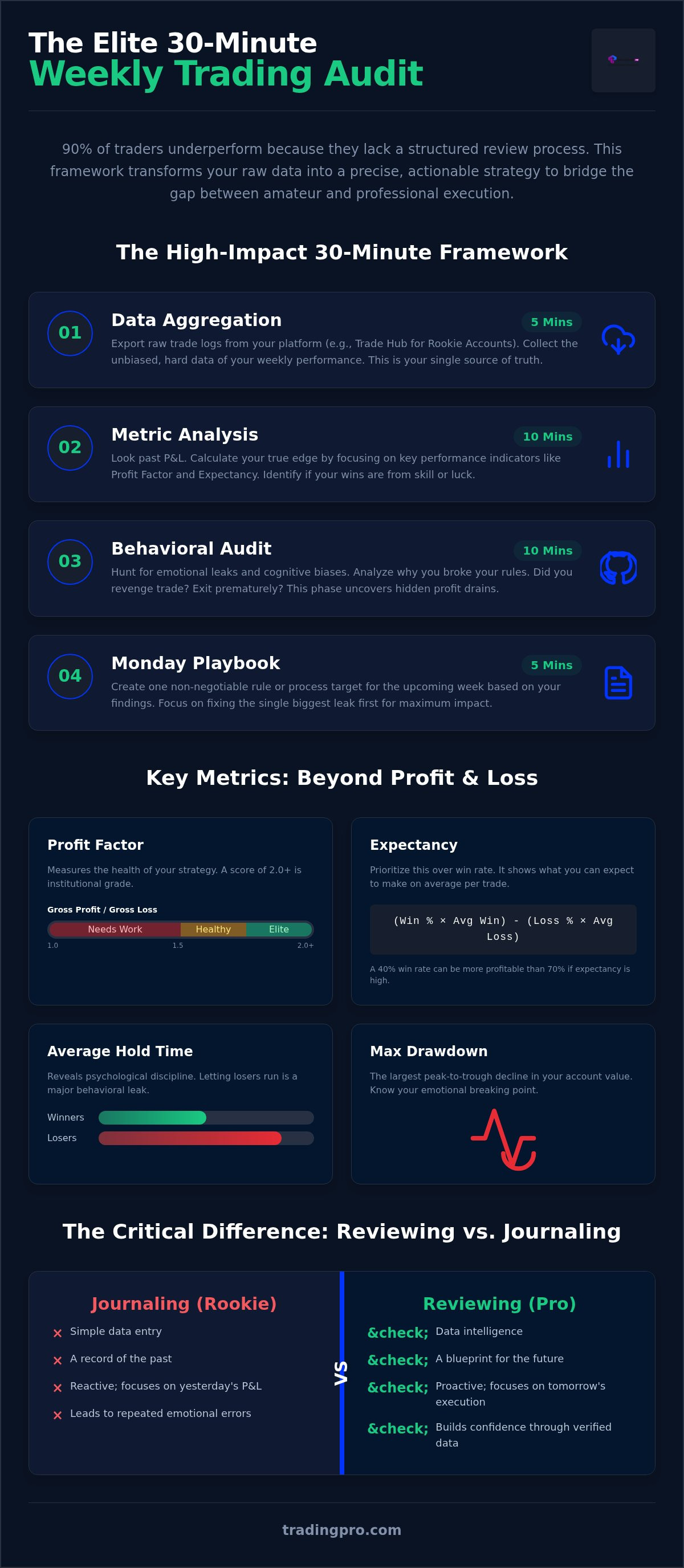
Efficiency is paramount. You don't need hours to find the truth; you need a system. Use this four-phase framework to strip away the noise and focus on what scales.
- Phase 1: Data Aggregation (5 mins). Export your raw trade logs. If you are starting out with a Rookie Account, use the Trade Hub to pull real-time execution data. Raw numbers don't lie.
- Phase 2: Metric Analysis (10 mins). Look past the P&L. Identify your Profit Factor and Expectancy. Are you winning because your edge is working, or did you just get lucky on a single oversized position?
- Phase 3: Behavioral Audit (10 mins). This is where you hunt for emotional leaks. Spend time understanding cognitive biases that may have triggered revenge trades or premature exits. Identify the "Why" behind every broken rule.
- Phase 4: Monday Playbook (5 mins). Set one non-negotiable rule change for the coming week. Do not try to fix everything at once. Fix the biggest leak first.
Reviewing vs. Journaling: The Critical Difference
Journaling is simple data entry. It is a record of the past. Reviewing is data intelligence. It is a blueprint for the future. Most traders fail because they stop at the entry phase. They record the trade, feel the pain of the loss, and then close the laptop. By reviewing my trading performance weekly, I transition from a reactive participant to a proactive market leader. You must move from a "Rookie" mindset that obsesses over yesterday's balance to a "Pro" performance auditor who obsesses over tomorrow's execution. Professional scaling requires the confidence that only comes from verified data.
Decoding the Hard Data: Key Metrics for Weekly Precision
Raw numbers are the pulse of your trading operation. If you aren't measuring, you aren't managing. While most amateurs obsess over their account balance, elite traders focus on the variables that drive that balance. When reviewing my trading performance weekly, I prioritize expectancy over a simple win rate. A 40% win rate can be significantly more profitable than a 70% win rate if your winners are substantially larger than your losers. It's about the math of the edge, not the ego of the win. Evaluating Investment Performance requires looking at the Profit Factor, which is your gross profit divided by your gross loss. Anything above 1.5 is a signal of a healthy strategy; anything above 2.0 is institutional grade.
Average hold time reveals your psychological discipline. If your losers are held twice as long as your winners, you have a behavioral leak, not a strategy problem. You must also identify "Skew" in your results. Did one lucky trade save your week? Strip out your best and worst trades to see the true baseline of your execution. This reveals if you are building a repeatable system or just surviving on variance. Finally, track your Max Drawdown. Knowing your emotional "uncle point" allows you to manage risk before you reach a psychological breaking point.
Beyond the P&L: The Metrics of Consistency
Consistency isn't a feeling; it's a calculation. Use the Sharpe Ratio to measure your risk-adjusted returns. High returns mean nothing if the standard deviation of those returns is erratic. A professional operation thrives on predictability. Your R-Multiple check ensures that you are maintaining a professional reward-to-risk profile on every entry. If your average R-multiple is dropping, your execution is likely degrading. Correct it before Monday morning.
Account Tier Calibration
Your data should dictate your tools. If your review shows high execution frequency and precision but high cost-sensitivity, switching to the Scalp Account is the logical power move. Use the Trade Hub to automate this metric extraction. It saves time and removes human error from the audit. If your data shows you've mastered the Micro level, it's time to scale. You can upgrade your account tier to match your evolving performance profile and unlock higher institutional potential.
The Behavioral Audit: Hunting for Pattern Breaks and Emotional Leaks
Numbers provide the "what," but psychology provides the "why." Reviewing my trading performance weekly means hunting for the internal triggers that sabotage your external strategy. You are the most dangerous variable in your trading plan. Identifying behavioral leaks is not about self-criticism; it is about protecting your capital from your own biology. Elite traders don't just look at what the candles did; they look at what their heart rate did when those candles moved.
The "Tiredness Trap" is a silent account killer. Analyze your performance by the hour and day of the week. You might discover that your win rate plummets after the London and New York overlap ends. Fatigue blurs your edge and slows your reaction time. Similarly, the "Red Day" spiral is a hallmark of revenge trading. If your equity curve shows a sharp vertical drop after a single loss, you aren't trading the market; you're trading your ego. Stop the cycle before it consumes your margin. Conversely, the "Honeymoon Effect" is equally lethal. Overconfidence following a winning streak often leads to reckless position sizing and ignored stop losses. Stay objective. Stay elite.
FOMO analysis is your tool for refining entry precision. Review your "Missed Trades" log to see if your filters are currently too tight or too loose. If you are missing high-quality winners because you are waiting for a perfect signal that never comes, you are leaving money on the table. If you are chasing trades that have already moved, you are absorbing unnecessary risk. Balancing these filters is a weekly requirement for maintaining a professional edge in a fast-moving landscape.
Identifying System Deviations
Precision requires categorization. Label every trade as an "A+ Setup," a "B- Setup," or an "Impulse Trade." Impulse trades represent a "Discipline Tax" on your portfolio. Calculate the exact dollar amount lost on these deviations this week. This number is the literal price of your lack of focus. To finalize this audit, write a single sentence defining your most frequent execution error from the last five days. For example: "I chased momentum entries on Friday afternoon without waiting for a confirmed structural retest."
The Psychology of Risk in Emerging Markets
Market velocity changes your mental chemistry. High-volatility sessions like the London/NY overlap demand faster decision speeds and tighter emotional control. Review your behavior during high-impact news events. Did you maintain your position sizing or did you gamble on the outcome? Mastering these moments is the difference between a retail gambler and a professional operator. For those just starting to build their mental fortress, our guide on Trading Psychology for Beginners provides the foundational tools needed to survive the world's most aggressive environments.
Optimizing the Social Ecosystem: Reviewing Your Copy Trading Portfolio
Copy trading is often marketed as a passive "set and forget" solution. This is a dangerous misconception. To maintain elite status, you must treat your social portfolio with the same institutional rigor as your manual entries. When reviewing my trading performance weekly, I dedicate a specific segment to auditing my social exposure. This ensures that every "Master Trader" in my portfolio is still earning their right to manage my capital. If you aren't auditing your masters, you are essentially running an unmanaged fund. Precision requires constant oversight.
Start with a Slippage Check. Compare your actual entry price to the Master Trader's entry price. In the high-velocity markets of 2026, even a few pips of delay can erode your net profit. If you find consistent slippage, it is time to adjust your copy settings or evaluate if that specific strategy is too crowded for your current account tier. Next, perform a Diversification Review. Ensure your copied traders aren't all correlated to the same currency pair or asset class. If three different masters are all heavy on the GBP/JPY, you aren't diversified; you are tripled-down on a single source of volatility. Use your review to rebalance this exposure.
Effective Drawdown Management is the final pillar of the social audit. Set "Stop-Copy" levels for every trader you follow based on their weekly performance. Don't wait for a total account wipeout to realize a strategy has failed. If a Master Trader hits a pre-defined loss threshold during your weekly review, prune them immediately. Protecting your capital is your primary objective.
Master Trader Drift
Identify when a professional trader changes their risk profile. This is known as "Style Drift." Watch for warning signs like a sudden increase in trade frequency or the use of significantly wider stops. These shifts usually signal that a trader is chasing losses or losing their edge. It's vital to understand the structural differences between Social Trading vs Copy Trading to know which platform tools allow you to lock in profits or limit these drifts automatically. If the drift is clear, exit the position before the market forces you to.
Rebalancing Your Social Exposure
Allocation is a dynamic weapon. Use your weekly review to shift capital away from traders in "Cool Downs" and toward those entering "Hot Streaks." This isn't about chasing past performance; it's about identifying consistent alpha. Cross-reference your data with the Social Feed to gauge community sentiment. If the community is flagging execution errors or erratic behavior from a Master, take it as a leading indicator. Success in the social ecosystem belongs to those who actively manage their followers. You can start building your high-performance social portfolio today and take control of your diversified growth.
From Review to Revenue: Building Your Monday Morning Playbook
Analysis is a precursor to action. If your review ends with a spreadsheet and no changes, you've wasted 30 minutes. The final stage of reviewing my trading performance weekly is the construction of a lethal Monday Morning Playbook. This document converts your behavioral and data audits into a tactical guide for the week ahead. It ensures that when the market opens, you aren't guessing; you're executing. By reviewing my trading performance weekly, I ensure that my strategy remains a living, breathing engine of growth rather than a static document.
The "One Rule" Strategy is your primary weapon for improvement. Most traders fail because they try to overhaul their entire system over a single weekend. This leads to confusion and inconsistent data. Instead, select the single most significant leak identified in your behavioral audit and create one non-negotiable rule to counter it. If you struggled with chasing entries, your rule is: "No entry without a 15-minute candle close." Mastery is built one variable at a time. It's about cumulative gains in discipline.
Shift your focus from P&L targets to "Process Targets." Aiming for a specific dollar amount creates pressure that leads to emotional errors. Aiming for 100% plan compliance creates the discipline that leads to profit. Visualization is the final mental prep. Mentally re-trade your worst losers from last week, but this time, execute the correct exit or skip the trade entirely. This rewires your brain to favor discipline over impulse. Finally, write a "Monday Memo" to your future self. Keep it short. Keep it sharp. List your "One Rule" and your primary focus for the first session.
Preparing for Market Volatility
Sync your review findings with the upcoming economic calendar. Identify high-impact news events that could shift the market regime from trending to ranging. Adjust your risk-per-trade accordingly. During high-volatility weeks, leverage your Deposit Bonus to provide a maximum equity buffer. This institutional-grade security allows you to navigate sharp rotations without compromising your long-term strategy. Stability is the foundation of scale.
The Elite Performance Checklist
Run through this 5-point checklist every Sunday night to ensure total readiness:
- Confirm your "One Rule" for the week.
- Review the high-impact news schedule for the next 48 hours.
- Verify your execution tech stack and platform stability.
- Check that your stop-copy levels are active for social portfolios.
- Read your "Monday Memo" to lock in your mental state.
Professional results require professional tools. You must register your Pro Account now to access the institutional-grade execution speeds and stability that your elite framework demands. Don't let sub-par tech undermine a superior strategy.
Secure Your Competitive Advantage
Success in the 2026 markets is reserved for those who prioritize precision over emotion. You now possess the 30-minute framework required to transform raw logs into a professional execution strategy. By reviewing my trading performance weekly, you strip away the market noise and expose the behavioral leaks that stall account growth. You've moved beyond simple journaling into the realm of data intelligence. Your Monday Playbook is ready. Your "One Rule" is set. It's time to execute with the confidence of a market leader.
Elite analysis demands elite infrastructure. TradingPRO supports your growth with institutional-grade execution speeds and advanced Trade Hub analytics to streamline your weekly audits. You trade with the security of Negative Balance Protection; this ensures your capital remains protected while you scale. Don't settle for stagnant results when professional tools are within reach.
Audit your performance with a TradingPRO Rookie Account today and take command of your trading future. The market opens soon. Be ready to dominate.
Frequently Asked Questions
How long should a weekly trading review actually take?
A high-impact weekly review should take exactly 30 minutes. This timeframe prevents analysis paralysis while ensuring you capture the vital data needed for Monday's open. By following the Elite Framework, you spend ten minutes on hard metrics, ten on behavioral leaks, and ten on tactical planning. Efficiency is the mark of a professional operator. Don't waste time on ornamentation; focus on the data that drives revenue.
Should I review winning trades as deeply as losing trades?
You must review winning trades with the same institutional rigor as losing trades. Winning because you followed your plan is a success; winning because you got lucky with a "B- Setup" is a systemic risk. Identifying skill-based wins allows you to scale with confidence, while luck-based wins signal a need for tighter discipline. Professionals value repeatable processes over random windfalls.
What is the most important metric to track in a weekly review?
Profit Factor is the most critical metric to track when reviewing my trading performance weekly. This value represents your gross profit divided by your gross loss. A factor above 1.5 indicates a healthy, sustainable edge. Tracking this metric allows you to see the true efficiency of your execution without being distracted by raw P&L fluctuations. It is the ultimate measure of your strategy's efficiency.
Can I automate my weekly performance review?
You can automate the data aggregation phase of your review using the Trade Hub. This tool extracts real-time execution logs and key metrics from your Pro or Scalp Account. Automation removes human error from the reporting process, allowing you to focus your mental energy on behavioral analysis and strategy recalibration. Use technology to reclaim your time and improve your precision.
What should I do if my review shows my strategy is no longer working?
Stop trading immediately if your review confirms your strategy has lost its edge. You must distinguish between a temporary drawdown and a structural failure. Use your data to identify if the market regime has shifted. Recalibrate your filters or move back to a Rookie Account to test adjustments without exposing your primary capital to unnecessary risk. Protect your balance at all costs.
How many weeks of data do I need before a review is statistically significant?
Twelve weeks of consistent data is required for a review to be statistically significant. This duration covers multiple market cycles and provides a clear picture of your performance expectancy. Reviewing my trading performance weekly over this 90-day period creates a powerful feedback loop that compresses years of unguided experience into three months of elite growth. Patience in data collection leads to precision in execution.
Is it better to review trades on Friday night or Sunday morning?
Sunday morning is the superior time for a performance audit. Friday night is often clouded by the emotional residue of the week's final sessions. Waiting until Sunday provides the psychological distance needed for objective analysis. Use this time to clear your head and build a cold, calculated playbook for the Monday morning open. A rested mind produces a more accurate audit.


