




- Published on: 2026-10-08 11:35:34
Range Trading Strategies: A Practical Guide to Trading Sideways Markets
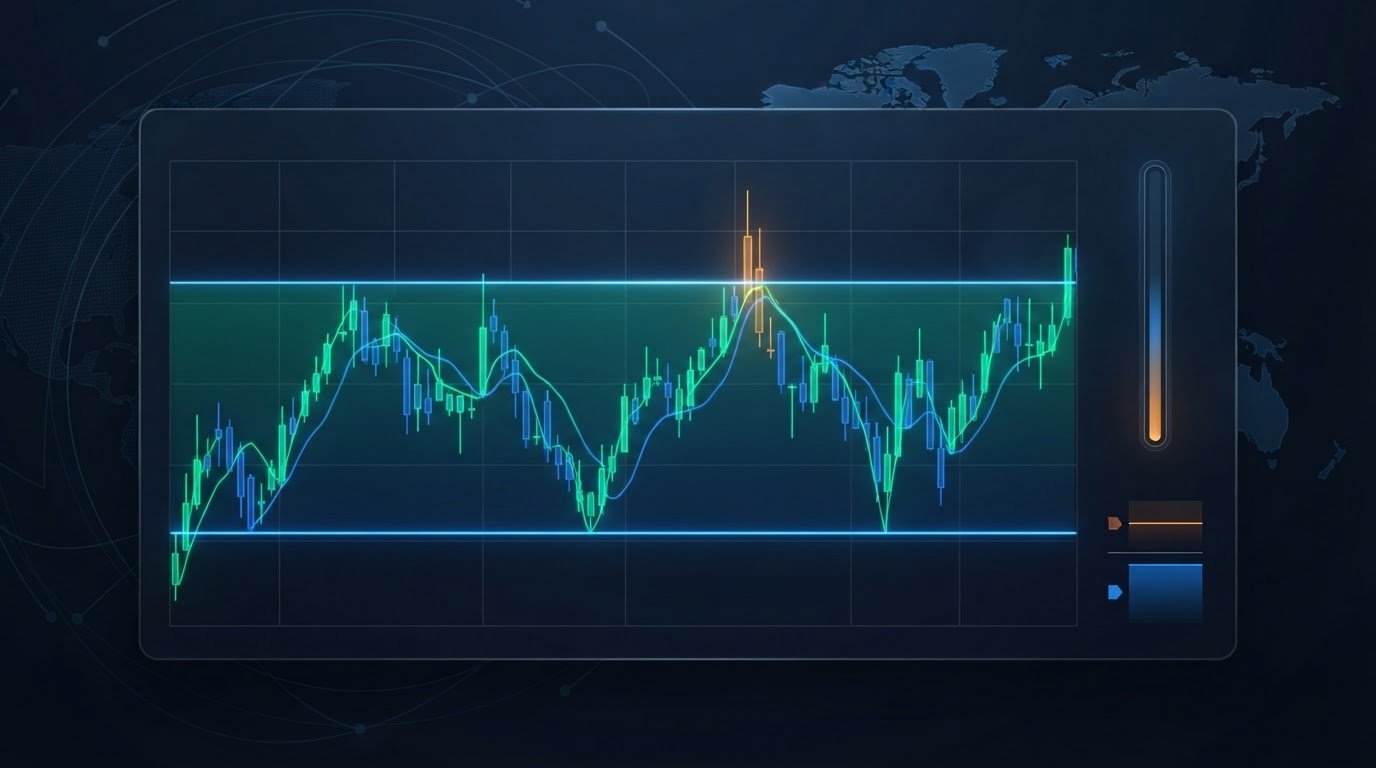
What if the best range trade is the one you skip? Sideways price action can look simple, but a brief move beyond support or resistance can turn a planned entry into a false signal. Effective range trading strategies start with confirming that the market is balanced, not just drawing two lines around recent prices.
It’s easy to spot a possible range and feel pressure to act. The challenge is deciding whether its boundaries are holding, when a breakout changes the picture, and which signals deserve your attention. This guide explains how to assess price structure and market context, compare entry approaches, and set clear rules for exits and risk before placing a trade.
You’ll also learn how indicators such as ADX can add context without replacing price analysis, and how to recognize when a range setup no longer fits. The principle is straightforward: trade the range only while evidence supports balance. When structure breaks or conditions turn strongly directional, stand aside or reassess. If you’re preparing to explore trading, build and test your rules before considering the Rookie Account.
Key Takeaways
- Read price structure and market context to decide whether a market is genuinely ranging before planning a trade.
- Build range trading strategies around observable boundary zones, a predefined entry trigger, and a clear invalidation point.
- Compare range entries with breakout signals, and treat a possible return toward the range as a hypothesis, not a promise.
- Set maximum exposure and calculate position size before entering; place stops where the setup is invalidated, not where a preferred profit begins.
- Test and review your rules before choosing a trading approach or account tier that fits your learning stage.
Range Trading Strategies in Sideways Markets
Range trading is a conditional approach that looks for opportunities as price repeatedly moves between observable upper and lower zones. Trend-following, by contrast, seeks to participate in sustained directional movement. The distinction matters: a chart that looks flat at a glance may still be developing a trend, and a range boundary is never a guaranteed turning point.
Think of the boundaries as zones inferred from past price action, not precise lines that price must respect. A market may briefly cross a zone, reverse, or break away altogether. That uncertainty is why range trading strategies begin with identifying the market state. Only after the evidence suggests balance should you compare entry triggers or consider indicators. An indicator can add context, but it can’t make an unsuitable market range-bound.
How to recognize a potential trading range
Start with one chart timeframe and inspect its visible swing highs and lows. Look for repeated reactions near similar upper and lower price areas. If price approaches the upper zone, retreats, then tests that area again, the repeated response may support a provisional boundary. Apply the same check to lows. Mark zones broad enough to reflect the price action instead of forcing every reaction onto one exact level.
Next, assess whether price is making limited directional progress between those areas. That’s consolidation: movement continues, but neither side is consistently pushing price farther in one direction. It describes the current structure; it doesn’t prove price will remain contained. Treat a potential range as a working hypothesis and reassess it as new candles form.
When range trading may fit, and when it may not
Orderly movement between zones, with repeated reactions and no clear sequence of advancing highs or declining lows, can support a range hypothesis. Look for evidence across your chosen timeframe before treating it as a setup. Ask whether price has responded at both ends and whether its current movement still resembles balance.
Persistent directional movement tells a different story. Successive higher highs and higher lows, or lower highs and lower lows, can signal that one side is gaining control. Expanding volatility can also make established boundaries less useful: price may travel through a zone rather than react to it. In those conditions, fading a boundary simply because it held earlier can put a range-based idea against a developing move. Stand aside or reassess instead of forcing a trade.
Volatility tools can help describe how much price is moving, but they don’t confirm a range on their own. The Average True Range (ATR) in Range Trading explains a measure of price volatility that traders may use as context when evaluating market movement. Treat it as supporting information, not a forecast or entry command.
Strong forex trading foundations start with reading chart context before choosing a method. Keep the sequence clear: identify possible balance first, then decide whether the evidence is strong enough to plan a range trade.
Building a Range Trading Strategy: Boundaries to Exit
Turn a possible range into a repeatable decision process. A chart can show a setup worth watching without offering a valid entry. The difference is whether your preselected conditions have appeared. Write your rules before price reaches a boundary, so you’re not inventing confirmation under pressure.
Mark support and resistance as zones, not exact lines
Use several observable reactions to frame each zone, not one isolated wick. Support and resistance are analytical concepts drawn from past price behavior, not promises about what price will do next. Keep the timeframe in view: a short-term chart may show a narrow range inside a broader, wider structure. Choose the timeframe that fits your plan, and avoid mixing boundaries from different views without a clear reason.
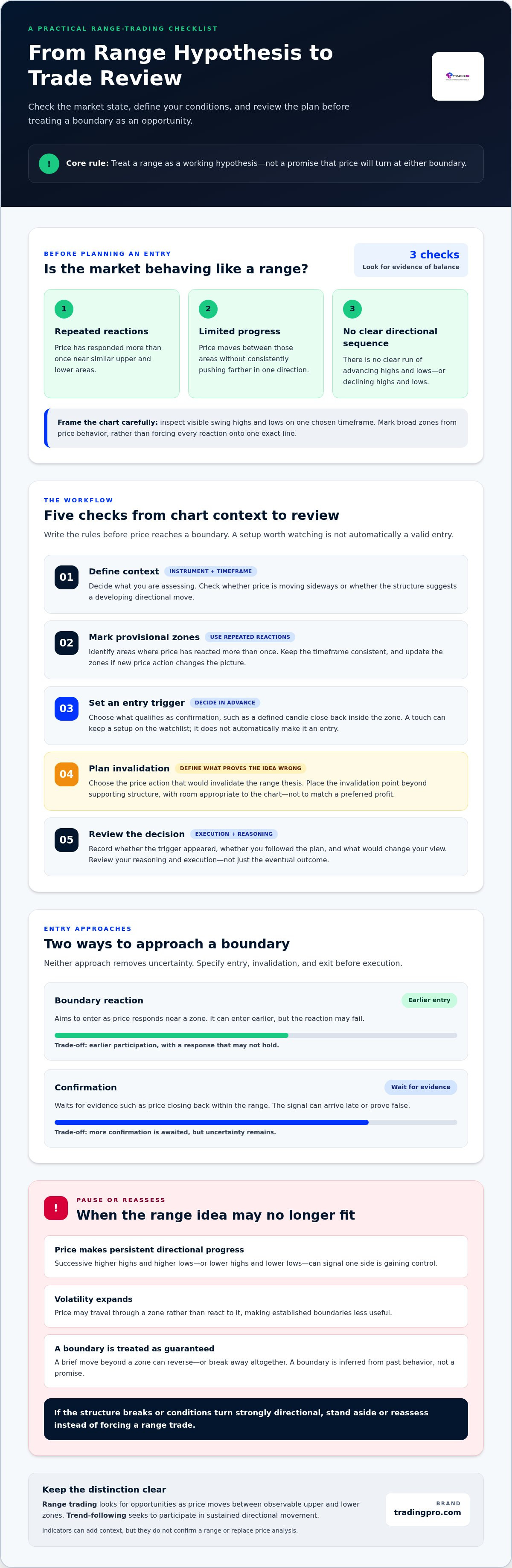
Use this five-step workflow to turn the chart into a trade plan:
- 1. Define context. Decide which instrument and timeframe you’re assessing. Check whether price is moving sideways or whether the structure suggests a developing directional move.
- 2. Mark zones. Identify areas where price has reacted more than once. Treat them as provisional and update them if new price action changes the picture.
- 3. Set a trigger. Choose in advance what would qualify as confirmation, such as a defined candle close back inside the zone. A touch alone can keep the setup on your watchlist; it doesn’t automatically make it an entry.
- 4. Plan invalidation. Decide what price action would show that your range thesis is wrong. Set the invalidation point beyond the supporting structure, with room appropriate to the chart, rather than choosing a stop to match a preferred profit.
- 5. Review. Record whether the trigger appeared, whether you followed the plan, and what would change your view. Review your execution and reasoning, not just the eventual outcome.
Choose an entry trigger and define the trade plan
A boundary-reaction approach aims to enter as price responds near a zone. It can enter earlier, but the reaction may fail. A confirmation approach waits for evidence, such as price closing back within the range, but the signal can arrive late or prove false. Neither approach removes uncertainty. Specify entry, invalidation, and exit in your trade plan before execution.
For a hypothetical example, suppose a chosen chart shows repeated reactions around an upper zone near 1.0840 and a lower zone near 1.0800. A trader watching the lower zone might require a close back inside it before considering an entry. If price instead moves through the zone and holds beyond the structure, the planned thesis may be invalidated. These sample levels illustrate the process, not a live signal.
For chart-based practice, you can visit the TradingPRO Trade Hub. DayTrading.com also discusses range trading indicators and risk management, useful context as you compare triggers. TradingPRO offers Rookie, Micro, Pro, and Scalp accounts for different trading styles and experience levels. You can review TradingPRO account information while keeping in mind that trading involves risk.
Range Trading vs Breakout Trading: Compare the Signals Before Acting
A price move near a range boundary creates a decision, not an automatic signal. A range trader may look for evidence that price is turning back toward the range; a breakout trader waits for evidence that price is moving beyond it. Both approaches can fail, so match your plan to market structure rather than guessing what one candle means.
Mean reversion is the hypothesis that price may move back toward an area it has traded in before. It isn’t a promise. Likewise, a brief boundary breach alone doesn’t establish a sustained breakout. Look for follow-through and a meaningful change in structure before treating the old range as broken.
| Factor | Range approach | Breakout approach |
|---|---|---|
| Market context | Repeated movement within established zones | Price pressing beyond a boundary, with potential follow-through |
| Entry logic | Consider a boundary reaction or return into the range | Wait for evidence of acceptance beyond the zone |
| Invalidation | Price action undermines the expected range response | Price falls back into the range or fails to sustain the move |
| Key failure mode | A developing trend makes fading the boundary costly | A short-lived breach reverses, creating a false breakout |
Use this comparison to decide what evidence your plan requires. Don’t switch from fading a boundary to chasing a breakout simply because price moves quickly. Define the conditions that would change your view before acting.
Range-bound signals and indicator context
Indicators can organize observations, but none can confirm a range alone. RSI gives momentum context; an extreme reading isn’t, by itself, an instruction to buy or sell. Bollinger Bands can help visualize volatility and price’s relative position around a moving average, but a touch of a band doesn’t guarantee a reversal. ADX can help assess trend strength, yet it isn’t a universal range detector. Read each tool alongside price structure and your chosen timeframe.
Signs the range thesis may be failing
Review the thesis when price moves beyond a boundary and continues to hold or build structure outside it. Follow-through matters more than a quick wick through the zone. Watch for a sequence of directional swings that no longer fits the previous back-and-forth behavior.
Volatility expansion can also change the trade’s character. Larger, faster moves may make old boundaries and assumptions less useful, even if they were relevant earlier. Pause and reassess rather than treating every return to a former boundary as a range entry. Short-horizon approaches such as scalping have different decision rhythms and execution demands, so study scalping strategy differences before applying range rules to a faster trading style.
Strong range trading strategies stay conditional: respond to evidence, distinguish a test from a breakout, and update the plan when structure changes.
How to Manage Risk and Test Range Trading Strategies
A clear setup still carries uncertainty. Before entering, define the maximum loss you’re prepared to accept on the trade and across all open positions. Then calculate position size from that limit and the distance between entry and the point where the setup is invalidated. The wider the stop distance, the smaller the position may need to be to stay within the same planned risk. Account for the instrument’s value per price movement when calculating size.
Risk controls can limit planned exposure, but they can’t eliminate trading losses. A stop is a planned exit, not a guarantee that a trade will close at the exact price you specify. Slippage can affect execution, and a gap may carry price past a stop level. False breakouts can also trigger an exit before price moves back into the range. Build these possibilities into your expectations, and don’t increase exposure to recover a previous loss.
Set position size and loss limits before entry
Keep the sequence consistent: identify the setup’s invalidation point, measure the stop distance, then calculate a position size that fits your chosen risk limit. Don’t move the stop closer just to justify a larger position, or farther away after entry because price is approaching it. If the structure changes, reassess the trade rather than expanding risk by default. Set an overall exposure limit too, so several simultaneous positions don’t exceed the risk you intended to take.
Backtest and journal the setup consistently
Test the same written rules across different market conditions, including orderly ranges, directional moves, and periods of changing volatility. A small cluster of examples can create a misleading impression, so don’t draw firm conclusions from a tiny sample. Historical results also can’t guarantee future outcomes, and a backtest may not fully reflect slippage, gaps, or other execution differences.
For each chart example, record the context, how you selected the boundaries, the entry trigger, the planned invalidation, the exit, and whether you followed your rules. Separate a well-executed loss from a rule-breaking decision. This makes review more useful: you can see whether the method needs adjustment or whether execution drifted from the plan.
Use this checklist before treating a strategy as ready:
- Exposure: Have you set a trade-level and overall risk limit?
- Size: Does position size reflect the stop distance and instrument value?
- Execution: Have you considered slippage, gaps, and false breakouts?
- Evidence: Have you tested the same rules across varied market conditions and documented each example?
Once your process is defined, you can review TradingPRO account options as part of your next steps. Trading involves risk, and no account or strategy removes it.
Choose a Trading Setup and Take Your Next Step with TradingPRO
A sound range plan is more than an entry idea. Make it a routine: identify the market conditions, decide whether a range approach fits, define the risk, test the rules, then review what happened. If price no longer supports your range hypothesis, standing aside is a valid decision. Consistency comes from applying the same process, not from forcing a trade every time a chart looks familiar.
Turn the strategy into a repeatable routine
Set regular chart-review times that fit your schedule and use a written checklist before considering any setup. For range trading strategies, the checklist should make three points clear: what supports the range hypothesis, what exact condition would trigger an entry, and what price action would invalidate the idea. If one answer is missing, keep the chart on your watchlist rather than treating it as a valid setup.
Review skipped trades and rule breaks alongside completed trades. A skipped trade may show that your confirmation rule kept you out of an unclear market. A rule break may reveal where pressure, impatience, or changing conditions affected your decisions. Record the reasoning, then use that review to refine your process instead of rewriting rules to justify a single outcome.
Explore account options without skipping preparation
Choose an account with your learning stage and intended trading approach in mind, but don’t treat account selection as a substitute for practice. TradingPRO offers Rookie, Micro, Pro, and Scalp accounts. Compare the options with your preparation and plans, and read the relevant terms before making a decision. The Rookie Account is one of TradingPRO’s account options, but no account guarantees suitability or trading success. You can review the Rookie Account details as part of your comparison.
Before trading, make sure you understand the product you plan to trade, its risks, and the terms that apply. Market conditions can change, and losses are possible. Build familiarity with your rules first; then decide whether taking a next step fits your circumstances.
View TradingPRO account options
Make Your Next Trading Decision Deliberate
The next step isn’t to find a trade at any cost. It’s to turn your rules into a steady decision-making routine, then let price action determine whether a setup deserves your attention. Keep refining your range trading strategies through careful practice and honest review. Over time, that discipline can help you recognize when your conditions are present and when patience is the stronger move.
As you prepare to explore trading, TradingPRO offers Rookie, Micro, Pro, and Scalp account tiers, along with Social Trading and Copy Trading, which lets clients automate trades by copying experienced market participants. Consider how these options fit your learning stage, and take time to understand the product risks and applicable terms before trading. No account or trading approach guarantees a particular outcome.
Ready to take the next step? Create your TradingPRO account and continue building your trading knowledge with care and purpose.
Frequently Asked Questions
Is range trading suitable for beginners?
Yes, beginners can study range trading, but should build chart-reading skills before risking money. Start by reviewing historical charts and marking where price repeatedly changed direction, then note how often those areas failed to contain price. This helps develop judgment without assuming every apparent range is tradable. Practice identifying conditions where you’d stand aside, too. Trading carries risk, so begin only when you understand the product and can follow a plan consistently.
Can range trading work in every market condition?
No. Range methods depend on price behaving differently from a persistent directional market. For example, if successive swings keep moving higher, a short taken near a previous high may be fighting an advancing trend rather than trading a balanced market. News or changing conditions can also shift how price behaves. Treat the strategy as conditional: if the market stops matching your criteria, pause rather than trying to force the same approach onto new conditions.
Which timeframe is best for range trading strategies?
There’s no single best timeframe for range trading strategies. Choose one that suits how long you can monitor a position and how much short-term movement you can tolerate. A practical check is to inspect the chart one timeframe above your planned entry view: a tidy small-chart range may sit inside a strong broader move. Keep your analysis and decision rules tied to consistent timeframes, and test any change before relying on it.
How can I tell a false breakout from a real breakout?
You can’t know with certainty in real time, so look for evidence rather than labeling a breach immediately. A move that quickly returns inside the range may be a failed attempt; a move that holds beyond the boundary and forms new swings outside it offers stronger evidence of a structural change. Some traders wait for a close or retest, but either can fail. Decide in advance what confirmation means in your own plan.
Should I use indicators for range trading?
Indicators can add context, but they shouldn’t replace reading price action or dictate trades automatically. Use a small, purposeful set: for example, one tool to describe momentum and another to track volatility. Check whether their message agrees with the chart, and note when it doesn’t. Indicator readings can lag or conflict, especially as conditions change. Test chosen settings on the instrument and timeframe you plan to trade instead of assuming defaults suit every market.
How do I manage risk when a trading range breaks?
Follow the invalidation and exposure limits you set before entering. If price reaches the point that disproves your setup, exit according to your plan rather than widening the stop or adding to the position. Afterward, wait for fresh evidence before considering another trade; a broken range doesn’t automatically create a reliable breakout entry. If a gap or fast move affects execution, reassess your total exposure and avoid making an impulsive recovery trade.


