




- Published on: 2026-11-18 18:15:55
Psychological Benefits of Risking Pennies on Live Trades

Small stakes can make live trading feel real without turning every decision into a crisis. The psychological benefits of risking pennies on live trades include practicing emotional control, following a plan under pressure, and building patience while keeping potential losses small. A modest stake does not remove risk or guarantee better decisions, but it can provide a more realistic setting than paper trading alone.
It is natural to feel the pull of a live position: a quick price move can spark excitement, fear, or the urge to act before your plan says to. Treat a small trade as practice in process, not as a shortcut to profit. Focus on whether you followed your entry and exit criteria, not just whether the trade won.
This article explores how small live-trade risks can shape emotions, decision-making, patience, and discipline. You will also find practical ways to use a pre-trade checklist, mindfulness, and breaks to interrupt reactive choices and stay focused through both wins and losses.
Key Takeaways
- Use small live positions to practice following a plan while keeping the emotional stakes lower.
- Build a pre-trade checklist around your setup, stop-loss level, and target before entering a position.
- Use mindfulness and timely breaks to create space between a market move and your next decision.
- Track both trade outcomes and your emotional responses to spot patterns that affect patience and discipline.
- Explore TradingPRO’s Rookie, Micro, Pro, and Scalp Accounts when you’re ready to choose an account tier for your trading approach.
1. Emotions when transitioning from simulated to live trading
A simulated trade tests a strategy, but a live position adds emotional pressure. Even a small loss can trigger hesitation, while a quick gain can lead to overconfidence. Start with a position size that keeps your planned exit manageable. The goal is to observe your response while practicing the same decisions you made in simulation.
Paper trading helps you rehearse entries and exits before real money is involved. Keep practicing until your setups feel routine, then consider a tiny live trade. Use the first position to test execution, not to prove your strategy works. A fill, a price move, and the prospect of a loss can feel different when your account is exposed.
Match your approach to the reason for the trade. Momentum trading looks for price movement supported by volume. Value-based trading focuses on what an asset may be worth relative to its current price. Catalyst-driven trading responds to an event that may affect price. For example, a momentum trader might enter after a volume surge, while a catalyst trader waits for a news-driven move.
Watch for psychological self-sabotage during each session. Fear can make you exit before your planned level; excitement can tempt you to add to a position without a fresh setup. Record the trigger and your response. If a fast-moving penny stock makes you abandon your strategy, pause and return to your written entry and exit criteria.
What are the risks of using leverage when trading with small amounts? Leverage magnifies market exposure, so a small deposit can face larger-than-expected losses. Futures and other listed products carry substantial risk, and losses can exceed the initial investment.
What evidence supports small-stakes exposure as a way to manage trading anxiety? Its practical basis is direct experience: a small live position lets you notice real emotional reactions while limiting the amount at stake. Compare each decision with your paper-trading plan to identify where live pressure changes your behavior.
When should a trader increase position size after practicing with tiny live trades? Increase only after you can follow your entry, exit, and risk rules consistently across changing sessions. A winning trade alone is not evidence of readiness; disciplined execution matters more than one outcome.
Broker rules and disclosures also shape the transition. In the United States, SEC Rule 15g-9 requires brokers to provide additional disclosures when recommending penny stock transactions. Read those disclosures before acting, and distinguish the broker’s stated terms from your own trading plan. Small stakes can support practice, but they don’t remove market risk.
2. Checklists, mindfulness, and taking breaks
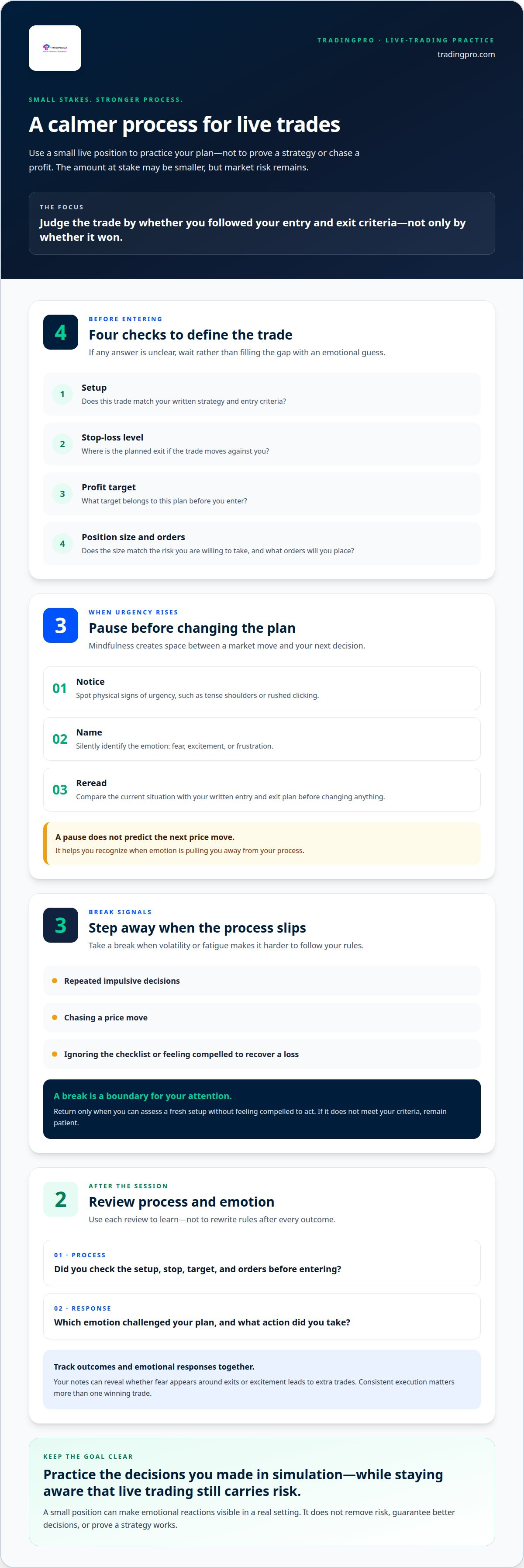
A checklist turns a fast stock decision into a repeatable process. Before entering a position, confirm the setup, planned stop-loss level, and profit target. Then check that the position size matches the risk you are willing to take. These steps connect an idea to a defined amount of capital and reduce the chance of entering simply because the price is moving.
Keep the checklist short enough to use during an active session. For each trade, ask: Does the setup match my strategy? Where is the exit if the trade moves against me? What orders will I place, and what is my target? If an answer is unclear, wait rather than filling the gap with an emotional guess. A setup deserves attention only when it meets your written criteria.
Mindfulness adds a pause between a market move and your response. Notice physical signs of urgency, such as tense shoulders or rushed clicking. Silently name the emotion: fear, excitement, or frustration. Then reread the entry and exit plan before changing anything. This mental reset will not predict a stock’s next move, but it can help you recognize when emotion is pulling you away from your process.
Use mindfulness before entry and after a sudden price change. For example, if a stock dips toward your planned stop, take a breath and compare its current level with the order you set. Do not move an exit just to avoid accepting a loss. If the setup has changed, reassess using the same criteria you applied before entry, not a new rule created under pressure.
Take a break when high volatility makes it difficult to follow your rules. Step away after noticing repeated impulsive decisions, chasing a move, or ignoring your checklist. A break does not predict that prices will settle; it is a boundary that protects your attention. Return only when you can review the next setup without feeling compelled to recover a loss immediately.
Make each review educational. After the session, note whether you checked the setup, stop, target, and orders before entering. Record the emotion that challenged your plan and the action you took. Over time, your notes can reveal whether fear appears around exits or excitement leads to extra trades. Use the pattern to refine your checklist, not to rewrite rules after every outcome.
To put a consistent process into practice, you can start your trading account registration and apply the same checklist to each decision.
During high-volatility periods, take breaks as needed to avoid burnout. Treat breaks as routine maintenance, not something reserved for when you have already lost focus. If the pace of decisions is wearing you down, pause before fatigue influences your choices. Use the time away to let urgency pass, then return with enough attention to assess whether a fresh opportunity still fits your criteria. If it does not, remain patient instead of forcing activity. Breaks support steadiness without implying that market conditions will change.
3. Emotional decision-making during live trades
A live position can turn a sound plan into a rushed decision. One reported trade ended after recovering to $500 shy of the daily goal. In another episode, an emotional choice to keep trading preceded a $5,000 loss within minutes. These examples show why a daily target needs a stopping rule, not just a profit number.
Separate the quality of a decision from its outcome. A successful trade can still result from breaking your strategy, while a loss can follow a well-planned entry. After closing a position, record whether the entry, exit, and position size matched your rules. Review the action first. The result alone does not show whether the decision was sound.
Panic can compress decision time. One example describes a stock falling 50% in 10 minutes, a move that can intensify the urge to sell immediately or average down. Before changing an order, identify what changed: price, the original setup, or your emotional response. If only your feelings changed, return to the exit conditions set before entry.
Use a clear response sequence when a trade moves sharply. First, stop adding shares. Next, compare the current price with your planned exit and the reason for entering. Then decide whether the original setup still holds. This sequence does not predict the next move; it prevents a single fast candle from triggering several unplanned decisions.
Daily goals can also distort judgment. Being $500 below a target may feel like a reason to take another trade, even when no suitable setup exists. Treat the target as a limit, not an obligation to keep trading until you reach it. Define in advance what ends your session, such as reaching your planned stop point or losing focus.
After a win, watch for the opposite trap: overconfidence. A profitable exit can tempt you to increase your next position or ignore technical levels. Tie the next trade’s size and entry criteria to its own setup, not the previous result. A run of successful trades does not make an unrelated entry safer.
Recommendations and market commentary can add pressure during a fast session. Treat them as information to evaluate, not commands to follow. Ask whether the idea matches your strategy, what would invalidate it, and where you would exit. If the answers do not fit your plan, do not let urgency turn someone else’s opinion into your position.
At the end of each session, review one emotional decision and one disciplined decision. Note the trigger, action, and result. For example, compare an exit made at the planned level with one delayed by hope. This record makes emotional patterns visible and gives your next trading session a specific behavior to improve.
4. Emotional management, patience, and discipline
Trading discipline is tested by losing trades, not only profitable ones. The best setups fail 40-50% of the time, so a loss alone doesn’t prove poor judgment. Define success as following your entry, exit, and risk rules, then review the result separately. That distinction stops one red trade from becoming a reason to abandon a sound process.
Losing streaks can span 5-10 trades, even when each decision follows a strategy. If your usual risk is 1% per trade, reduce it to 0.5% during an extended losing streak. This adjustment gives you room to assess execution and emotions without increasing exposure to recover prior losses. Treat the change as risk management, not a prediction that the next trade will win.
Does risking pennies on live trades help traders build confidence and discipline? It can build confidence grounded in repeated rule-following, because small live positions let you practice under real market conditions. Measure progress by consistent decisions, not by a profitable outcome or a larger position size.
How can traders set safe position sizes and loss limits for micro-stakes trades? Set a maximum loss before entry, then calculate position size from that limit and the distance to your planned exit. The 1% rule caps risk at 1% of trading capital on a single trade; during an extended losing streak, the suggested reduction is 0.5% when your usual risk is 1%. A loss limit defines when you stop, not a guarantee against losses.
Patience protects your plan from tempting but weak opportunities. Wait for a pullback instead of chasing a stock that has already risen quickly. Before entering, ask whether the setup still meets your criteria at the current price. If not, letting the trade pass is a disciplined decision, even if the stock continues upward without you.
Stay focused after both wins and losses. After a profitable exit, do not assume the next setup deserves more capital; assess it on its own. After a losing exit, do not take another trade solely to recover profit. Set a clear stopping point for the session, then follow it when your attention or patience starts to slip.
A journal turns those choices into material you can review. Record the setup, position size, result, and feelings before and after each trade. At the end of the session, compare your actions with your written rules. Note one decision you handled well and one behavior to develop, such as chasing a move or moving an exit. This record makes improvement specific and trackable.
5. How can micro-stakes live trading reduce fear and emotional decision-making?
A tiny live position makes the emotional difference between simulation and real execution easier to observe. Your account is exposed, but your planned loss is limited by your position size and exit point. For example, note whether you hesitate at entry, watch every price tick, or close early. Those reactions reveal which part of your process needs practice.
Keep the learning objective specific. Choose one behavior to observe during the next trade, such as following your exit plan after a sudden dip. Before entering, write down the setup, the reason it would no longer be valid, and your response if that happens. After closing, compare your action with the written plan. This turns each small trade into feedback on execution, not a test of personal ability.
Small exposure can also make it easier to distinguish discomfort from a genuine change in the trade. Suppose a stock pulls back and you feel an urge to sell immediately. Check the price against your planned exit and the conditions that would invalidate your setup. If neither has changed, the urge may reflect anxiety rather than new market information. If the setup has changed, follow your exit rules.
Fear often grows when a possible loss feels vague. Set a maximum acceptable loss before entry, then size the position around the distance to your exit. A wider stop generally requires a smaller position to keep the planned loss within the same limit. This connects risk management to a concrete decision instead of relying on confidence alone.
Micro-stakes do not remove uncertainty or prove a strategy is profitable. They let you practice a repeatable sequence: identify a setup, define the exit, place the position, and review your response. Keep the sequence unchanged while observing emotional patterns. If you alter the setup, size, and exit together, you will not know which change affected your decisions.
Build a progression around execution rather than a winning streak. Continue with small positions while fear still causes you to break rules, such as delaying an exit or entering without a valid setup. Consider increasing exposure only after your actions consistently match your written plan across different market conditions. A profitable result alone does not show that your emotional control has improved.
Use account registration to put a structured live-trading routine into practice, keeping your planned risk and decision rules in view.
Mindfulness can help reduce reactive trading behavior. Before acting on an urge, pause and notice whether it follows a change in the setup or simply discomfort with uncertainty. Then compare the trade with your written rules before deciding what to do. This brief check gives you a chance to respond deliberately rather than letting fear make the decision.
The risks of day trading also make it important to judge progress by disciplined execution, not a few favorable outcomes. A study of the complete Taiwan Stock Exchange transaction history from 1992 to 2006 found that 97% of day traders could expect to lose money from trading. More than 90% of day-trading volume in that study was attributed to investors who predictably lose money. These findings do not determine the outcome of any one trade, but they reinforce the value of treating micro-stakes as practice in following rules, not as evidence that a strategy is profitable.
TradingPRO
TradingPRO offers account options for traders putting a disciplined live-trading routine into practice. The Rookie Account, Micro Account, Pro Account, and Scalp Account provide different tiers for varied trading approaches. Choose an account that fits your experience and intended style, then focus on defined position sizes, planned exits, and steady review.
If you’re ready to apply the article’s approach, explore the Rookie Account as one account option. Small live trades can help you observe your decisions, but they don’t remove market risk or guarantee results. Keep your exposure within limits you can manage, and make each decision according to your plan.
To discuss your trading needs, contact TradingPRO.
Make your next trade a deliberate one
The psychological benefits of risking pennies on live trades matter most when they lead to better decisions beyond a single position. Treat each session as a chance to strengthen your process, not as a verdict on your ability. Over time, the aim is to make calm, planned action your default response, even when markets move quickly.
Choose a clear standard for your next step: follow your rules, record what happened, and adjust only after reviewing your decisions. Keep your progress deliberate. Confidence built on disciplined practice is more durable than confidence built on one profitable result.
If you’re ready to take your next step, contact TradingPRO to discuss trading. Keep learning, stay patient, and let consistent decisions guide your progress.
Frequently Asked Questions
What are the psychological benefits of risking very small amounts on live trades?
Very small live stakes can help you notice how real exposure affects your choices. For example, you may feel tempted to cancel an order after placing it, even though the market setup has not changed. That reaction offers useful insight into your habits. The psychological benefits of risking pennies on live trades come from observing those responses and learning to make decisions deliberately, not from any promise of profit.
How does live trading with tiny stakes compare with paper trading for learning?
Paper trading lets you test ideas without risking capital, while tiny live trades add actual order placement and execution to the experience. A simulated order cannot fully recreate the feelings that come with a live position. Use simulation to rehearse unfamiliar setups, then use a small live trade to observe how you respond to real execution. Comparing both experiences can show whether a strategy is clear in theory and manageable in practice.


