




- Published on: 2026-08-18 10:45:27
Mastering New York Session Trading Strategies: The 2026 High-Performance Guide
The New York open isn't a random spike of volatility. It is a pre-engineered liquidity hunt designed to trap retail traders before the real move begins. If you have ever felt the sting of an 8:00 AM EST stop-hunt or watched a massive trend take off while your order sits in slippage, you know that standard retail indicators often fail when the "Big Money" enters the room. You are right to feel frustrated by the noise, but that noise is actually your greatest opportunity if you know how to read the tape.
This guide changes everything. We will unlock the exact institutional setups and New York session trading strategies you need to dominate the world's most liquid window in 2026. You will master a repeatable 4-step checklist for the NY Open, learn how to extract maximum pips from the London-New York overlap, and discover how to select the high-performance account tier that eliminates execution lag. It's time to stop guessing and start trading with the precision of a global leader. Let's dive into the mechanics of peak performance.
Key Takeaways
- Identify the "Golden Hours" of the London-New York overlap to capture peak market volume and the tightest spreads available in 2026.
- Execute high-performance New York session trading strategies, such as the 10:30 AM Reversal, to profit from shifts in institutional order flow.
- Scale your execution speed using Scalp or Pro accounts to eliminate slippage and dominate high-volatility price action during major news events.
- Utilize Social Trading to automate your participation in the New York window and mirror the precision of seasoned session specialists.
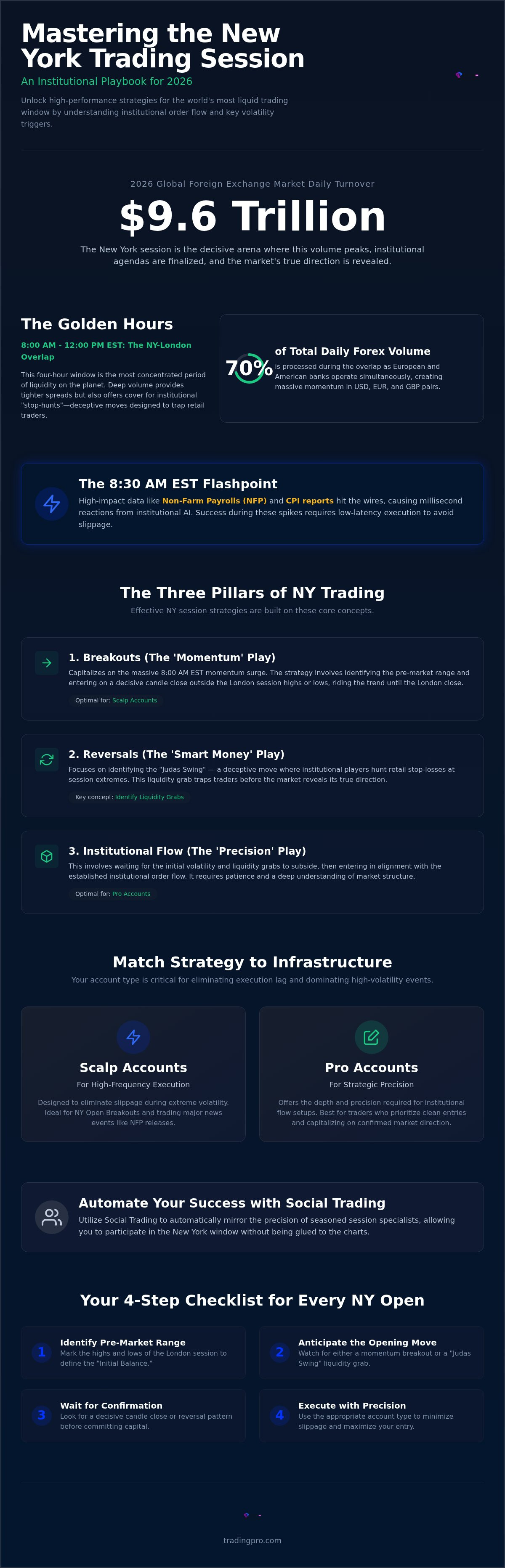
- Master the "Three Pillars" of NY trading—Breakouts, Reversals, and Institutional Flow—to build a professional, repeatable 4-step checklist for every open.
The New York Session: Why the 'Big Apple' Dominates Global Liquidity
New York isn't just a trading session; it's the ultimate engine of price discovery. As the 2026 global foreign exchange market reaches a staggering $9.6 trillion in daily turnover, the New York window remains the decisive arena where institutional agendas are finalized. It's where the world's most aggressive AI algorithms fight for dominance. These high-frequency systems create a high-stakes environment that rewards precision and punishes hesitation. If you want to succeed, you must understand that the "Big Apple" doesn't just follow the market. It makes the market.
London traders often establish the morning's trend, but New York traders specialize in breaking it. Transitioning into this session requires a sharp mental pivot. You aren't just following momentum anymore. You're hunting for the institutional reversal. Understanding these New York session trading strategies is the difference between getting swept away by a fake-out and riding the real institutional wave. The volatility here is intentional, designed to shake out weak hands before the true daily expansion begins.
The Power of the NY-London Overlap
This four-hour window from 8:00 AM to 12:00 PM EST is the most concentrated period of liquidity on the planet. Roughly 70% of total daily Forex volume is processed during this overlap. The "Big Three" (USD, EUR, and GBP) drive massive momentum as European and American banks operate simultaneously. Deep liquidity typically ensures tighter spreads, but it also provides the perfect cover for institutional "stop-hunts." Large players use this massive volume to hide their entries, often triggering sharp, deceptive moves before the true direction is revealed. You must learn to wait for the trap to spring before committing your capital.
Key Economic Catalysts in 2026
The 8:30 AM EST mark is the most critical flashpoint in your trading day. This is when high-impact data like Non-Farm Payrolls (NFP) and CPI reports hit the wires, sending shockwaves through the charts. In 2026, institutional AI reacts to these numbers in milliseconds, making the NY open both dangerous and highly profitable. Success here depends on your grasp of session liquidity. Session Liquidity is the volume required for institutional orders to fill without slippage. Without this depth, your setups become costly lessons in execution lag. To survive these spikes, traders must align their New York session trading strategies with the raw power of these economic drivers.
Top New York Session Trading Strategies for 2026
Volatility isn't a threat; it's the raw fuel that creates clear directional bias. While retail traders fear the "NY madness," elite performers recognize that price action during this window is highly systematic. In 2026, the most effective New York session trading strategies are built on three pillars: Breakouts, Reversals, and Institutional Flow. Each pillar offers a distinct risk-to-reward profile. Breakouts provide high-frequency opportunities for those using a Scalp Account, while institutional flow setups favor the precision and depth of a Pro Account.
Timing is your ultimate filter. The market doesn't move randomly; it moves on a schedule. If you're trading outside the peak liquidity windows, you're fighting for scraps against low-volume noise. By focusing on specific time-based "kill zones," you align your capital with the world's largest banks. This alignment turns volatility into a predictable advantage. If you're ready to stop guessing and start executing with institutional clarity, it's time to secure your professional trading environment and master these high-performance setups.
The NY Open Breakout (The 'Momentum' Play)
The NY Open Breakout capitalizes on the massive 8:00 AM EST momentum surge. To execute this, you must first identify the pre-market range established by the Asian and London sessions. This range represents the "Initial Balance." When the NY bell rings, the first 30 minutes of price action usually set the bias for the entire morning. Look for a decisive candle close outside the London session highs or lows. This move signals that "Big Money" has chosen a direction, providing a high-probability entry for a trend-following trade that can run until the London close.
Institutional Liquidity Grabs (The 'Smart Money' Play)
Banks don't trade like retail. They need massive liquidity to fill their orders, which means they often hunt retail stop-losses at the extremes of the London session. This phenomenon is known as the "Judas Swing." It's a deceptive move that looks like a breakout but is actually a liquidity grab designed to trap traders on the wrong side of the market. To master this, monitor the 15-minute chart for the following signals:
- Order Blocks: Specific price levels where institutions have previously placed heavy buy or sell orders.
- Fair Value Gaps (FVG): Imbalances in price action that act like magnets, drawing price back to be "filled" before the real trend continues.
- Stop-Run Confirmation: A quick sweep of a previous session high followed by a rapid displacement in the opposite direction.
By identifying these Fair Value Gaps and Order Blocks, you can enter trades exactly where the institutions are positioned. This strategy offers an exceptional risk-to-reward ratio because your stop-loss is placed just outside the institutional footprint, allowing for tight management and explosive targets.
Step-by-Step: Executing the 'NY Reversal' Strategy
The New York reversal is the hallmark of sophisticated market participation. While the opening hour is often defined by raw momentum, the mid-session frequently sees a dramatic shift in direction. This is the "London Lunch" phenomenon. Around 10:30 AM EST, European liquidity begins to fade as London traders step away, leaving a vacuum that New York institutional algorithms exploit to rebalance price action. Mastering this turn is a core component of elite New York session trading strategies.
Success requires more than just spotting a candle wick. You need a disciplined, mechanical approach to filter out the noise and identify the exact moment the tide turns. Before engaging, always consult the TradingPRO Trade Hub to verify real-time sentiment analysis. This ensures your technical setup aligns with broader market positioning, giving you a definitive edge over the retail crowd.
Step 1-3: Setup and Identification
Precision begins with patience. Follow these three steps to identify a high-probability reversal setup:
- Step 1: Wait for the Liquidity Grab. Look for price to sweep above the London Session high or below the low after the 8:30 AM news release. This move is designed to trigger retail stop-losses and generate the liquidity institutions need for the reversal.
- Step 2: Monitor for a Market Structure Shift (MSS). Switch to the 5-minute timeframe. Look for a clean break of the most recent swing low (for a bearish reversal) or swing high (for a bullish reversal). This shift confirms that the momentum has officially rolled over.
- Step 3: Identify the 'Discount' Entry Zone. Apply your Fibonacci Retracement tool from the liquidity grab peak to the MSS low. Your entry trigger sits at the 0.618 level. This "Ote" (Optimal Trade Entry) zone provides the highest risk-to-reward ratio.
Step 4-5: Execution and Management
Once you are in the trade, technical discipline is your only protection against late-session volatility. Execution must be surgical. Don't let emotions override your plan when the candles start moving fast.
- Step 4: Set Strategic Stop Losses. Place your stop loss exactly 5 pips above the swing high established during the liquidity grab. This small buffer protects you from minor price fluctuations while keeping your risk tight.
- Step 5: Target High-Probability Liquidity. Your primary Take Profit target should be the Asian Session midpoint or the London Session low. These levels represent logical magnets for price as the session matures.
Stop-loss placement in NY must account for 2026's higher average true range (ATR). Increased market participation and algorithmic speed mean that wicks are longer and moves are more aggressive than in previous years. Adjust your position sizing accordingly to maintain your risk parameters without getting shaken out by standard session noise. This systematic approach transforms the chaos of the New York session into a repeatable profit engine.
Infrastructure Matters: Matching Strategy to Account Type
Execution speed isn't a luxury. It's the deciding factor between a winning trade and a catastrophic fill. In the high-stakes arena of the New York open, the market moves faster than human reaction time. If your broker's engine lags during the 8:30 AM EST volatility spike, your risk-to-reward ratio is already compromised. You need institutional-grade infrastructure that processes orders in sub-milliseconds to ensure your New York session trading strategies actually work when the "Big Money" starts moving.
Different strategies require different environments. Elite performers distinguish between "Zero Spread" environments, which are critical for high-frequency scalping, and "Bonus-Heavy" environments that provide the margin cushion needed for intraday swing plays. Security is equally vital. Trading high-impact US news like the NFP or CPI in 2026 requires Negative Balance Protection. This safeguard ensures that even during extreme slippage events, your losses never exceed your account balance. It's the "safe-haven" feel you need to trade with absolute confidence. Learn more about selecting the right partner in our guide on the Best Broker for Rookie Traders.
The Scalp Account for High-Frequency NY Moves
Aggressive scalpers need raw, unfiltered speed. When the 8:30 AM news hits, slippage can instantly vaporize your edge if your infrastructure isn't up to the task. The ScalpX Account is pre-engineered for these high-velocity moments. It maintains razor-thin spreads during peak NY liquidity by tapping into deep institutional pools. By choosing a commission-based structure over wide spreads, you gain the transparency needed for high-volume session trading. This allows you to calculate execution costs with 100% precision before you ever click a button.
The Rookie Account: Learning the NY Ropes
Don't jump into the deep end without a tactical advantage. The Rookie Account serves as the ultimate training ground for mastering New York session trading strategies with lower financial stakes. It allows you to test the reversal setups we covered earlier without the pressure of a pro-tier balance. Use the Deposit Bonus to increase your margin, providing a necessary buffer against 2026's higher ATR. This extra breathing room is essential as you transition from demo environments to the live New York window. Success here is about building the psychological resilience to handle institutional fake-outs.
Ready to dominate the most liquid window in the world with a partner that values your success? Open your high-performance account today and trade with the precision of a global leader.
Automating Success: Social Trading in the New York Session
Global liquidity doesn't wait for your sleep schedule. For traders based in Asia or Europe, the 8:00 AM EST open often occurs at the most inconvenient times. You shouldn't have to sacrifice your lifestyle or health to capture the explosive moves of the US market. Social trading bridges this gap by allowing you to deploy high-performance New York session trading strategies through automation. This ensures you never miss a liquidity grab or a mid-session reversal, regardless of your physical location.
The key to success in this space is identifying "Session Specialists." These are master traders who specifically thrive during the high-volatility window of the New York open. By utilizing our Social Trading vs Copy Trading Guide, you can learn how to filter for performers who dominate US market hours. This level of precision allows you to step away from the charts while maintaining an institutional-grade presence in the market.
Replicating Expert NY Strategies
Identify Master Traders who utilize Smart Money Concepts (SMC) or momentum breakouts. These approaches are perfectly engineered for the aggressive price action seen at the NY open. When you follow a specialist, you aren't just copying trades. You're leveraging years of experience in reading institutional order flow and session-specific volume. This passive participation in the 2026 market allows you to scale your results without increasing your screen time.
Protection remains your top priority. Even when automating, you must set strict risk parameters. Adjust your copy ratio to align with your account balance and establish hard stop-loss limits. This ensures that even during unusually volatile sessions, your capital is protected by a professional safety net. Reliable infrastructure is the foundation of this passive approach, allowing you to profit while the world's most active session unfolds.
Building a Multi-Strategy Portfolio
True dominance comes from strategic diversification. Don't rely on a single trader. Combine a London-based trend-follower with a New York reversal specialist to create a balanced equity curve. While the London expert captures early morning momentum, your NY specialist can capitalize on the 10:30 AM reversals we analyzed in previous sections. This combination ensures your portfolio remains active and profitable throughout the entire day's peak liquidity.
Diversify across asset classes to maximize your potential. The New York window is the prime time for Gold (XAU/USD) and US Indices like the NAS100. A multi-strategy portfolio reduces your reliance on a single currency pair and captures pips from various institutional drivers. Success in 2026 is about working smarter and using every tool at your disposal. Register your account today and dominate the New York session with institutional-grade automation.
Dominate the Global Engine of Price Discovery
The New York session is the definitive arena for institutional price discovery. You now possess the tactical blueprints for high-performance New York session trading strategies, from identifying institutional liquidity traps to executing surgical mid-session reversals. Success in this high-octane environment isn't about luck. It's about aligning your capital with "Big Money" flow and utilizing infrastructure that matches your ambition. The window of opportunity is narrow, but the rewards for precision are immense.
Whether you're refining your psychology on a Rookie Account or demanding sub-millisecond fills on a Pro or Scalp tier, your edge is backed by Negative Balance Protection. For those who can't monitor the 8:00 AM EST volatility live, our global social trading network provides direct access to expert NY specialists. The tools for market dominance are at your fingertips. It's time to trade with the confidence of a global leader.
Open a TradingPRO Scalp Account for Institutional Execution and claim your stake in the world's most liquid trading window today.
Frequently Asked Questions
What is the best time to start trading the New York session?
The prime entry window begins at 8:00 AM EST. This marks the start of the London-New York overlap, the most liquid period in the global market. You should focus your energy on the first three hours of the session. The 8:30 AM EST news releases often act as the primary catalyst for the day's trend. Aligning your New York session trading strategies with this specific time block ensures you're trading when institutional volume is at its peak.
Which currency pairs are best for New York session strategies?
Major USD pairs offer the best performance due to their massive liquidity depth. EUR/USD remains the dominant choice, accounting for approximately 25% of global daily volume in 2026. GBP/USD and USD/JPY also provide excellent volatility during the US morning. If you're looking for emerging trends, USD/CNY has surged to become the third most traded pair globally, with daily averages reaching nearly $500 billion. Stick to these high-volume instruments to minimize slippage during peak hours.
Can I trade the New York session with a small account?
You can absolutely dominate this window with a small account by using a Rookie or Micro Account. These tiers allow you to navigate the session's intense volatility with controlled risk parameters. High liquidity during the NY open ensures that even smaller positions benefit from tight spreads. Success isn't about the size of your balance; it's about the precision of your execution and your ability to follow institutional order flow without over-leveraging your capital during the initial spike.
How does the London-New York overlap affect trading volatility?
The overlap creates a massive concentration of liquidity that drives global price discovery. With the global forex turnover reaching $9.6 trillion daily in 2026, this four-hour window represents the "Golden Hours" of trading. While the depth of the market leads to the tightest spreads of the day, the sheer volume also fuels aggressive institutional stop-hunts. You must be prepared for rapid price shifts as European and American banks battle for dominance in the order books simultaneously.
What are the most common mistakes traders make during the NY Open?
Most traders fail because they chase the 8:00 AM EST volatility spike without a confirmed setup. They often get trapped by the "Judas Swing," a deceptive move designed to hunt retail stops before the real trend begins. Another fatal error is over-trading during high-impact news releases like the NFP. Instead of guessing the direction, wait for the market to stabilize and look for a clear institutional footprint before committing your capital to a high-stakes position.
Is the New York session better for scalping or swing trading?
This session is a powerhouse for both styles, though it favors different account types. Scalpers thrive in the 8:00 AM to 11:00 AM EST window, utilizing a Scalp Account to capture rapid fluctuations during the overlap. Intraday swing traders often use the New York open to identify the daily bias and hold positions until the London close. The key is matching your strategy to the session's natural rhythm of expansion and its typical mid-session reversal patterns.
Do I need special software to trade institutional order blocks in NY?
You don't need specialized software, but you do need institutional-grade infrastructure. Identifying order blocks and fair value gaps is a skill based on technical analysis, but executing those trades requires the sub-millisecond speed of a Pro Account. Standard charting platforms are sufficient for mapping institutional levels. However, if your brokerage execution lags during peak hours, even the best technical setup will result in inferior fills and reduced profit margins due to slippage.
How do I handle high-impact news like NFP during the New York session?
Patience is your most valuable asset during high-impact releases. Avoid placing orders seconds before the data hits the wires. In 2026, AI algorithms process these numbers in milliseconds, creating extreme "whipsaw" price action. The professional approach is to wait for the initial reaction to exhaust itself. Look for a reversal or a continuation pattern once the spread stabilizes. Mastering these New York session trading strategies allows you to trade the real move rather than the noise.


