




- Published on: 2026-08-17 10:29:54
Master the Move: How to Trade the London Session Opening Range in 2026

The London open isn't just another trading hour. It is a calculated explosion of institutional liquidity that separates the amateurs from the masters. If you've ever felt the sting of a 08:00 GMT fakeout while trading the London session opening range, you know morning volatility is ruthless. Missing the move due to late entries isn't just frustrating. It's a sign that you lack a definitive edge in a high-stakes environment.
You deserve a framework that turns this chaos into a consistent advantage. This guide delivers a high-precision breakout strategy to help you execute with absolute confidence. We've engineered a system to capitalize on massive volume while maintaining institutional-grade security. You'll learn to identify genuine breakouts, dodge the traps, and trade with the speed of a Scalp account professional.
We provide a clear set of rules for the first 60 minutes of the day. You will master risk management during peak volatility and build a repeatable daily routine that positions you as a dominant force in the 2026 markets. It's time to stop reacting and start leading the move.
Key Takeaways
- Leverage the 08:00 GMT liquidity surge to capture moves driven by over 30% of daily global forex volume.
- Define the high and low price boundaries established in the first hour to create a precise framework for daily execution.
- Develop the discipline to distinguish between high-momentum breakouts and deceptive fakeouts when trading the London session opening range.
- Adopt a systematic approach to risk management that pairs higher-timeframe trend analysis with rapid-fire execution on lower timeframes.
- Secure a performance advantage with specialized Scalp accounts that provide the institutional execution speed required for session-specific trading.
The Power of the London Open: Why Volatility is Your Best Friend
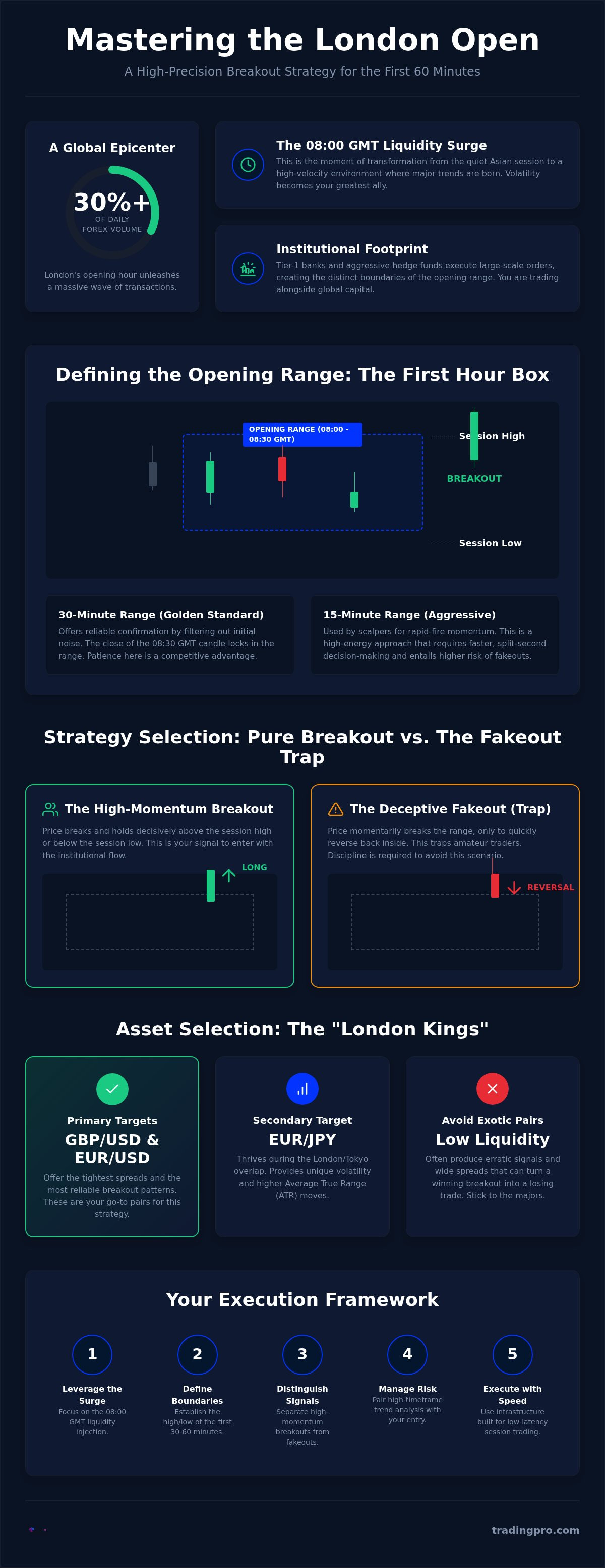
London dominates the financial landscape. It handles over 30% of all daily transactions in the global foreign exchange market. When the clock strikes 08:00 GMT, the market undergoes a massive transformation. This isn't a gradual awakening. It is a sharp, decisive injection of liquidity as institutional desks in the City of London go live. Volatility is your greatest ally here. Without it, price remains stagnant; with it, you have the momentum needed to hit your targets within the first hour of the day.
Successful execution when trading the London session opening range depends on recognizing this institutional footprint immediately. You aren't just looking at candles. You're observing the shift from the relatively quiet Asian session to a high-velocity environment where major trends are born. Volatility provides the range, and liquidity provides the exit. Mastering this balance is what separates high-performance traders from the crowd.
Market Participants and Institutional Flow
The 08:00 move is driven by the world's most powerful financial entities. Tier-1 banks and aggressive hedge funds wait for this specific moment to execute large-scale orders. These players move the needle. Their entry creates the "Opening Range" boundaries that amateur traders often misinterpret as random noise. Understanding the "London Fix" is also vital. This benchmark rate, set later in the day, often influences the early intraday trends. You're watching the footprints of global capital. If you're building your strategy from the ground up, explore our resources on Mastering the Markets in 2026 to sharpen your foundational edge.
Choosing Your Assets: The 'London Kings'
Precision matters in asset selection. Focus your energy on the "London Kings" to ensure you have the liquidity to enter and exit without slippage. When trading the London session opening range, certain pairs offer much cleaner price action than others.
- GBP/USD and EUR/USD: These are the primary targets. They offer the tightest spreads and the most reliable breakout patterns during the open.
- EUR/JPY: This pair thrives during the London and Tokyo overlap. It provides a unique volatility profile for traders seeking higher Average True Range (ATR) moves.
Avoid low-liquidity "exotic" pairs during this window. They often produce erratic signals and wide spreads that can turn a winning breakout into a losing trade. Stick to the majors where the institutional volume is guaranteed. This ensures that when the breakout happens, the move has the weight of the market behind it.
Defining the Opening Range: The Mechanics of the First Hour
The opening range isn't a vague concept. It's a specific price window that defines the day's potential. During the London trading session, the market establishes its initial boundaries with surgical precision. This range represents the absolute high and low price points reached during the first 30 or 60 minutes of trading. By marking these "Session High" and "Session Low" levels on your chart, you create a visual "box" that contains the morning's initial volatility. It's your map for the hours ahead. Mastering the art of trading the London session opening range requires a deep understanding of these mechanics.
While some traders look at the full hour, the 30-minute range is the golden standard. It provides a perfect balance. It's long enough to let institutional flow settle but short enough to ensure you don't miss the primary trend. These levels carry immense psychological weight. Institutional algorithms and retail traders alike watch these boundaries. When you are trading the London session opening range, you aren't just looking at lines; you're identifying the levels where the market's "big money" has decided to take a stand. If price breaks and holds above the range, the sentiment is clear. If it stays trapped, you wait.
The 15-Minute vs. 30-Minute Range
Speed defines your choice here. Aggressive scalpers often utilize the 15-minute range to capture rapid-fire momentum. It's a high-energy approach that requires split-second decision-making. However, the 30-minute range offers significantly more reliable confirmation. It filters out the "noise" of the first few minutes. Ensure your charts are perfectly aligned to 08:00 GMT. The close of that 30-minute candle is your definitive signal that the range is locked. Don't front-run the close. Patience is a competitive advantage.
Key Technical Indicators for Range Identification
You don't need a cluttered screen to find success. Focus on these three pillars to define your trade zone:
- Horizontal Lines: Mark the absolute wick high and wick low. This box is your field of play.
- ATR (Average True Range): Check the ATR to see if the range is overextended. If the first 30 minutes already cover 90% of the pair's daily move, the breakout might lack follow-through.
- Volume Bars: Look for a surge in volume as price approaches the boundaries. High volume suggests institutional commitment to the move.
Precision starts with the right platform and execution speed. Start your trading journey now to access the high-performance tools needed for professional range identification.
Strategy Selection: Pure Breakouts vs. The 'London Fakeout'
Choosing your execution style is the difference between a high-performance career and a blown account. When trading the London session opening range, you generally face two paths: the aggressive pure breakout or the conservative retest. The pure breakout requires lightning-fast reflexes. You enter the moment price violates the range high or low with massive momentum. This works best when institutional volume is undeniable. However, the market often performs a 'Judas Swing' first. This is a deceptive move in the opposite direction designed to trigger stop losses before the true trend of the day begins. Understanding this trap allows you to position yourself for the primary move rather than getting shaken out in the first fifteen minutes.
Patience often pays more than speed. The retest entry involves waiting for price to break the range and then return to the boundary to test it as new support or resistance. This provides a safer entry with a tighter stop loss. Whether you're hunting for a quick morning scalp or positioning for the full trend of the day, your strategy must be fixed before the 08:00 GMT candle closes. Indecision during peak volatility is a recipe for disaster. You must act with the confidence of a seasoned authority.
Identifying the High-Probability Breakout
Confirmation is your shield. Use the 'Three-Bar Rule' to validate a move: wait for a candle to close decisively outside the range, followed by two more candles that hold that direction. This signals sustained commitment from the big banks. You can also utilize the TradingPRO Trade Hub to monitor real-time sentiment and ensure your bias aligns with global flow. Always check correlations. If GBP/USD is breaking higher while EUR/USD is stalling, the move lacks the broad institutional support needed for trading the London session opening range successfully.
Avoiding the Fakeout Trap
Fakeouts are expensive lessons for the unprepared. A classic sign of a false break is a long wick extending past the range boundary while the candle body closes back inside the box. This suggests a lack of follow-through and a potential reversal. The session midpoint often acts as a magnetic pivot. If price can't distance itself from this center line after a break, the momentum is likely fading. Use the RSI to spot divergence. If price hits a new high outside the range but the RSI is making lower highs, the move is a mirage. Stay disciplined and wait for the candle body to confirm the move.
Step-by-Step: Executing the London Opening Range Strategy
Precision execution begins before the first candle of the session even forms. You must align your intraday bias with the higher timeframe narrative. Analyze the Daily and H4 charts to identify the dominant trend. If the higher timeframes show a clear bullish structure, your priority when trading the London session opening range is to look for long breakouts. This top-down approach ensures you aren't fighting the institutional current. It provides the confidence to hold your position as the move develops.
Step 1: Mark the Range (08:00 - 08:30 GMT)
Wait for the 08:30 GMT candle to close decisively. This establishes your field of play for the morning. Draw your horizontal lines at the absolute high and low of this 30-minute window. Do not use pending orders inside this box. Wait for the market to declare its intention through a confirmed close. Check for a "Clear Path" ahead. If a major H4 resistance level sits just a few pips above your range high, the risk-to-reward ratio for a breakout is likely poor. You want room for the price to run.
Step 2: The Entry and Stop Loss Placement
Your entry style should match your risk profile. An aggressive entry involves a market order the moment a 5-minute or 15-minute candle closes outside the range boundaries. This ensures you're in the move, but it carries a higher risk of a fakeout. A conservative entry utilizes a limit order on a retest of the range boundary. This offers a superior entry price but risks missing the move if price rockets away. Place your stop loss at the range midpoint or just below the most recent swing low. This provides enough room for the trade to breathe without exposing you to excessive drawdown while trading the London session opening range.
Step 3: Managing the Trade to Maturity
Active management is the hallmark of a professional. Once price reaches a 1:1 risk-to-reward ratio, trail your stop loss to break-even. This secures a risk-free trade and protects your capital. Take partial profits by closing 50% of your position at the first major Fibonacci extension or the previous day's high or low. Most session-specific moves begin to exhaust as the New York Open approaches. Be prepared to close the remainder of your position before the afternoon volatility shift takes hold. Consistency in these steps builds a professional edge.
Register for a Pro Account today to execute these moves with institutional-grade speed and reliability.
Optimizing Your Edge: High-Performance Infrastructure for Session Trading
Execution speed is the ultimate deciding factor. In the high-velocity environment of the London open, a delay of even a few milliseconds can erode your edge. When trading the London session opening range, you're competing against institutional algorithms designed for instantaneous response. To win, your infrastructure must match their pace. Generic platforms often fail during these liquidity spikes, leading to slippage that turns a high-precision entry into a mediocre one. Milliseconds matter.
The Scalp Account is specifically engineered for this intensity. It provides the millisecond execution required to capture breakouts as they hit the tape. For those just beginning their journey, the Rookie Account offers a perfect entry point. It combines institutional-grade stability with an accessible environment, allowing you to refine your strategy without sacrificing performance quality. High-performance trading isn't just about the chart. It's about the engine behind it.
Eliminating Slippage During the Open
Slippage is the enemy of the breakout trader. During the first hour of London trading, price gaps are common. You need ECN-style execution to ensure your orders are filled at the best available price. TradingPRO’s multi-tiered accounts cater to these demanding speed requirements. Setting up a VPS and utilizing low-latency connections further reinforces your technical advantage. It ensures your platform remains responsive even when global volume peaks. Don't let technical lag dictate your PnL.
The Social Advantage: Copying the Pros
Success leaves clues. If you're still mastering the nuances of trading the London session opening range, our Social Trading ecosystem provides a unique window into professional execution. You can filter for "Session Specialists" who focus exclusively on morning breakouts. Analyzing their drawdown and risk profiles helps you understand how veterans navigate the volatility. It's an elite mentorship tool. Explore our Social Trading vs Copy Trading Guide to find the best way to mirror these high-performance strategies. This infrastructure doesn't just support your trades; it elevates your entire approach to the market.
Dominate the Open with Precision Execution
Success in the 2026 markets requires more than just a basic understanding of price action. It demands a systematic approach to volatility. You've learned how to harness the 08:00 GMT liquidity surge and define the boundaries of the first 30 minutes. By distinguishing between high-momentum breakouts and deceptive fakeouts, you position yourself alongside institutional flow rather than against it. Mastery of trading the London session opening range is about combining these rules with absolute discipline and elite infrastructure.
Your edge is only as strong as your execution speed. Whether you're utilizing specialized accounts for rapid moves or leveraging an institutional-grade social trading ecosystem, the right tools transform potential into profit. It's time to take control of your morning routine and trade with the confidence of a global leader. Start your journey with a TradingPRO Rookie Account today and capture the high-speed execution needed for session breakouts. The market is moving. Make sure you're ready to lead.
Frequently Asked Questions
What time does the London session opening range start?
The range begins exactly at 08:00 GMT (or BST) when the London banks go live. This is the precise moment when institutional liquidity hits the tape. The opening range is typically defined by the high and low price points established between 08:00 and 08:30. Aligning your charts to this specific window is critical for accurate identification. It ensures you're capturing the true morning sentiment rather than pre-market noise.
Is the 15-minute or 30-minute range better for beginners?
The 30-minute range is significantly better for beginners. It provides a more stable foundation and filters out the extreme noise of the first few minutes of trading. While the 15-minute range offers faster entries, it also increases the risk of being caught in a deceptive fakeout. Starting with the 30-minute window allows you to build confidence while observing how institutional liquidity settles into a clear trend for the day.
Which currency pairs are best for the London opening range strategy?
Focus your energy on the "London Kings" such as GBP/USD and EUR/USD. These pairs offer the highest liquidity and tightest spreads during the open. EUR/JPY is also an excellent candidate for those seeking higher volatility due to the Tokyo overlap. Avoid exotic pairs with low volume. They often produce erratic price action and wide spreads that can compromise your risk management when trading the London session opening range.
How do I avoid fakeouts during the London open?
Avoid fakeouts by waiting for a full candle body to close outside the range boundaries. Long wicks that pierce the high or low before retreating are classic signs of a "stop run" or Judas Swing. You should also look for volume confirmation. A breakout with low volume is likely a trap. Patience remains your best defense. Wait for the market to prove its commitment before you decide to pull the trigger.
Can I use this strategy on a Rookie account with small capital?
Yes, you can successfully execute this strategy on a Rookie account. These accounts are specifically designed for those starting their journey with smaller capital while still providing institutional-grade stability. The key is to maintain strict risk management. Use the high-performance execution speed to capture breakouts precisely. It's an ideal environment to practice the discipline required for session-based trading without overexposing your initial capital to unnecessary risk.
What happens if the range is too large to trade?
If the opening range is excessively large, it's often best to stay on the sidelines. A range that exceeds 80% of the pair's Average True Range (ATR) suggests that the primary move has already happened. In these scenarios, the risk-to-reward ratio becomes unfavorable. Your stop loss would be too wide, and the potential for further extension is limited. Discipline means knowing when the market doesn't offer a high-probability setup.
Do I need to stay at my screen all day for this strategy?
No, this is a session-specific strategy designed for maximum efficiency. Most opportunities for trading the London session opening range materialize within the first two hours of the open. Once you've entered your position and set your stop loss and take profit levels, the heavy lifting is done. Many professionals close their positions before the New York Open to avoid the afternoon volatility shift. It values your time and efficiency above all else.
How does news (like CPI or GDP) affect the opening range?
High-impact news events like CPI or GDP can significantly distort the opening range. If a major release is scheduled near 08:00 GMT, volatility often spikes well before the range is established. This can lead to massive gaps or erratic price swings. Professional traders often wait for the news reaction to settle before defining their range. Trading during a news release requires extreme caution and a focus on institutional-grade, slippage-free execution.


