




- Published on: 2026-08-11 10:12:31
Margin Call Explained Simply: How to Protect Your Trading Capital in 2026

A margin call isn't a market failure; it's a final safety trigger that you can master through institutional-grade discipline. If you've ever felt that cold spike of adrenaline when a trade turns against you, you're not alone. Most traders view the sudden demand for more capital as a sign of defeat, but high-performance investors see it as a vital data point for correction. This guide provides a margin call explained simply, stripping away the technical jargon to reveal how leverage actually functions in the 2026 market. It's time to stop fearing the liquidation price and start commanding your capital with precision.
You'll master the mechanics of maintenance requirements and learn the professional strategies used to safeguard your portfolio from unexpected liquidations. We'll break down the shift to real-time intraday monitoring under FINRA Rule 4210 and show you how to use tools like the Rookie Account to build elite discipline. This article previews the actionable steps needed to set up an automated safety net and identifies exactly when your account enters the danger zone. You'll exit this guide with the confidence to use leverage as a tool for aggressive growth rather than a source of constant anxiety.
Key Takeaways
- Demystify the trigger: Recognize the margin call as an institutional-grade safety mechanism designed to protect your capital from extreme market volatility.
- Master the math: Access a margin call explained simply, focusing on the maintenance margin thresholds that define your account's danger zone.
- Execute under pressure: Learn the three decisive actions you must take the moment a notification hits to maintain total control over your portfolio.
- Shield your equity: Implement the professional 2% Rule and utilize pre-trade calculations to eliminate the risk of unexpected liquidations.
- Train for excellence: Leverage the Rookie Account infrastructure to build elite margin discipline before scaling into high-stakes trading environments.
What is a Margin Call? The Simple Truth for 2026 Traders
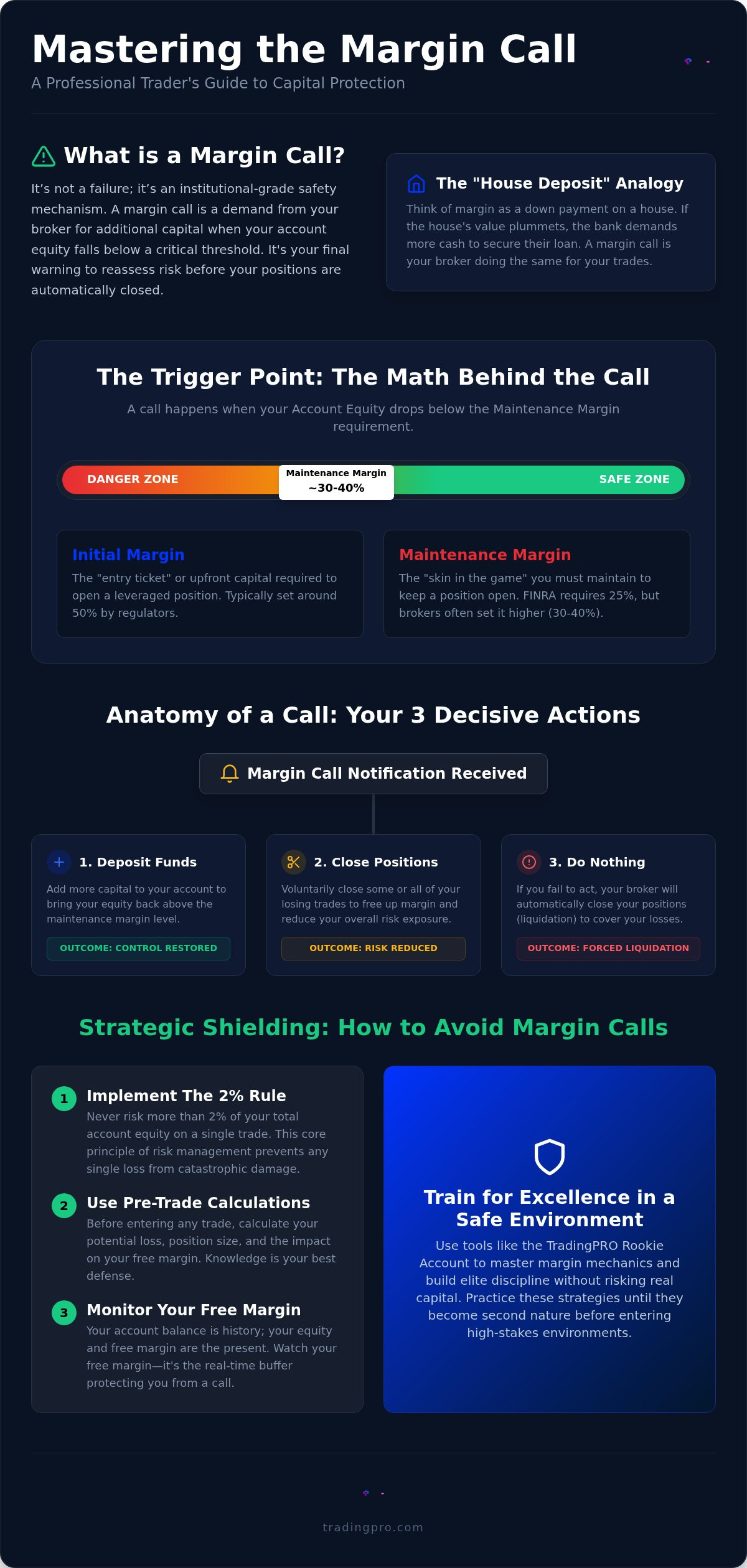
A margin call is the market's way of telling you that your risk has outpaced your resources. It's a demand for additional capital sent by your broker when the value of your account equity drops below a specific maintenance threshold. In the fast-moving 2026 environment, understanding what a margin call is represents the difference between a controlled recovery and a total account wipeout. It exists as a dual-sided safety mechanism. It protects the broker from absorbing your losses and acts as a final warning for you to reassess your exposure before the system intervenes.
Think of it like a "House Deposit" in real estate. If you want to control a property worth $500,000 with only $50,000 down, that deposit is your margin. If the market value of that house starts to plummet, the bank wants to ensure your deposit still covers the potential loss. If it doesn't, they call you for more cash. In trading, a margin call is the alert; liquidation is the actual closing of your positions. They're related, but a margin call is your last chance to act. This margin call explained simply perspective shifts the focus from fear to tactical management.
Margin vs. Leverage: Clearing the Confusion
Leverage is the force that amplifies your buying power; margin is the collateral that secures it. Margin is the good faith deposit required to maintain a leveraged position in the market. When you use 1:100 leverage, your margin requirement drops to just 1% of the total trade value. This gives you massive market reach, but it also means a small price move against you can trigger a call by eroding that 1% deposit almost instantly. Precision is mandatory. You must respect the math behind the power to avoid unnecessary liquidations.
The Role of Equity in Your Trading Account
Equity is the real-time heartbeat of your account. It's calculated as your Balance plus floating profits minus floating losses. While your balance looks stable, your equity fluctuates with every tick of the market. You must prioritize your "Free Margin" over your account balance. Free margin is the capital available to open new trades or absorb losses before the broker intervenes. Learn how to manage your equity in a TradingPRO Rookie Account to master these metrics without the stress of high-stakes institutional pressure. Monitoring this number ensures you stay in the game even when volatility spikes.
Why Margin Calls Happen: The Math Behind the Call
Math is the heartbeat of every trade. It's cold, calculated, and entirely predictable. To survive in high-stakes environments, you must understand the exact line where your broker's tolerance ends and a margin call begins. This line is known as the Maintenance Margin. While regulatory bodies like FINRA set a minimum maintenance requirement of 25%, many brokerage firms set higher internal standards, often between 30% and 40%. When your account equity falls below this percentage of your total position value, the system triggers a demand for more capital.
Over-leveraging is the primary reason traders hit this wall. When you use aggressive leverage, a price move of just 1% or 2% can wipe out a massive portion of your collateral. This isn't always about one catastrophic trade, either. "Death by a thousand cuts" occurs when multiple small losing trades accumulate, slowly draining your free margin until your account can no longer support your open positions. This margin call explained simply perspective reveals that mathematical discipline, not market luck, dictates your longevity.
Initial Margin vs. Maintenance Margin
Your Initial Margin is the "entry ticket" required to open a position. It's the upfront capital you commit to the trade. Maintenance Margin is the "skin in the game" required to keep that position alive as market prices fluctuate. If your equity drops to the maintenance level, the broker will demand an immediate deposit to bring your account back up to the initial margin requirement. Failure to act results in the broker closing your positions to prevent your balance from sliding into the negative. Precision in these calculations is what separates professionals from retail gamblers.
The Volatility Trigger: When Markets Move Too Fast
Markets don't always move in smooth, predictable waves. High-impact news events or "black swan" incidents can cause sudden price gaps that bypass your stop-loss orders entirely. In 24/5 markets, a gap down during the market open can lead to an instant margin deficit. Even a trade that eventually hits your target profit can trigger a call if a temporary dip violates your maintenance requirement. You must maintain a significant capital buffer to absorb these shocks and stay in the game. Success requires a platform that keeps you informed in real-time. Before you place your next trade, secure your access to the professional infrastructure needed to monitor these thresholds with absolute clarity.
The Anatomy of a Margin Call: What Happens Next?
When your margin level hits the warning zone, the market's silence breaks. Your trading platform will launch a series of high-priority emails, push notifications, and in-app alerts designed to grab your attention instantly. These aren't suggestions. They're critical data points requiring immediate intervention. To have a margin call explained simply, you must view these alerts as a tactical crossroads where your next move determines the survival of your portfolio. You have three distinct paths: deposit more capital to bolster your collateral, close positions manually to free up margin, or do nothing and let the system take command.
Choosing to do nothing is the amateur's mistake. It surrenders your decision-making power to an automated algorithm. If the market continues to move against you and you fail to act, the Liquidation Phase begins. The system will systematically close your trades to restore your margin level to an acceptable range. It doesn't care about your long-term price targets or your belief that the market will "turn around." It only cares about protecting the integrity of the trading environment. Professional traders never wait for the broker to close their trades; they execute their own exits with precision.
Automatic Liquidation and Stop-Out Levels
The Stop-Out level is your account's point of no return. This is the specific percentage where the broker's system automatically kills your positions to prevent your balance from falling into a deficit. Usually, the algorithm targets your largest losing positions first, as these are the heaviest drains on your equity. For a rookie trader, this forced exit is psychologically devastating. It feels like a loss of control, yet it is actually the final safety net. Reclaiming that control starts with understanding that the system is doing exactly what it was programmed to do: prevent a total wipeout of your remaining capital.
The Danger of 'Feeding the Loser'
Many traders fall into the trap of "feeding the loser" by depositing more cash just to keep a sinking trade alive. This is rarely a winning strategy. It's often a desperate attempt to avoid admitting a mistake. Instead of throwing good money after a bad entry, the professional alternative is to cut the loss, preserve your remaining capital, and reassess the market with a clear head. If you find yourself constantly battling these levels, check our Forex Trading for Beginners Guide to master better entry strategies and refine your execution before you risk more capital.
Strategic Shielding: How to Avoid a Margin Call Forever
Prevention is the hallmark of an elite trader. You don't manage a margin call; you eliminate the possibility of one through superior preparation. The most effective weapon in your arsenal is the 2% Rule. By never risking more than a small fraction of your account equity on a single setup, you ensure that even a string of losses won't trigger a maintenance alert. This is how you achieve institutional-grade longevity. Diversification acts as your secondary shield. Concentrating your capital in one massive position creates a single point of failure. Spreading that risk across several smaller, uncorrelated trades provides a structural buffer that protects your collateral from isolated market shocks.
This is a margin call explained simply through the lens of proactive defense. You must maintain a constant "Buffer Margin" to handle the natural ebb and flow of market volatility. Professionals never trade at the edge of their capacity. They leave a significant surplus of free margin to absorb temporary price swings, ensuring their positions stay open during the "noise" of the trading day. This surplus isn't wasted capital; it's the insurance policy that keeps you in the game when others are being liquidated.
Position Sizing: The Ultimate Margin Protector
You must calculate lot sizes based on your available margin, not just your account balance. The size of your trade determines your risk, not the size of the market. Over-leveraging a small account is the fastest route to liquidation because it leaves no room for error. Use professional tools to remove the guesswork from your execution. Use the TradingPRO Trade Hub for instant margin calculations before you commit capital to a new position. This ensures every lot you trade is perfectly sized for your specific account equity and risk tolerance.
Stop-Loss Discipline: Your First Line of Defense
Automation is your greatest ally in high-stakes environments. You must set hard stop-losses that trigger long before the market reaches your maintenance margin level. Trailing stops are particularly effective; they lock in profits as a trade moves in your favor while simultaneously keeping your margin free for new opportunities. Mental stops are a myth that leads to ruin. When the pressure of a margin call arrives, emotional hesitation often replaces logical discipline. Hard stops remove the human element, ensuring your exit is executed with clinical precision every single time. Ready to execute with institutional precision? Register your account today and start trading with the elite tools you deserve.
Master the Margin: Why TradingPRO is Your Safe Haven
TradingPRO delivers a high-performance environment where institutional-grade stability meets retail empowerment. In a market that moves at the speed of light, you need infrastructure that respects your capital as much as you do. Our platform is engineered for peak performance, offering the lightning-fast execution speeds required to ensure your stop-losses hit exactly when they should. This precision is your ultimate defense against the slippage that often turns a minor dip into a catastrophic account event. By choosing a partner that prioritizes technical excellence, you're not just trading; you're commanding your financial future with the best tools in the industry.
The Rookie Account provides the ideal training ground for those who want a margin call explained simply through practice rather than painful loss. It allows you to master the mechanics of maintenance requirements and position sizing within a secure, controlled framework. This isn't just about making trades; it's about building the elite discipline necessary to scale into our Pro and Scalp accounts. Every feature of our ecosystem is designed to act as a safe haven, giving you the confidence to pursue aggressive growth while maintaining a rock-solid safety net.
Leveraging the Social Feed for Risk Insights
The TradingPRO Social Trading ecosystem offers a unique advantage that most retail platforms ignore. You can gain direct insights into how professional traders manage their margin levels in real-time. By identifying "Low Drawdown" traders in our feed, you can analyze their defensive strategies and see how they maintain a healthy buffer during periods of high volatility. This is a masterclass in capital preservation. You have the choice to replicate these high-performance strategies or simply use them as a blueprint for your own risk management. Compare Social vs. Copy Trading to find your risk style and start learning from the best in the business.
Register Today and Trade with Confidence
Your journey toward elite market mastery starts with a frictionless signup process. We've eliminated the barriers to entry, allowing you to launch your first high-performance account in minutes. To give your strategy an immediate edge, you can access the TradingPRO deposit bonus to bolster your initial margin from day one. This additional capital provides the extra breathing room needed to navigate the 2026 market with absolute poise. Don't leave your portfolio's safety to chance. Secure your financial future-Register for a TradingPRO account now and experience the difference that institutional-grade support makes.
Command Your Capital with Elite Precision
Mastering the market requires more than just predicting price movements; it demands absolute control over your collateral. You've seen the margin call explained simply as a final line of defense, not a mark of failure. By implementing the 2% Rule and respecting maintenance thresholds, you transform leverage from a threat into a high-performance tool. Success in 2026 belongs to those who prioritize capital preservation through automated stop-losses and strategic diversification.
TradingPRO has provided elite multi-asset infrastructure since 2017, empowering traders to scale with confidence. Whether you're refining your discipline in a Rookie Account or executing high-frequency strategies in a Scalp tier, our ecosystem is built for your success. You can also leverage our global social trading network to mirror the risk-management tactics of seasoned experts. It's time to stop reacting to the market and start dictating your terms.
Empower your strategy. Open your TradingPRO account today and take command of your financial future. The path to market dominance is open; step forward with the tools of a leader.
Frequently Asked Questions
Can I lose more than my initial deposit during a margin call?
Yes, it's possible to lose more than your initial deposit if market volatility causes a price gap that bypasses your stop-loss. While modern safety features aim to prevent this, extreme events can still impact your equity. This is why maintaining a significant capital buffer is mandatory. Never trade with capital you can't afford to lose; always respect the market's power to move unexpectedly.
What is the difference between a margin call and a stop-out?
A margin call is a warning; a stop-out is the execution. The margin call alert notifies you that your equity has dropped below the maintenance requirement. If the market continues to move against you and hits the stop-out level, the system automatically liquidates your positions. This margin call explained simply logic ensures you understand that the call is your final chance to take manual control before automation takes over.
How much money do I need to add to clear a margin call?
You must add enough capital to bring your account equity back up to the initial margin requirement, not just the maintenance level. Simply clearing the maintenance threshold leaves you vulnerable to the next small price tick. Professionals aim for a significant surplus to ensure their positions have breathing room. Calculate your needs precisely using the Trade Hub to avoid repeated calls during the same trading session.
Does TradingPRO offer negative balance protection for rookie accounts?
TradingPRO provides negative balance protection as part of its institutional-grade commitment to retail safety. This feature ensures that your account balance never falls below zero, even during "black swan" events or extreme price gaps. For those using a Rookie Account, this provides an essential layer of security while you master margin discipline. It's a foundational safety net designed to protect you from catastrophic market anomalies.
Is it possible to have a margin call on a winning trade?
Yes, you can face a margin call on a winning trade if a temporary price dip violates your maintenance requirement before the target is reached. Market noise and volatility can erode your free margin even if your long-term thesis is correct. This happens most often when a trader is over-leveraged and lacks a sufficient capital buffer. It's proof that entry timing and position sizing are just as important as the final price direction.
How can I calculate my margin requirement before opening a trade?
You can calculate your requirements instantly using the TradingPRO Trade Hub before you click 'Buy'. This tool factors in your leverage, lot size, and the specific asset's margin requirement to give you an exact figure. Manual calculations involve dividing the total trade value by your leverage ratio. For example, a $100,000 position at 1:100 leverage requires $1,000 in margin. Always do the math before committing capital.
What happens if I don't respond to a margin call notification?
If you ignore a margin call notification, the system will move to automatic liquidation once your equity hits the stop-out level. The broker's algorithm will systematically close your open trades, starting with the largest losing positions. This action restores your account's margin level but locks in your losses. Surrendering control to the system is a high-risk move that often results in a significant reduction of your remaining trading capital.
Can social trading help me avoid margin calls?
Social trading is a powerful tool for avoiding margin calls because it allows you to observe the risk-management habits of elite professionals. By following traders with low drawdown histories, you learn how they size their positions and where they set their safety buffers. Replicating these institutional-grade strategies helps you avoid common retail mistakes. It's a masterclass in capital preservation that builds your confidence and protects your account equity.


