




- Published on: 2026-08-10 10:07:47
Is High Leverage Trading a Bad Idea? The Truth About Scaling Your Potential in 2026
Leverage isn't a trap for the reckless. It's the precision instrument of the market's most dominant players. If you've been told to avoid it at all costs, you're likely listening to someone who doesn't understand how to manage elite-level risk. You want to scale your capital fast. Yet, the fear of a total account wipeout feels like a constant shadow. It's the classic dilemma for every ambitious trader: is high leverage trading a bad idea when you're starting with a modest deposit?
We agree that the stakes are high. Data shows that margin accounts dropped nearly 40% during the 2022 bear market. However, the 2026 elimination of the PDT rule has opened a new frontier for intraday agility. This article promises to transform leverage from a dangerous gamble into a high-performance tool for market dominance. You'll learn the exact math required to trade safely, identify the right account tier for your profile, and see how our Rookie and Micro accounts provide the granular control needed to win. We're moving past the fear and straight into the mechanics of professional-grade scaling.
Key Takeaways
- Reframe leverage as a high-performance tool for capital efficiency that allows you to dominate markets with precision and speed.
- Understand why asking "is high leverage trading a bad idea" is the wrong approach, as the true risk stems from undisciplined strategy rather than the leverage ratio.
- Master institutional-grade risk management by applying the 1-2% equity rule and utilizing hard stop-losses to protect your capital.
- Identify how tiered accounts, like the Rookie Account, offer a secure environment to develop leverage mastery through granular lot sizing.
- Leverage the expertise of global leaders by using Social Trading to mirror high-performance strategies and accelerate your path to success.
The Leverage Debate: Is It a 'Bad Idea' or a Precision Tool?
Stop treating leverage like a payday loan. It's a precision instrument for capital efficiency. Most retail traders fail because they approach the market with a lottery mindset. They see a high ratio and gamble. Then they ask: is high leverage trading a bad idea? The truth is that leverage is neutral. It's a multiplier of whatever strategy you bring to the table. If your strategy is flawed, leverage accelerates your exit. If your strategy is institutional-grade, leverage accelerates your dominance. Asking is high leverage trading a bad idea misses the point; the real question is whether your risk management is up to the task.
The 2026 market landscape demands flexibility. Volatility has spiked, and the old "buy and hold" approach with cash accounts often leaves traders trapped in stagnant positions. Capital flexibility allows you to pivot. It lets you enter high-probability setups without liquidating your entire portfolio. Shift your psychology from fear to precision. You aren't "borrowing" money; you're optimizing your buying power to capture elite-level returns. Command your capital with the confidence of an institutional player.
Leverage vs. Margin: Clearing the Confusion
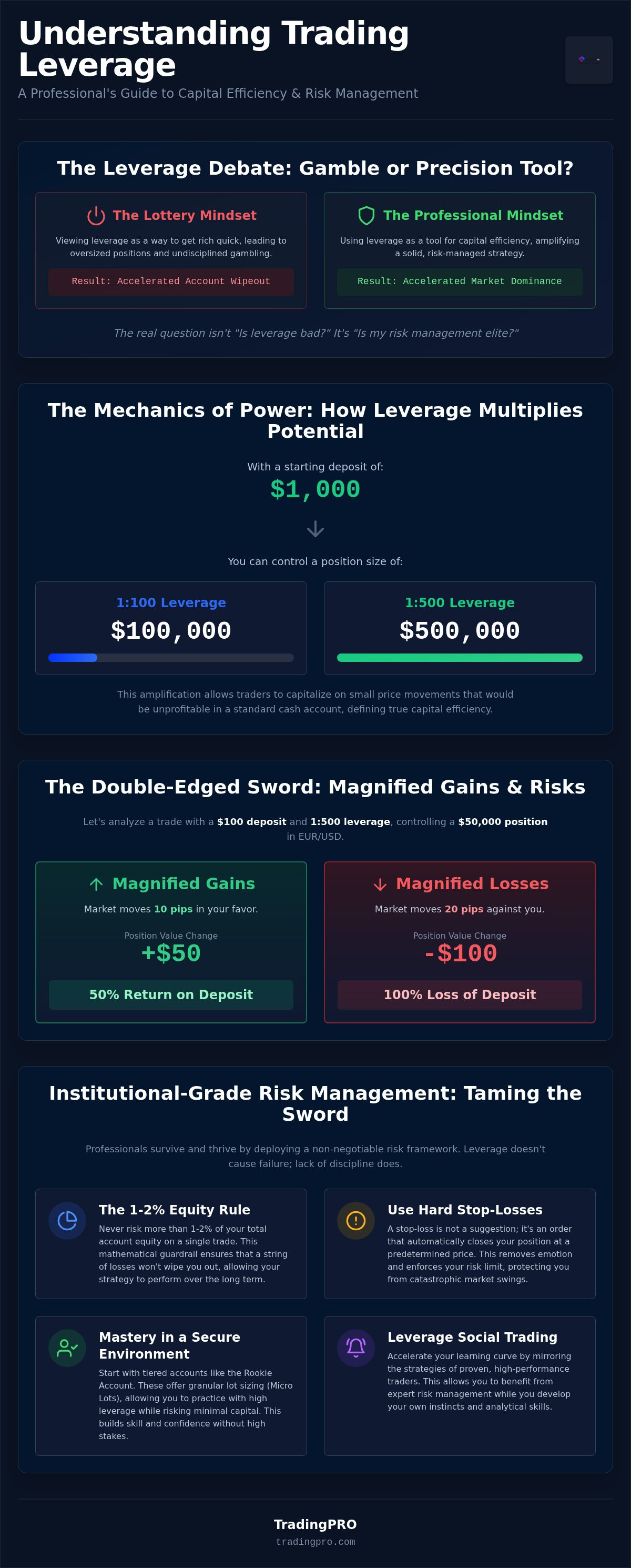
Confusion between these two terms leads to catastrophic errors. Margin is the specific "good faith deposit" your broker requires to keep a position open. Leverage is the resulting ratio of that deposit to the total trade value. For example, a 1% margin requirement translates to 1:100 leverage. Understanding The Mechanics of Power: How Leverage Multiplies Your Potential is essential for anyone serious about scaling. Margin is the collateral that unlocks global market access. It acts as the anchor for your trades, while leverage provides the reach and momentum needed to capitalize on small price movements.
The Empowerment Factor: Why Retail Traders Need Leverage
Institutional giants have billions in liquidity. You don't. Leverage is the great equalizer that levels the playing field. It allows retail traders to diversify a small portfolio across multiple assets, from forex majors to indices, without needing a massive bankroll. This isn't about being reckless; it's about being strategic. TradingPRO Rookie accounts are specifically engineered for this growth phase. They provide the infrastructure to master these tools without the institutional barriers. You get the same market access as the pros, but with the granular control necessary to build your skill set safely. Use leverage to expand your reach, not to inflate your ego.
The Mechanics of Power: How Leverage Multiplies Your Potential
Leverage isn't just a number. It's a force multiplier. Compare 1:100 to 1:500. At 1:100, you control $100,000 with $1,000. At 1:500, that same $1,000 commands $500,000. This is how sophisticated players capture institutional-sized moves with retail-sized deposits. Many skeptics ask, is high leverage trading a bad idea? It's only a bad idea if you lack the speed to execute. High-speed execution is non-negotiable. Even a micro-second of slippage on a highly leveraged trade can erode your margin before you can react. You need precision entry and elite infrastructure to survive this high-velocity environment.
The Math of a Leveraged Trade
Let's look at the raw numbers. Imagine a $100 deposit. With 1:500 leverage, you control a $50,000 position. In the EUR/USD market, a 10-pip move on this position is worth roughly $50. That's a 50% return on your initial margin from a tiny market fluctuation. This is the definition of capital efficiency. However, the math works both ways. If the market moves against you by 20 pips, your equity vanishes. You must calculate pip values and margin requirements in real-time to maintain dominance. Use the TradingPRO Trade Hub to automate these calculations instantly and stay ahead of the curve.
Magnifying Gains Without Sacrificing Stability
Professional scalpers don't gamble. They use "controlled aggression." They hunt for 3 to 5 pip moves that cash accounts would find unprofitable. High leverage makes these small intraday shifts incredibly lucrative. Some traditionalists argue the strategic case for lower leverage is the only path to survival. We believe that's an outdated view for the modern, tech-forward trader. Lower leverage requires massive capital to see meaningful results. High leverage allows for fractional trading in emerging markets, giving you the flexibility to diversify without overextending your base.
Precision is your shield. Surviving a high-leverage environment requires you to enter at the exact moment momentum shifts. This minimizes drawdown and keeps your margin healthy. Is high leverage trading a bad idea? Only for those who refuse to master the mechanics. For the rest of us, it's the ultimate gateway to market dominance. Secure your competitive advantage and start scaling with institutional power today.
Why Traders Fail: The Real Risks Behind the High-Leverage Myth
High performance tools require high performance operators. Leverage isn't a villain. It is a mirror. It reflects your discipline, or your lack of it, with brutal clarity. The primary reason beginners ask is high leverage trading a bad idea is that they have witnessed the carnage of over-leveraging. Trading beyond your psychological risk tolerance is the fastest way to transform a precision tool into a destructive weapon. When you gamble with ratios you don't understand, you aren't trading; you're just waiting for the market to collect your deposit. Emotional instability turns leverage into a trap. Revenge trading is the final stage of this collapse. After a loss, the urge to "win it back" by maxing out your ratio is a siren song that leads straight to total liquidation.
The dreaded "Margin Call" is your final warning. It happens when your account equity falls below a specific percentage of your required margin. At this point, the broker's system automatically closes your positions to prevent further losses. It's a cold, calculated safety mechanism designed to protect the institution. For the unprepared trader, it feels like a personal defeat. For the professional, it's a sign that their risk management failed long before the trade was even placed. If you're constantly hitting the danger zone, the problem isn't the market. It's your failure to respect the math of the trade.
The Over-Leveraging Trap
Using 100% of your available margin is a recipe for instant disaster. You need a significant buffer of "free margin" to withstand market noise. Prices don't move in straight lines. They breathe. If a minor 5-pip correction makes you sweat, your leverage ratio is too high for your current strategy. Professional traders keep their utilization low, leaving plenty of room for the trade to develop. Watch for these red flags:
- Your heart rate spikes every time a candle flickers.
- You can't walk away from your screen for five minutes.
- A single losing trade wipes out a week of gains.
Market Volatility and the Flash Crash Risk
In 2026, news moves markets in milliseconds. Sudden events can trigger flash crashes that bypass standard stop-losses. Highly leveraged accounts are particularly vulnerable during these liquidity gaps. This is why retail traders must demand institutional-grade infrastructure. You need a safety net that works when the market doesn't. We provide Negative Balance Protection to ensure your losses never exceed your initial deposit. It's the ultimate "safe-haven" feature in a high-stakes environment. Don't leave your capital exposed to black swan events without this critical layer of security. Is high leverage trading a bad idea? It is if you're trading without a net. With the right protection, it's simply a calculated path to dominance.
Institutional-Grade Risk Management: Taming the Double-Edged Sword
Success in high-velocity markets isn't about avoiding risk. It's about commanding it. If you are still wondering, is high leverage trading a bad idea, you likely haven't implemented a professional risk framework. Institutional players don't fear leverage; they respect it through rigorous, automated protocols. Taming this double-edged sword requires a four-step execution plan that removes emotion from the equation and replaces it with mathematical certainty.
- Step 1: Define Your Risk per Trade. Never risk more than 1-2% of your total equity on a single setup. This ensures that even a string of losses won't compromise your long-term dominance.
- Step 2: Deploy Hard Stop-Losses. Automation is your greatest ally. A hard stop-loss acts as an unbreakable exit strategy, cutting losses before they can spiral into a margin call.
- Step 3: Monitor Margin Levels. Keep a religious watch on your margin level percentage. Aim for a healthy buffer to absorb market noise without triggering defensive liquidations.
- Step 4: Segment Your Strategies. Utilize tiered accounts to isolate high-risk scalping from more conservative swing trades.
By following these steps, you transform leverage from a gamble into a calculated advantage. The goal is to survive long enough to become profitable, then scale your success with precision. Professional traders don't look for the "big win" at the cost of their account safety. They look for consistent, repeatable setups that allow them to utilize leverage as a tool for growth rather than a catalyst for failure.
Position Sizing: The Professional's Secret
Lot size is the true engine of your trade. Leverage provides the capacity, but your position size determines the impact. Many traders focus solely on the ratio, yet the professional knows that controlling a micro-lot allows for precise scaling. You can enter a position with minimal capital commitment and add to your winners as the trend confirms. This granular approach is the hallmark of a disciplined operator. For a deep dive into the math behind these calculations, study our Forex Trading for Beginners Guide to master the markets with confidence.
Leveraging Social Intelligence
You don't have to master every variable alone. Social intelligence allows you to benefit from the expertise of seasoned risk managers. Copy Trading is a powerful tool for mitigating individual error, provided you evaluate Master Traders with institutional scrutiny. Don't just look at their returns. Analyze their maximum drawdown versus their leverage usage. A trader who delivers high returns with low relative drawdown is a master of the craft. Explore our Social Trading vs Copy Trading guide to select a strategy that aligns with your specific risk profile. Is high leverage trading a bad idea? Not when you are following a proven, professional roadmap. Register your account now and start trading with the security of a global leader.
Strategic Empowerment: Choosing the Right Infrastructure for 2026
Elite infrastructure is the foundation of market dominance. TradingPRO’s multi-tiered system isn't just about variety; it’s about providing a structured path to mastery. Many newcomers ask is high leverage trading a bad idea because they attempt to use professional-grade ratios without the necessary training. The Rookie Account solves this by acting as the ultimate training ground. It allows you to develop your skills in a high-performance environment with the granular control needed to manage risk effectively. Master your discipline here first. Once your precision is undeniable, scale your operations to the Scalp Account. This is where ultra-high-speed execution meets the capital efficiency required for elite-level scalping.
The final verdict is clear. Leverage is a "bad idea" only for the uneducated and the undisciplined. For the professional trader, it is an essential tool for scaling potential and navigating the 2026 markets. Without it, you are restricted by the size of your deposit. With it, your growth is limited only by your ability to execute a proven strategy. Command your capital with the confidence of a leader.
Matching Your Account to Your Ambition
Your trading style dictates your leverage requirements. High-octane day traders need aggressive ratios to capture meaningful returns from small price shifts. Conversely, swing traders often prefer moderate ratios to absorb the wider price swings of multi-day trends. TradingPRO offers the flexibility to align your account settings with your specific objectives. Boost your margin cushion by utilizing the TradingPRO deposit bonus. This extra capital acts as a critical shock absorber, allowing you to maintain market presence during periods of heightened volatility. Stop waiting for the perfect moment. Register your professional account today and secure your competitive advantage.
The Future of High-Performance Trading
The 2026 landscape demands a partner that prioritizes your success. TradingPRO continues to lead the industry by innovating in execution speed and institutional-grade security. We provide the frictionless experience you need to stay ahead of the curve. Choosing a partner that values your long-term profitability as much as your trade volume is the ultimate strategic move. Don't settle for outdated infrastructure that stalls your momentum. Take full control of your financial destiny with a global authority that empowers your ambition. Your path to market dominance starts with the right tools and a partner that never hesitates. Execute with precision. Trade with power.
Command Your Financial Future with Precision Leverage
Stop viewing leverage as a threat. It is the ultimate force multiplier for the disciplined trader. The question of whether is high leverage trading a bad idea depends entirely on your infrastructure and your education. You now understand that capital efficiency is about precision, not gambling. By applying institutional-grade risk management and selecting the right account tier, you transform market volatility into a strategic advantage. You've learned that position sizing and the 1-2% risk rule are the true foundations of a sustainable career.
The 2026 landscape demands a partner that provides ultra-fast execution speeds and the security of Negative Balance Protection. Whether you are scaling through our Social Trading integration or mastering the craft in a Rookie Account, you have the roadmap to dominance. Don't let limited capital stall your ambition. It's time to trade with the authority of a global leader. Take command of your strategy and execute with absolute confidence.
Master the Markets: Register for Your TradingPRO Account Now
Your path to financial empowerment is open. Take the tools, apply the discipline, and watch your potential expand in real-time. The most sophisticated markets in the world are ready for your next move.
Frequently Asked Questions
Is 1:500 leverage too high for a beginner?
1:500 leverage is a high-performance setting that requires elite discipline. It isn't inherently "too high," but it demands a mastery of position sizing that most beginners lack. We recommend starting with a Rookie Account to refine your strategy before utilizing maximum buying power. Asking is high leverage trading a bad idea for beginners usually reveals a lack of risk education, which we solve through tiered account structures and precise lot sizing.
Can I lose more than my deposit with high leverage?
No, because we provide Negative Balance Protection as a standard security feature. This ensures your losses never exceed your initial deposit, even during periods of extreme market volatility. While high leverage magnifies price movements, this institutional-grade safety net prevents you from falling into debt with the broker. It's a critical "safe-haven" feature that allows you to pursue aggressive goals without the risk of catastrophic personal liability.
What is the best leverage for a $100 trading account?
A ratio of 1:100 to 1:500 is often used to make small accounts viable. Without it, a $100 deposit lacks the buying power to capture meaningful moves. High leverage allows you to control larger positions while keeping margin requirements low. You must keep position sizes small to survive. If you're asking is high leverage trading a bad idea for a $100 account, it's only a mistake if you risk your entire balance on one trade.
How do I change my leverage ratio on TradingPRO?
You can adjust your leverage settings directly through your secure client portal. Log in, select the specific trading account you wish to modify, and navigate to the account settings tab. Changes are typically processed instantly, allowing you to pivot your strategy as your experience grows. This flexibility ensures your infrastructure always matches your current ambition and risk tolerance. Command your capital by tailoring your account settings to your specific trading style.
Why do professional traders use high leverage if it is risky?
Professionals use leverage to maximize capital efficiency, not to take bigger gambles. It allows them to diversify across multiple assets without tying up all their liquidity in a single margin requirement. They treat leverage as a tool for precision, using it to capture small, high-probability price movements. For a seasoned operator, the risk is managed through strict position sizing and automated stop-losses, making high leverage a calculated advantage rather than a gamble.
Does high leverage increase the cost of my trades (spreads/commissions)?
No, leverage does not directly impact the spread or commission rates. Your trading costs are based on the volume you trade, not the ratio you use. However, because leverage allows you to control larger lot sizes, the nominal cost of the spread may feel higher in relation to your margin. Maintaining high-speed execution is essential to ensure these costs don't increase through slippage. Focus on precision entry to minimize the impact of trading costs.
What happens to my account during a margin call?
A margin call occurs when your account equity falls below the required threshold to maintain open positions. Our system will notify you to either deposit more funds or close positions to free up margin. If the equity continues to drop, the system automatically liquidates trades to protect your remaining balance. It's a cold, calculated protocol designed to prevent your account from falling into a negative balance. Always maintain a healthy margin buffer to avoid this.
Is leverage the same as a loan from the broker?
Leverage is a temporary extension of buying power, but it isn't a traditional loan. You don't receive cash in your bank account, and there are no monthly repayment schedules. Instead, the broker provides the liquidity necessary to control a larger market position using your deposit as collateral. It’s an institutional agreement that allows you to dominate larger trades while only committing a fraction of the total value. You retain full control over when to close the position.


