




- Published on: 2022-08-22 15:03:00
How to Use an Economic Calendar: A Trader's Essential Guide to Market-Moving Events
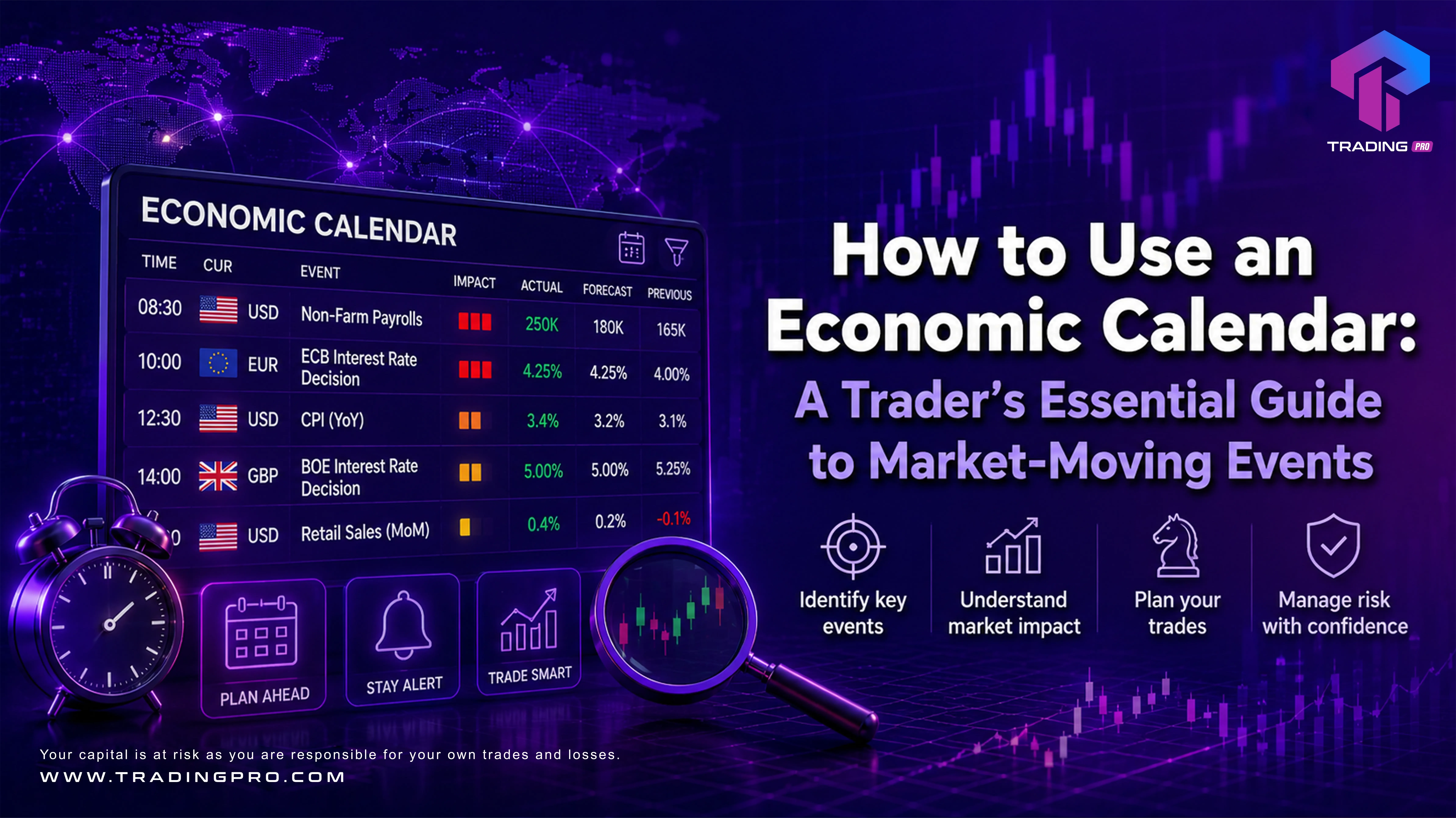
Every trading day, a stream of economic data releases, central bank decisions, and geopolitical developments has the potential to move financial markets significantly — sometimes violently. Traders who are caught off guard by these events can see carefully planned positions move sharply against them in seconds. Traders who are prepared can either manage their risk appropriately or deliberately position to profit from the resulting volatility.
The economic calendar is the tool that keeps you informed of what is coming. Available directly within TradingPRO's platform, it is one of the most practical and underutilised resources available to retail traders. This guide explains exactly how to read and use an economic calendar effectively, which events deserve the most attention, and how to incorporate calendar awareness into your daily trading routine.
What Is an Economic Calendar?
An economic calendar is a schedule of upcoming economic data releases, central bank meetings, policy announcements, and other significant financial events. For each event, it typically shows the date and time of the release, the country or region it relates to, the name of the data release, its historical importance (usually rated as low, medium, or high impact), the previous reading, the consensus forecast, and the actual result once released.
The calendar is not just a passive information tool — it is an active trading aid. By reviewing it before each session, you know exactly when potential volatility spikes are scheduled, which lets you make informed decisions about entering, exiting, or adjusting positions ahead of significant events.
Understanding Impact Ratings
Economic calendar services rate each event by its typical market impact — usually displayed as low (one bull/bear icon), medium (two icons), or high (three icons). These ratings reflect the historical tendency of each release to move markets significantly, based on how important the data is to central bank policy decisions and economic assessments.
-
High impact events — these are the releases that most consistently move markets significantly. They deserve full attention and require active position management decisions before and during the release. Examples include US Non-Farm Payrolls, CPI inflation data, central bank interest rate decisions and press conferences, and GDP releases.
-
Medium impact events — these can move markets meaningfully but are less consistently market-moving than high-impact events. They are worth noting but may not require the same level of pre-release position management. Examples include retail sales, trade balance data, and manufacturing PMI surveys.
-
Low impact events — these rarely cause significant market moves and can generally be monitored passively rather than requiring active management decisions. Examples include minor regional data releases and second-tier economic surveys.
The Most Important Events on Any Economic Calendar
Central Bank Interest Rate Decisions
Central bank meetings — particularly those of the US Federal Reserve (FOMC), European Central Bank (ECB), Bank of England (BoE), Bank of Japan (BoJ), Reserve Bank of Australia (RBA), and Reserve Bank of New Zealand (RBNZ) — are the single most market-moving category of scheduled events. Rate decisions, forward guidance, and the subsequent press conferences can trigger sustained moves across forex, bonds, equities, and commodities simultaneously.
Pay particular attention not just to the rate decision itself, but to the accompanying statement and press conference. Often, the market's reaction to the language and tone of the communication is larger than its reaction to the numerical decision — particularly when the decision itself was already fully priced in by the market.
US Non-Farm Payrolls (NFP)
Released on the first Friday of every month at 1:30 PM GMT, the NFP report is arguably the single most anticipated scheduled data release in all of financial markets. It measures job creation across the US economy outside the agricultural sector and is a key input into the Federal Reserve's assessment of economic health and labour market conditions.
NFP releases are famous for their market-moving potential. Significant beats or misses against consensus can trigger immediate and substantial moves in USD pairs, US indices, gold, and other correlated markets. Many experienced traders either significantly reduce their position size ahead of NFP or close out positions entirely and re-enter after the initial volatility settles.
Inflation Data (CPI)
Consumer Price Index releases have become some of the most market-moving events of the current cycle given the elevated inflation environment of 2021-2022 and its central role in shaping central bank policy. US CPI (released monthly, typically in the second week of the month) in particular has generated some of the largest single-day market moves of recent years.
The relationship is straightforward: above-consensus CPI raises rate hike expectations and typically strengthens the dollar while pressuring bonds and sometimes equities. Below-consensus CPI does the reverse. The 'core' CPI reading (which excludes food and energy) is often considered the more important figure for central bank policy purposes.
GDP Data
Quarterly GDP releases provide the broadest measure of economic health and are typically high-impact events, particularly when they deviate significantly from expectations or when they reveal whether an economy has entered a technical recession (two consecutive quarters of negative growth). GDP can trigger substantial moves in the currency, equity market, and bond market of the reporting country.
PMI Surveys
Purchasing Managers' Index surveys (Manufacturing and Services PMI) are released monthly and provide one of the most timely leading indicators of economic conditions available to traders. Because they are released early in the month before other data, they often set the tone for market sentiment in the days following their release. Readings above 50 indicate expansion; below 50 indicate contraction.
How to Incorporate the Economic Calendar Into Your Trading Routine
The Evening Review
Make it a habit to review the next day's economic calendar every evening before your trading session. Identify all high-impact events scheduled for the following day, note the times (and convert to your local timezone if necessary), and assess which of your planned or open trades might be affected. This five-minute review prevents the unpleasant surprise of waking up to find a market-moving event has triggered your stops overnight.
The Pre-Session Check
Before beginning any trading session, re-check the calendar for events scheduled within the next few hours. For each high-impact event during your planned trading period, decide in advance how you will handle it: will you close or reduce positions before the release, widen your stop to accommodate the volatility, or sit on the sidelines entirely until the event has passed and the market has settled?
Post-Release Management
After a significant data release, markets often experience an initial spike of volatility followed by a more considered repricing as participants digest the implications of the data. The initial spike can be unpredictable and dangerous to trade directly. Many experienced traders wait 10-15 minutes after a major release before re-engaging, allowing the immediate reaction to settle before assessing the post-event trend.
Common Mistakes Traders Make Around Economic Releases
-
Holding full positions through high-impact events without considering the gap risk — even a well-planned trade can be stopped out instantly by a data surprise, regardless of the longer-term validity of the thesis
-
Trading the initial spike immediately after a release — the first 30-60 seconds after a major release are often chaotic, with thin liquidity and extremely wide spreads. Trying to trade in this window typically results in poor execution and unnecessary risk.
-
Assuming the 'obvious' reaction will occur — sometimes good news causes selling ('buy the rumour, sell the fact') and bad news causes buying. Markets are forward-looking and the actual reaction depends heavily on what was already priced in before the release.
-
Forgetting about events in different time zones — Asian session events (BoJ decisions, Australian/New Zealand data) occur while many Western traders are asleep. If you hold positions overnight, check the full 24-hour calendar, not just your local trading session.
Using the Economic Calendar on TradingPRO
-
Integrated directly into the platform — access the full economic calendar without leaving TradingPRO, with all major global events, impact ratings, forecasts, and previous readings in one place
-
Customisable filters — filter by country, impact level, or asset class to focus on the events most relevant to the markets you trade
-
Real-time result updates — actual results are updated in real time as data releases hit, allowing you to see the beat or miss immediately alongside your charts
-
Alert functionality — set reminders for upcoming high-impact events so you are never caught off guard regardless of how busy your trading session becomes
Conclusion: Preparation Is the Professional Edge
The economic calendar separates reactive traders from prepared ones. Reactive traders are surprised by volatility; prepared traders have already decided how they will handle it. The few minutes you spend reviewing the calendar before each session is one of the highest-return activities available to any trader — the cost is minimal, and the protection it provides against avoidable surprise losses is substantial.
Make the economic calendar a non-negotiable part of your pre-session routine. Know what is coming, plan your response in advance, and trade with the confidence that comes from being genuinely prepared. TradingPRO's integrated calendar makes this easier than ever — open your account today and start trading with full awareness of the events shaping your markets.
Stay Ahead of the Market with TradingPRO


