




- Published on: 2026-08-14 10:15:42
How to Minimize Slippage: Master Your Trade Execution in 2026
Stop treating slippage like an unavoidable tax on your trading success. In the high-velocity markets of 2026, every millisecond of lag and every pip of deviation represents a direct leak in your profit margin. You click buy and watch the price jump instantly, leaving you with an entry that sabotages your risk-to-reward ratio before the trade even breathes. Learning how to minimize slippage isn't just a technical skill. It's the definitive boundary between elite performance and the frustration of missed targets. You deserve execution that matches your ambition.
We understand the sting of being filled far from your intended level during volatile news events. It often feels like the market is actively moving against you the moment you commit. This guide delivers the professional strategies and institutional-grade setups required to eliminate execution gaps. You'll discover how to keep your hard-earned profits exactly where they belong.
We'll dive into the precision of Scalp and Pro account infrastructure, master the specific order types that protect your capital, and show you how to leverage the Trade Hub to achieve near-instant execution. Get ready to transform your trade execution into a dominant competitive advantage.
Key Takeaways
- Identify the primary drivers of execution gaps, including volatility, liquidity, and latency, to protect your margins from unpredictable market shifts.
- Discover how to minimize slippage by prioritizing Limit orders and utilizing advanced instructions like Fill or Kill (FOK) to ensure price precision.
- Target the London and New York session overlap to capitalize on peak liquidity while avoiding the high-risk zones at session opens and closes.
- Upgrade your technical infrastructure with a VPS and institutional-grade tools to eliminate latency and secure near-instant trade execution.
- Deploy specialized environments like the Scalp and Pro accounts to gain direct access to deep liquidity pools and keep your profits where they belong.
What is Slippage and Why is it the Silent Profit Killer?
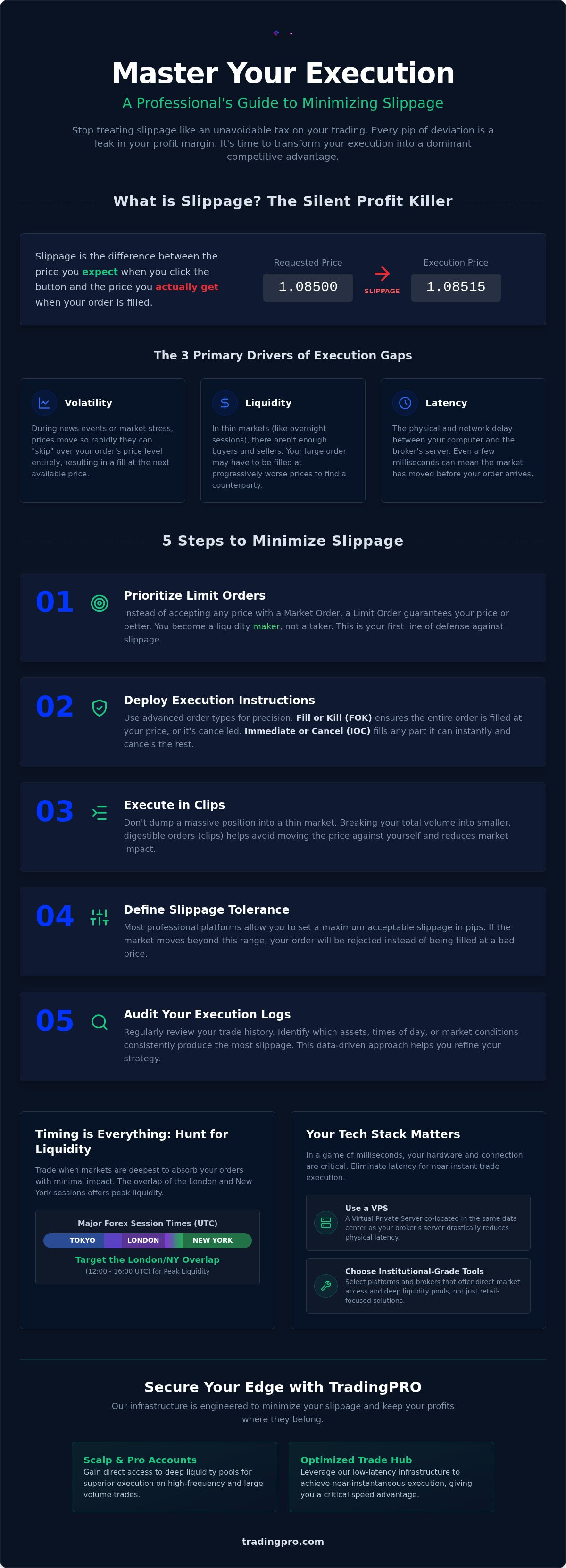
Slippage is the delta between your intent and the cold reality of the market. You see a specific price, you execute, and you receive a fill at a different level. It's the variance between your requested price and the final execution price. This isn't just a technical glitch. It's a structural leak that can turn a high-performance strategy into a break-even struggle. Understanding how to minimize slippage is the first step toward institutional-grade execution.
Three primary forces drive this phenomenon: Volatility, Liquidity, and Latency. During high volatility, prices skip levels faster than orders can process. In low liquidity, the lack of counterparty orders forces your trade to seek fills at worse prices. Latency adds a technical delay, making your data obsolete before it reaches the server. Even "positive slippage," where the price moves in your favor, indicates a lack of market depth that could easily flip against you on the next trade.
The damage isn't just financial; it's psychological. Constant execution gaps erode your discipline. When you can't trust your entries, you start to hesitate and second-guess proven setups. This loss of confidence often triggers emotional trading, which is far more dangerous than any single pip of slippage.
The Mechanics of Execution: Why Prices Change in Milliseconds
Aggressive market orders sweep the order book. They consume every available price level until your total volume is satisfied. In thin markets, this sweep creates a price spike that leaves you with a poor entry. Your starting slippage is also influenced by the spread, as wider gaps between bid and ask prices increase your immediate transaction cost. Market depth is the measure of a market's ability to absorb large order volumes without causing significant price fluctuations.
The Cumulative Cost: How 1 Pip of Slippage Erases Your Edge
Stop viewing slippage as a one-time fee. Start viewing it as a compounding tax on your equity. For an active trader, a single pip of slippage per trade across hundreds of positions represents a massive capital drain. This cumulative cost often outweighs the benefits of finding a "perfect" technical entry. Mastering how to minimize slippage ensures your edge remains intact over the long term. You can explore further strategies for mastering the markets in 2026 to stay ahead of the curve.
Master Your Execution: 5 Steps to Minimize Slippage Today
Take command of your fills. If you're wondering how to minimize slippage, start by removing the "Market Order" button from your primary workflow. Relying on market orders is essentially handing the market a blank check. You're telling the exchange you'll accept any price just to get in. Elite traders don't hope for good fills. They engineer them. Follow these five steps to tighten your execution immediately:
- Prioritize Limit Orders: Use these for any entry where seconds don't dictate the trade's success. It guarantees your price or better.
- Deploy Execution Instructions: Use "Fill or Kill" (FOK) to ensure your entire order is filled at your price or not at all. Alternatively, "Immediate or Cancel" (IOC) fills what it can and cancels the rest.
- Execute in Clips: Don't dump a massive position into a thin order book. Break your total volume into smaller, digestible pieces to avoid moving the price against yourself.
- Define Slippage Tolerance: Configure your platform settings to reject any fill that deviates beyond a specific pip range.
- Audit Your Logs: Review your execution history weekly. Identify which times of day or specific assets consistently produce the widest gaps between your click and your fill.
The Limit Order Advantage: Guaranteeing Your Price
Limit orders transform you into a liquidity maker. By placing an order at a specific price, you add depth to the book rather than consuming it. This provides absolute price certainty. The trade-off is the risk of being left behind if the market moves aggressively away from your level. During high-volatility sessions, place your limits slightly ahead of key structural levels to ensure you're at the front of the queue when the price arrives. Secure your execution edge by choosing a professional account environment that prioritizes speed.
Advanced Order Types: Protecting Your Entry and Exit
Standard stop-market orders are slippage magnets because they convert to market orders the moment they're triggered. Switch to stop-limit orders. This allows you to set a trigger price and a secondary limit price, ensuring you aren't filled at a disastrous level during a flash crash. A stop-loss triggers a market order once a price level is hit to limit losses, while a limit order specifies a precise price for execution to ensure value. Professional hubs often include built-in slippage control features that automate these protections, allowing you to focus on the setup rather than the fill quality. Mastering how to minimize slippage is about using the right tool for the specific market condition.
Timing the Market: Avoiding Low Liquidity and News Traps
Markets operate on a pulse. To master your execution, you must synchronize your activity with global liquidity cycles. Trading during peak hours is the most effective way how to minimize slippage. When the world's largest financial centers are active, order books are deep and spreads are razor-thin. This ensures your orders find immediate counterparties without forcing the price to move against you.
The London and New York session overlap is the ultimate "Golden Hour" for traders. Between 13:00 and 17:00 GMT, the sheer volume of transactions creates a frictionless environment for both retail and institutional players. Conversely, you must treat the first and last 15 minutes of any session as slippage minefields. During these transitions, institutions rebalance massive portfolios, leading to erratic price swings and sudden spread blowouts. Stay alert for these common liquidity traps:
- Bank Holidays: When major hubs like London or New York are closed, liquidity vanishes, making even small orders prone to slippage.
- Weekend Gaps: Prices can "jump" over your orders between Friday's close and Sunday's open.
- The "Asian Slosh": The period between the New York close and Tokyo open often sees wider spreads and thinner books.
The Liquidity Map: When Global Markets are Most Efficient
Peak efficiency occurs when multiple major hubs are open simultaneously. Major pairs like EUR/USD thrive in the London-NY window, while minors and exotics require even more specific timing to avoid execution gaps. Be wary of the lower participation periods where spread widening becomes a standard feature rather than an exception. For real-time market insights and data-driven timing, utilize the Trade Hub to track liquidity shifts as they happen. Understanding how to minimize slippage requires knowing exactly when the "big money" is at the table.
Trading the News: Strategy vs. Gambling
News trading is a high-stakes environment where price gapping is a structural reality. During high-impact events like Non-Farm Payroll (NFP), the market can jump dozens of pips in a millisecond, skipping your stop-loss entirely because no prices exist in the gap. This isn't a technical failure; it's a temporary absence of liquidity. To survive these spikes, adjust your position size downward to account for the increased volatility. Many professionals adopt a "Wait and See" approach, entering 5 to 10 minutes after the initial price discovery phase once the order book stabilizes. This ensures you're trading on confirmed momentum rather than speculative chaos.
Optimizing Your Technical Infrastructure for Elite Speed
Speed is the ultimate equalizer in modern markets. If your technical setup lags, your strategy is already compromised. Latency, the delay between sending an order and its arrival at the exchange, is the silent engine of technical slippage. To master how to minimize slippage, you must optimize every link in the data chain. Start with your physical connection. Wi-Fi is the enemy of precision. It introduces jitter and packet loss that can stall your execution at the worst possible moment. Hardwire your station with a high-quality Ethernet cable to ensure a stable, high-speed pipeline.
Your broker's physical location matters as much as their platform. Choose a partner with data centers strategically positioned near major liquidity hubs like London, New York, or Tokyo. This proximity slashes the distance data must travel, giving you a millisecond advantage over the rest of the retail crowd. Every mile of fiber optic cable saved is a win for your profit margin.
The Power of a Trading VPS
A Virtual Private Server (VPS) is a non-negotiable tool for the serious professional. By hosting your platform on a server located in the same data center as your broker, you reduce the "round-trip" time of your trade requests to near-zero. This infrastructure ensures 99.9% uptime, which is vital for automated systems and social trading strategies that need to mirror signals instantly. Explore our Scalp Account for ultra-low latency environments designed for high-frequency precision.
ECN vs. Market Maker: Understanding Execution Models
The account type you choose dictates how your orders interact with the global market. Electronic Communication Network (ECN) accounts provide direct access to multiple liquidity providers, resulting in tighter fills and transparent pricing. Unlike traditional market makers, No Dealing Desk (NDD) execution ensures your broker isn't taking the other side of your trade, which drastically reduces artificial interference and delays. Institutional-grade liquidity refers to the massive pool of buy and sell orders provided by tier-one banks and prime brokers that ensures even large retail trades are filled with minimal price impact.
Mastering how to minimize slippage is a multi-front war. You've already optimized your order types and timing; now secure the technical edge that keeps you ahead of the curve. Register your professional trading account today and experience the power of institutional-grade infrastructure.
Secure Your Edge: How TradingPRO Minimizes Your Slippage
TradingPRO doesn't just offer market access; we provide a dominant competitive advantage. We've engineered an ecosystem where your strategy can thrive without the drag of technical inefficiency. Our commitment to your success is reflected in every millisecond we shave off our execution speeds. Learning how to minimize slippage is a vital step, but the platform you choose is the final piece of the puzzle. You deserve a partner that treats your profit margin with the same respect you do.
Our infrastructure shows you exactly how to minimize slippage by providing direct routes to the world's most liquid markets. We maintain deep relationships with top-tier liquidity providers to ensure your orders are matched against a massive pool of global volume. When you click buy or sell, our system finds the best possible match instantly. This reduces the risk of price gaps and ensures your hard-earned profits stay in your account. You're no longer fighting the infrastructure; you're leveraging it for victory.
From Rookie to Scalp: The Right Environment for Your Style
Your journey toward elite execution starts with the right environment. The Rookie Account serves as the ideal training ground to master execution basics without the pressure of institutional volume. It's the perfect entry point for those refining their discipline. For traders demanding peak performance, the Scalp Account provides the ultimate high-speed solution. It's engineered for zero-spread precision and lightning-fast fills, making it the premier choice for high-frequency strategies. This same institutional-grade infrastructure powers our social trading ecosystem, ensuring that copied trades are replicated with the same millisecond accuracy as the original signal.
Join the Elite: Start Trading with Precision Today
Registration is frictionless and designed for the modern professional. You'll gain immediate access to the tools used by the world's most successful traders. 2026 is the year to stop settling for average fills and start demanding excellence in every trade. Your potential is limitless when your platform finally matches your ambition. The market moves fast; we move faster. Secure your status as a high-performance trader and leave the frustration of execution gaps behind. Register now to minimize slippage and maximize your potential.
Take Command of Your Trading Future
Execution isn't a game of chance; it's a discipline of precision. You've discovered that mastering how to minimize slippage requires a strategic blend of timing, technical optimization, and advanced order management. By aligning your activity with peak liquidity windows and hardwiring your infrastructure for speed, you eliminate the friction that erodes your edge. The difference between a profitable year and a break-even struggle often comes down to the quality of your fills. Don't leave your capital at the mercy of outdated setups or thin order books.
Success in 2026 demands institutional-grade tools. Our global multi-asset infrastructure and direct liquidity access across all account tiers ensure you're always trading on the front foot. Whether you're utilizing our specialized Scalp accounts for millisecond execution or leveraging the Trade Hub for real-time insights, the power to dominate the market is in your hands. It's time to upgrade your environment and trade with the confidence of a global leader.
Register with TradingPRO to Access Institutional-Grade Execution and secure your competitive advantage today. Your potential is limitless when your platform matches your ambition.
Frequently Asked Questions
Is it possible to have zero slippage in forex trading?
Absolute zero slippage is impossible in a live market environment. Because prices fluctuate in milliseconds, the time it takes for your order to travel to the server creates a window for price movement. Even institutional systems experience micro-deviations. Your goal shouldn't be perfection but rather learning how to minimize slippage through superior infrastructure and strategic order placement to keep your execution as close to your intent as possible.
Can slippage be positive for the trader?
Slippage can definitely work in your favor. This occurs when the price moves to a better level for your trade during the millisecond gap between your request and the final execution. While traders often focus on negative outcomes, positive slippage is a common byproduct of trading in highly liquid environments where price discovery is efficient. It reinforces why choosing a broker with deep liquidity access is a strategic necessity for your bottom line.
Why does slippage increase during high-impact news events?
Slippage surges during news events due to a temporary imbalance in market liquidity. When high-impact data drops, liquidity providers often pull their orders to manage risk, causing the order book to thin out. Simultaneously, volatility spikes as the market seeks a new fair value. This combination of fewer available orders and rapid price jumps means your trade may need to sweep the book to find a fill, often far from your requested price.
How do limit orders help in minimizing slippage?
Limit orders eliminate negative slippage by guaranteeing your specified price or better. Unlike market orders, which prioritize speed of entry over price, a limit order sits in the book until a counterparty meets your exact requirements. This is a primary tactic for those focused on how to minimize slippage. While you risk a missed fill if the market never hits your level, you secure absolute control over your entry and exit costs.
Does my internet speed affect the amount of slippage I experience?
Your internet speed and stability directly impact your execution quality. Slow connections increase the time it takes for your trade request to reach the broker's server, which expands the window for price movement. This technical delay is a major contributor to avoidable slippage. To maintain a competitive edge, use a hardwired Ethernet connection rather than Wi-Fi and consider a professional hosting solution to ensure your data travels the shortest path possible.
What is the difference between latency and slippage?
Latency is the technical delay in data transmission, while slippage is the resulting price difference between your request and the fill. Think of latency as the cause and slippage as the effect. High latency gives the market more time to move away from your price before your order arrives. Reducing latency through better infrastructure is the most direct way to tighten your fills and ensure your strategy executes exactly as planned.
How does a VPS help reduce trade execution delays?
A VPS reduces delays by placing your trading platform in a data center physically close to your broker's servers. This proximity slashes the ping time, ensuring your orders are transmitted and acknowledged in milliseconds. By bypassing the hurdles of your local internet provider and physical distance, a VPS provides the institutional-grade stability required for high-frequency trading and social trading replication where every fraction of a second counts toward your success.
Which TradingPRO account is best for minimizing slippage?
The Scalp Account is our premier environment for minimizing execution gaps. It's specifically engineered for high-frequency traders who require institutional-grade speed and zero-spread precision. By providing direct access to deep liquidity pools and utilizing our most advanced server infrastructure, the Scalp Account ensures that even the most aggressive strategies are executed with maximum efficiency. It's the definitive choice for professionals who refuse to let slippage compromise their profit margins.


