




- Published on: 2026-10-07 11:39:35
How to Know When to Quit Trading: A Risk-First Checklist

A losing streak doesn’t automatically mean you should quit, but trading through stress and mounting losses can turn a rough patch into a damaging pattern. If you’re trying to work out how to know when to quit trading, start with one principle: stepping back is a risk-management decision, not a verdict on your ability.
It’s difficult to judge clearly when you’re tired, anxious, or focused on winning money back. A written checklist can help you act on observable signals before pressure takes over. Use it to review your finances, behavior, and trading results, then decide whether to pause, adjust your approach, or stop.
This guide covers warning signs that deserve attention, how to assess performance beyond a few recent trades, and what safeguards to set before any return. Use the checklist to make a deliberate decision and protect your financial wellbeing, rather than treating another trade as the answer.
Key Takeaways
- Look for financial, emotional, and rule-following signals that trading may be putting your wellbeing or finances at risk.
- Use a written checklist away from the markets to decide whether to take a brief break, a longer pause, or stop.
- Before deciding, check whether your trading funds are separate from essential expenses and emergency savings.
- Learn how to know when to quit trading by reviewing patterns in your results, not reacting to one difficult session.
- If you choose to return, set a written plan, affordable risk limits, and a regular review process first.
When to Quit Trading: Recognize the Warning Signs
It can be hard to tell whether a losing stretch is temporary or trading has become too costly. One losing trade doesn’t decide the answer. Look for recurring patterns instead: breaking your rules, increasing losses, or finding it difficult to stop when you intended to. Pausing or quitting can be a responsible risk-management choice, not a judgment on your ability.
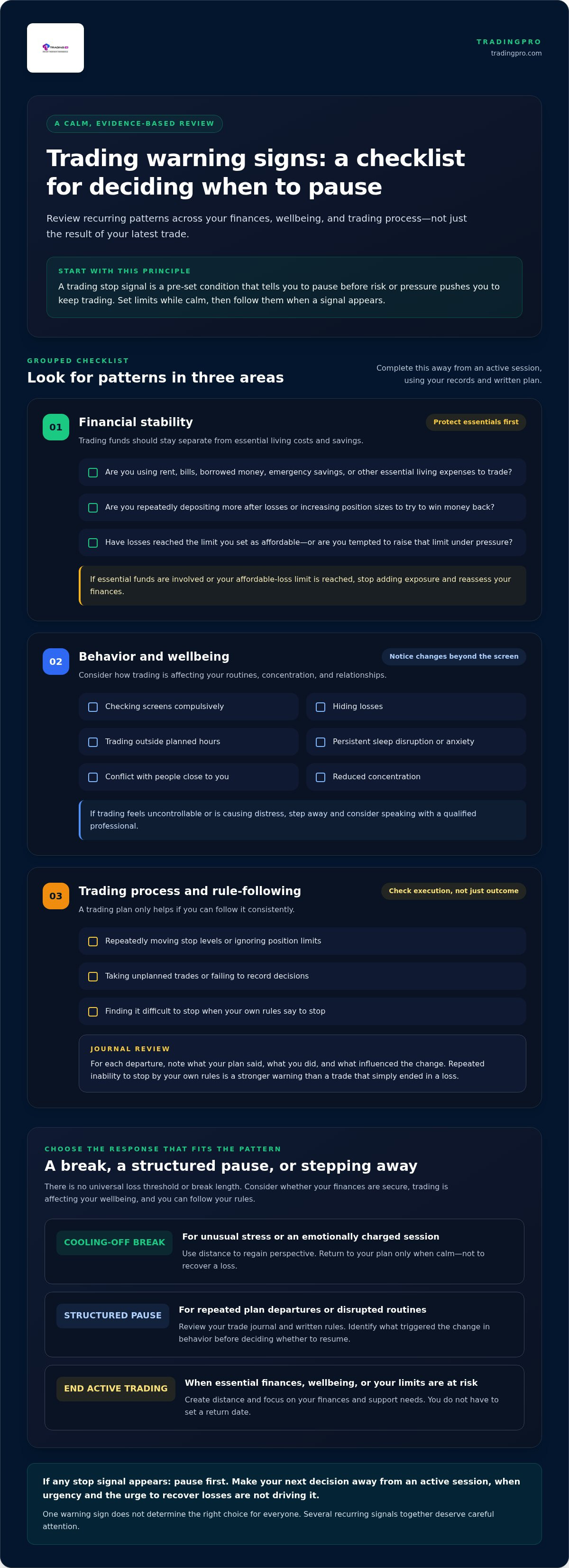
A trading stop signal is a pre-set condition that tells you to pause before risk or pressure pushes you to keep trading. Set your limits while you’re calm, then follow them when a signal appears. No single warning sign determines the right choice for everyone, but several signals occurring together deserve careful attention.
Financial signs that trading may no longer be sustainable
Keep trading funds separate from rent, bills, borrowed money, emergency savings, and other essential living expenses. If you’re using any of these to trade, or repeatedly depositing more after losses, stop adding exposure and reassess your finances. The same applies if you’re increasing position sizes to try to win money back. When losses reach the limit you set as affordable, stop trading rather than raising that limit under pressure.
Behavioral and wellbeing signs to take seriously
Notice whether you’re checking screens compulsively, hiding losses, or trading outside your planned hours. Persistent sleep disruption, anxiety, conflict with people close to you, or reduced concentration are also reasons to pause. Psychological biases can influence decisions, as explored in behavioral finance. If trading feels uncontrollable or is causing distress, step away and consider speaking with a qualified professional.
Process signals: your rules aren’t holding
A trading plan only helps if you can follow it. Repeatedly moving stop levels, taking unplanned trades, ignoring position limits, or failing to record your decisions can point to a process that needs a reset. Review your journal for patterns: note what your plan said, what you did, and what influenced any deviation. Inability to stop when your own rules say to stop is a stronger warning than a trade that simply ended in a loss.
To assess how to know when to quit trading, look at patterns across your finances, behavior, wellbeing, and execution, not just your latest result. If you reach a stop signal, pause first. Make your next decision away from an active session, when urgency and the urge to recover losses aren’t driving it.
Should You Quit Trading or Take a Break? Make the Distinction
A short break and an exit serve different purposes. A cooling-off break creates space to settle after a stressful session. A structured pause gives you time to review your behavior, finances, and trading process before deciding what to do next. Ending active trading means stepping away without treating a return as the expected next step.
There’s no universal loss threshold or break length that works for everyone. Base your decision on whether your finances are secure, trading is affecting your wellbeing, and you can follow your own rules. This distinction can help you answer how to know when to quit trading without forcing a permanent decision in the middle of a difficult moment.
Cooling-off break
- Purpose: Regain perspective after unusual stress or an emotionally charged session.
- May fit when: You can generally follow your rules but need distance before making another decision.
- Review action: Return to your plan only when calm, not to recover a loss.
Structured pause
- Purpose: Investigate a repeated problem and decide what needs to change.
- May fit when: You’ve departed from your plan more than once, or your routines and concentration have been disrupted.
- Review action: Study your trade journal and written rules before deciding whether to resume.
End active trading
- Purpose: Protect your financial and personal stability by stepping away.
- May fit when: Essential finances or wellbeing are at risk, or you can’t stick to the limits you set.
- Review action: Focus on your finances and support needs. You don’t have to set a return date.
When a temporary trading break may be appropriate
Consider a break after unusual stress, disrupted routines, or repeated departures from your plan. Use the distance to review what happened, not to count down to another attempt at winning losses back. Before considering a return, review your journal and rules. Identify what triggered the change in behavior and whether you can follow your process again.
When stopping may be the safer decision
If trading puts essential finances or personal wellbeing at risk, stopping deserves serious consideration. The same is true if you repeatedly override your own limits. Create distance and seek support if you need it. Leaving active trading isn’t failure; it can be a deliberate way to protect your stability now and in the future.
If you later complete your review and independently decide to return with a defined plan, you can register for a TradingPRO account. Registration is an optional next step, not a solution to losses or distress.
Use This Trading Checklist to Make a Clear, Evidence-Based Decision
Complete this checklist away from an active trading session. Use your records and written plan, not the pressure of a live market or the outcome of your latest trade. Honest answers can help you decide whether to pause, stop, or review your approach. They aren’t a diagnosis or a guarantee about future results.
Review your finances, rules, and trading records
- 1. Is your trading capital separate? Confirm that the money you trade doesn’t come from rent, bills, borrowed funds, emergency savings, or other essential expenses. If it does, stop adding exposure and reassess your finances.
- 2. Are you staying within personal limits? Compare actual position sizes and losses with the limits in your written plan. Note any limit you moved or ignored after trading began, and what prompted the change.
- 3. Are deposits or positions growing after losses? Review account activity for added funds or larger trades intended to recover money. Record what prompted each increase rather than judging yourself.
- 4. What does your trade journal show? Check whether decisions followed your rules, including entries, exits, and position sizing. A single losing trade can happen despite sound execution; repeated rule breaks or attempts to chase losses point to a process that needs attention.
Check whether trading is affecting life outside the markets
- 5. Has daily life changed? Write down whether trading is affecting sleep, relationships, concentration, work, or other responsibilities. Look for recurring effects, not just one difficult day.
- 6. What do people close to you notice? Ask a trusted person whether they’ve seen changes in your mood, routine, or ability to be present. Treat their observations as useful information, not a verdict.
- 7. Can you step away when you decide to? Consider whether you can stop at your planned time, stick to your limits, and avoid immediately returning to the market. If distress or loss of control persists, prioritize support from a qualified professional over account activity.
Write down your answers and the evidence behind them. To assess how to know when to quit trading, look for patterns across your finances, execution, and wellbeing rather than trying to settle the question with another trade. Choose one next step: pause to create distance, exit if continuing puts your stability at risk, or review your plan before making any future decision. Don’t place an impulsive trade while completing the checklist.
How to Quit Trading Safely: Protect Your Money, Records, and Wellbeing
Stepping away works best as a deliberate process, not a rushed reaction to a market move. Decide whether you’re pausing or ending active trading, then move through these steps in order. The goal is to reduce new exposure while protecting your records and giving yourself room to think clearly.
Close out or pause activity deliberately
- Review open positions first. Understand how each position could change in value and what actions are available before you adjust or close anything. Closing a position, leaving it open, and changing account activity can have different implications, so consider your circumstances before acting.
- Read the relevant account terms. Check how a pause, withdrawal, or account closure may affect your account and any open positions. Understand the process and consequences that apply to your situation before making changes.
- Save your records. Retain account statements, trade confirmations, deposit and withdrawal history, and your trade journal. These records can help you review what happened and meet applicable tax or recordkeeping obligations. Requirements vary, so seek qualified tax guidance if you’re unsure what applies to you.
- Set a clear boundary. If you’re pausing, decide what activity you’ll stop and what would need to change before you reconsider. If you’re leaving, don’t make account closure or withdrawal decisions on impulse. Handle them after reviewing the terms and your financial needs.
A pause doesn’t require you to take every action at once. First understand your positions, account terms, and responsibilities. Then make each decision with the relevant information in front of you.
Create distance and get support when needed
Reduce reminders that pull you back into trading: turn off market alerts, remove app shortcuts, and stop routine platform checks. Tell a trusted person you’re stepping away if accountability would help you maintain that boundary. These changes can make it easier to follow through, especially when the urge to check prices returns.
If distress or behavior that feels compulsive persists, prioritize support from a qualified mental-health professional. Account activity shouldn’t take precedence over your wellbeing.
Knowing how to know when to quit trading includes planning what happens after the decision. If you’ve completed your review and independently decide to return with a defined plan, TradingPRO’s Rookie Account is one optional account tier. You can begin TradingPRO account registration if that choice fits your plan. Account access doesn’t remove trading risk or promise a particular result.
If You Return to Trading, Set Safeguards Before You Restart
Returning is optional. You don’t need to trade again to prove that taking a break or stopping was the right decision. If you’re still under financial pressure, feeling distressed, or struggling to control trading, prioritize your stability and support rather than planning a restart.
If you’ve independently decided to consider trading again, make readiness measurable. Set conditions before you reopen a position, and give yourself room to review them without a deadline to resume.
Set measurable conditions before considering a return
- Finances: Trading funds must be separate from essential expenses and emergency savings. Decide on a maximum loss you can afford, and write down what you’ll do if you reach it.
- Routine: Identify which routines need to be stable, such as sleep, work, or time away from screens, before you reassess.
- Rule-following: Write a plan that defines position sizing, entry and exit criteria, and when to stop for the day. Set a review process to check whether you followed the plan, not just whether a trade made or lost money.
Use a low-pressure review period to assess these conditions. It’s a checkpoint, not a countdown. If the safeguards aren’t in place, keep your pause in place too.
Choose tools only after deciding that trading is appropriate
A demo environment can help you rehearse entries, exits, and risk rules without placing live trades, but it can’t remove the financial and emotional risks of real market activity. Treat practice as a way to test whether you can follow your process, not as proof that future results will be positive.
For structured planning and review, use your written plan and trade journal. You can also explore the Trade Hub trading tools. If you’ve already decided that returning fits your circumstances, TradingPRO’s Rookie Account is one optional account tier. Neither tools nor account access can guarantee results or resolve financial distress.
Take the next step only if your written safeguards are ready and you feel able to follow them. If you’re prepared to proceed, you can register for a TradingPRO account. There’s no need to act today, or to restart at all.
Make Your Next Trading Decision on Your Terms
Knowing how to know when to quit trading starts with looking beyond one result. Review patterns across your finances, behavior, wellbeing, and ability to follow your plan. A cooling-off break, a structured pause, or leaving active trading can each be valid choices. You don’t have to return to prove you made the right one.
Let your checklist, not the urge to recover losses, guide your next move. If you’re considering a return, set affordable risk limits and a written plan first. If trading is affecting your financial stability or wellbeing, protect those before considering any account or trade.
TradingPRO offers account tiers for different trader profiles, including the Rookie Account. It’s an optional brokerage account, not a promise of profit or a way to recover losses. If you’ve independently decided that trading fits your circumstances and your safeguards are in place, explore the TradingPRO Rookie Account.
Choose the path that supports your stability. A deliberate pause or a decision to stop can be a strong step forward.
Frequently Asked Questions
How do I know if I should quit trading?
Consider stopping or pausing if trading repeatedly puts essential finances, wellbeing, or your ability to follow your own rules at risk. To assess how to know when to quit trading, look for patterns such as escalating losses, repeated deposits to recover money, hidden activity, or disrupted sleep and relationships. Compare your behavior with your written plan, and make the decision away from an active trading session.
Is it normal to lose money before becoming a profitable trader?
A losing trade or stretch of losses can happen, but it doesn’t guarantee future profitability or mean you should keep trading until you recover. Review whether trades followed your plan, whether position sizes stayed within your limits, and whether results make sense after relevant trading costs. If losses are escalating or you’re breaking rules to chase them, pause and reassess instead of treating losses as a necessary step toward success.
When should I take a break from trading?
Take a break when stress, poor sleep, disrupted routines, or repeated departures from your plan are affecting your decisions. Step away after a session that leaves you focused on making losses back, rather than choosing a break length based on a universal rule. Use the time to review your journal and rules. Consider returning only if you can explain what needs to change and follow your safeguards without pressure.
Can I quit trading and come back later?
Yes. You can stop trading and reconsider later, but you don’t owe yourself a return date. Before restarting, check that trading funds are separate from essential expenses, your wellbeing is stable, and you have a written plan with affordable risk limits. A demo environment may help you rehearse that plan, but it can’t remove the risks of live trading. Choosing not to return is valid too.
What should I do if I keep trading to recover my losses?
Stop placing new trades, and don’t add funds or increase position sizes to try to win losses back. Create distance from the platform and review your finances and trading records away from the market. Tell someone you trust if support would help you maintain the pause. If you feel unable to stop or the behavior is causing distress, seek support from a qualified professional.
How do I stop trading safely?
First, review open positions and account terms so you understand the implications before changing or closing anything. Save statements, trade confirmations, and journal entries, and consider any applicable tax or recordkeeping obligations. Then set boundaries that make stepping away easier, such as turning off market alerts and removing app shortcuts. Don’t make rushed decisions about account closure or withdrawals without understanding their effects.
Should I switch trading strategies instead of quitting?
Consider a strategy change only after you’ve paused and reviewed your evidence. Compare actual trades with your existing rules and identify whether the issue is the strategy, inconsistent execution, or pressure to recover losses. Changing methods won’t necessarily resolve financial strain or difficulty following limits. If you can’t trade within affordable risk boundaries, prioritize pausing or stopping over testing another approach with live money.


