




- Published on: 2026-11-21 12:05:23
Forex broker withdrawal process: compare fees and arrival times

A fast approval isn’t the same as fast cash in your account. In the forex broker withdrawal process, “instant” describes an ideal request processed within 24 hours, not a guarantee of immediate payment arrival. E-wallet withdrawals often arrive the same day after approval, while card withdrawals commonly take 1-3 business days; any fee depends on the broker’s terms and payment route.
It’s reasonable to expect a quick, clear payout, but two stages shape the timeline: the broker’s review and the payment provider’s transfer. A request may be approved quickly and still take longer to reach your account.
This guide explains what “instant” means, when withdrawal fees may apply, and how to compare around 10 payment options by processing time, arrival time, and other practical criteria. You’ll also see how verification, payment method, and request timing can shape the experience, so you can assess the full withdrawal journey, not just the headline speed.
Key Takeaways
- Separate the broker’s review time from the payment provider’s transfer time to understand when funds may actually arrive.
- Compare possible broker fees with charges from payment providers, since the withdrawal route can affect the total cost.
- Account verification and anti-fraud checks can shape processing, including whether funds must return to the original funding source.
- Requests made overnight or during a weekend may move into the next business day’s processing cycle.
- Use the comparison criteria to weigh payment methods by speed, fees, and practical fit rather than relying on an “instant” label alone.
What defines an "Instant Withdrawal" in a forex broker?
An “instant” withdrawal describes a fast handling target, not one universal arrival time. An ideal request is processed within 24 hours, while the payment method and transfer rail shape the final delivery.
E-Wallet and Card Withdrawals
E-wallets are often among the fastest routes, with approved withdrawals sometimes arriving the same day. PayPal and Skrill are examples, but availability depends on the broker’s supported methods and the account’s payment route.
Card withdrawals usually take longer, commonly arriving within 1-3 business days. The card issuer and region can affect delivery, so a fast broker approval does not mean the funds appear instantly. Compare the full transfer time, not just the method’s “instant” label.
Withdrawal Payment Rails
The payment method is the destination, while the payment rail carries the transfer. An e-wallet route sends funds to a digital wallet; a card route credits the relevant card account. A bank wire moves funds between banks and involves interbank settlement.
Available methods vary by broker, account, and region. A payment option shown during a deposit may not also be supported for withdrawals. Before choosing a route, identify the destination account and confirm that the broker supports it for payouts.
Processing Times by Method
Time your expectation across two stages: broker handling and payment-provider delivery. E-wallets often complete on the same day after approval, while cards commonly take 1-3 business days. Bank wire withdrawals can take longer to arrive than some other methods.
The forex broker withdrawal process can feel quick at approval but slower in transit. Use this comparison to assess the route, then choose based on your preferred destination and timing.
| Withdrawal route | Typical arrival timing | What affects the route |
|---|---|---|
| E-wallet | Often same-day after approval | Supported wallet and provider processing |
| PayPal or Skrill | E-wallet timing applies | Availability and payment-provider handling |
| Card | 1-3 business days | Issuer and region |
| Bank wire | 2-5 business days | Interbank settlement and regional rules |
Choose a supported route that balances arrival speed with a suitable destination account.
Withdrawal Limits
There is no single minimum or maximum withdrawal limit across all forex brokers. The amount depends on the broker’s rules, payment method, account conditions, and any applicable transaction limits. Different routes may have different thresholds.
Open trades can tie up some account funds as margin, reducing the amount available to withdraw. A request must also leave enough margin for open positions. Bonus terms may affect which funds are eligible or set conditions that apply before withdrawal.
Account verification and withdrawal processing
Verification and payment checks can affect when a withdrawal is approved. Once approved, broker processing is described as same-day or 24-48 hours.
Can a withdrawal go to a different payment method from the one used for a deposit? Sometimes, but anti-fraud rules may require withdrawals up to the deposited amount to be returned to the original funding source.
Why are withdrawals delayed or rejected? Incomplete verification, mismatched account details, payment-route restrictions, or a request submitted overnight or at the weekend can slow or stop processing.
Account Verification Checks
KYC and AML checks help a broker verify the trader and review the payment route. This may involve comparing account details with payment information and resolving inconsistencies before approval.
This review happens before funds leave the broker, so it is separate from the transfer itself. Submit complete, consistent information through the broker’s process, and make sure the requested details match the account. A mismatch can trigger further review instead of an immediate payout.
Withdrawals to Like-Named Accounts
Withdrawing to a verified account in the trader’s name links the payout destination to the trading account. This supports identity and anti-fraud checks, unlike a request to send funds to someone else’s account.
For example, the name on a Neteller wallet should match the verified trading-account holder. If the broker applies an original-source return rule, it may send the deposited amount back through that source. Multiple payment methods can make the review more involved because each route must be matched to its owner and transaction.
How does a forex broker handle withdrawal requests, and can the payment method differ from the deposit method?
A request typically moves through review, approval, and payment processing. Before authorizing the transfer, the broker checks account verification, the requested amount, and the destination method.
A different destination may be possible for funds beyond the deposited amount, but the route must still meet the broker’s checks. Distinguish the broker’s handling from the payment provider’s delivery stage: approval does not mean the receiving bank or wallet has completed the transfer.
Approved requests are described as processed the same day or within 24-48 hours. A request submitted overnight or during a weekend may enter processing on the next business day. That timing refers to broker processing, not necessarily the moment funds appear in a wallet or bank account.
To keep the review clear, use the account holder’s verified details, select a supported destination, and provide accurate request information. If you’re ready to choose an account for trading, open a trading account and follow its account setup process.
How should clients assess a broker’s withdrawal fees?
Compare the full cost of a payout, not just the broker’s stated withdrawal charge. Broker fees and third-party payment-provider charges are separate, and either may apply depending on the route.
Separate broker fees from provider charges
A broker withdrawal fee is a charge for handling a request. A payment provider may also charge for receiving, converting, or transferring funds. For example, a Skrill withdrawal could incur a broker-side charge as well as a separate wallet or currency-conversion charge.
Trace each possible cost from the trading account to the final destination. Check whether the broker deducts a fee from the withdrawal or charges it separately. Then consider currency conversion: a transfer received in a different currency may incur a provider’s exchange-rate margin or conversion charge.
Keep trading costs in a separate column. Spreads affect the cost of entering and exiting market positions; they are not withdrawal fees. A clear comparison lists trading costs, broker withdrawal charges, and provider charges separately.
Compare Fusion Markets and ActivTrades consistently
For Fusion Markets and ActivTrades, compare the same route and fee categories rather than relying on a headline claim. Review the stated withdrawal charge, route-specific conditions, and possible third-party costs for the payment method you are considering.
Use a like-for-like comparison: compare a card request with another card request, or a Skrill transfer with another Skrill transfer. Changing the payment method, currency, or destination may change the total cost. Don’t assume one broker’s fee structure applies to another.
Include timing in the comparison, but keep it separate from price. A broker may process a request before the payment provider completes the transfer. A less expensive route may take longer, so assess both expected arrival time and possible charges.
Build a practical fee comparison
Before submitting a withdrawal request, record the details that determine its cost. Compare the same withdrawal amount and currency wherever possible. Use these fields:
- Broker charge: identify whether a fee applies to the request.
- Provider charge: include wallet, card, or bank-transfer costs.
- Conversion: note whether the account and destination use different currencies.
- Net payout: estimate what remains after applicable charges.
- Timing: compare processing separately from arrival.
Fees can reduce the amount that reaches your destination, including funds withdrawn from trading profits. A route with no visible broker charge may still carry a provider cost, while a stated charge may come with a simpler transfer route. Compare the total cost before choosing how to submit a request.
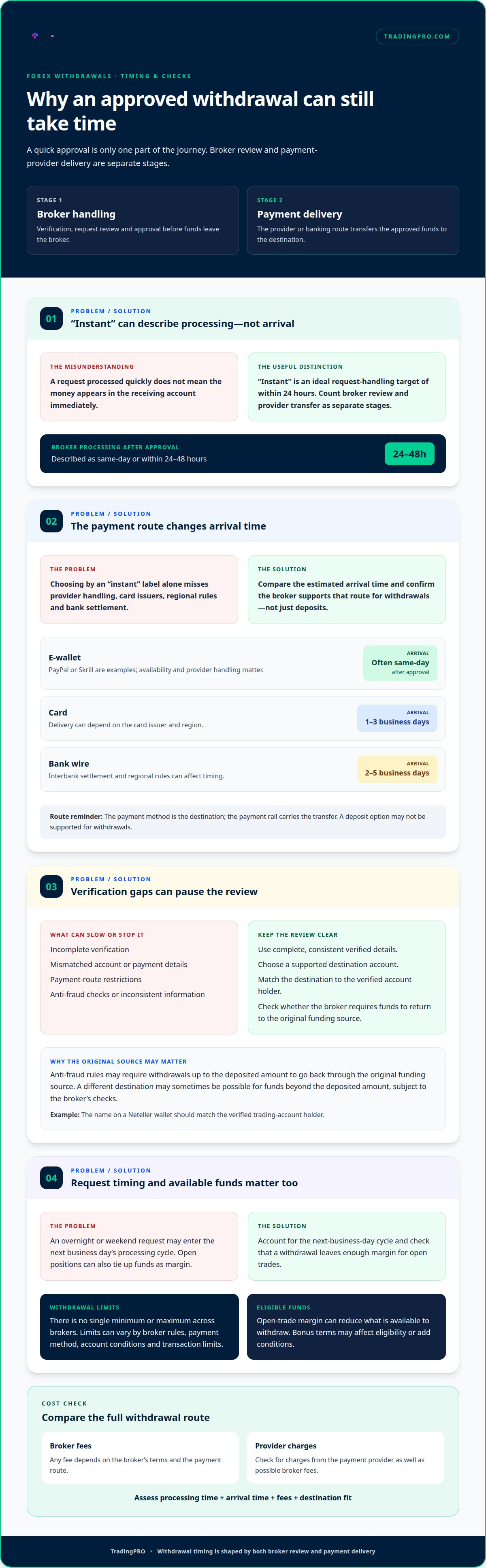
Broker processing times versus payment-provider arrival times
A withdrawal has two clocks: broker processing and payment-provider delivery. The first ends when the broker approves and sends the funds; the second ends when the receiving account is credited.
Broker processing and transfer delivery
Broker processing is the review and release stage. Once a request is approved, processing is described as same-day or 24-48 hours. That timing doesn’t mean your bank or wallet has received the funds. Approval marks the handoff, not the final arrival.
Payment providers then move the transfer through their own systems. For example, a PayPal or Skrill withdrawal made during trading hours might arrive in 30-60 minutes. That example describes provider delivery after release, not the broker’s approval time. Keep the two stages separate when estimating the full wait.
| Payment route | Broker stage | Provider arrival | Main timing factor |
|---|---|---|---|
| PayPal or Skrill | Same-day or 24-48 hours after approval | 30-60 minutes example during trading hours | Provider transfer |
| Bank wire | Same-day or 24-48 hours after approval | Typically 2-5 business days | Interbank settlement and regional rules |
A bank wire typically takes 2-5 business days because interbank settlement and regional rules affect delivery. This longer arrival stage doesn’t necessarily mean the broker held the withdrawal longer. Track the broker’s release separately from the bank transfer’s progress.
Request timing also matters. A withdrawal submitted overnight or during a weekend may be processed the next business day. That shifts the start of broker processing; the payment-provider transfer follows afterward. Trading hours matter in the PayPal and Skrill example because the stated 30-60 minutes relates to requests made during those hours.
Keep trading activity separate from transfer timing. An active position or leverage may affect the funds available to withdraw, but neither indicates how quickly a payment rail delivers approved funds. Trade execution and withdrawal execution are different events: one opens or closes a market position, while the other releases account funds.
Charges are another separate factor. A provider charge may reduce the amount received, but it does not explain time spent in broker review or bank settlement. Compare costs separately from processing and arrival estimates.
- Mark the request time: note whether it was submitted during trading hours, overnight, or on a weekend.
- Record approval: identify when broker processing ends.
- Follow delivery: measure provider arrival from the release point.
Use these stages to pinpoint where a delay occurs, rather than treating the entire wait as one processing time.
How does a forex broker process a withdrawal request?
A withdrawal request moves through review, approval, release, and payment delivery. Each stage has a distinct role, so a delay at one point does not automatically mean the entire request has stopped.
- Request submission: The trader selects a withdrawal amount and supported payment route, then submits the request through the broker’s account system. The selected destination matters because the broker needs to route approved funds correctly. An incomplete request or incorrect payment detail can hold up the next stage.
- Account and payment review: The broker checks the request against the verified trading account and destination details. KYC and AML checks may be part of this review. The broker may also apply anti-fraud rules, including returning withdrawals up to the deposited amount to the original funding source.
- Available balance assessment: The requested amount is considered alongside funds committed to open positions. Margin requirements can limit the amount available while trades remain active. A request exceeding the withdrawable balance may need adjustment before it can proceed.
- Approval and release: Once the checks are complete, the broker approves the request and sends the payment through the selected route. Broker processing is described as same-day or 24-48 hours after approval. That is the broker’s stage, not a promise that the receiving account is already credited.
- Provider delivery: After release, the payment provider or bank completes the transfer. A PayPal or Skrill payment during trading hours might arrive in 30-60 minutes, while bank wires typically take 2-5 business days. The payment route determines this later stage.
The timing of a request can affect when its review begins. A request submitted overnight or at the weekend may be processed on the next business day. The sequence remains the same, but the broker’s review starts later than it would for a request received during its normal processing cycle.
If a request is delayed, identify the latest stage it has completed. Pending verification points to account review; an approved request may already be with the payment provider. For example, a bank wire still moving through interbank settlement is different from a request awaiting broker approval.
Keep the request details consistent: account holder, destination, payment route, and amount. This gives the broker a clear record to review and helps distinguish a verification hold from transfer time. It also keeps provider charges separate from the broker’s processing stage.
Ready to set up an account for trading? Register for a trading account and review the account details before submitting a withdrawal.
TradingPRO
TradingPRO offers account options for different trading styles, making it a natural next step after comparing withdrawal methods, processing stages, and possible charges. Its Rookie, Micro, Pro, and Scalp Accounts provide distinct trading environments. Consider how your preferred approach fits before choosing an account.
Use this guide’s withdrawal criteria when reviewing your trading setup: distinguish broker processing from payment arrival, understand verification requirements, and account for possible payment-route costs. TradingPRO’s Social Trading and Copy Trading options may also suit traders who want to follow other strategies rather than manage every decision independently.
If you’d like to discuss which trading approach fits your needs, contact TradingPRO.
Make your next trading decision with clarity
Build a withdrawal plan into your trading routine before opening your next position. Consider how payout choices fit your broader approach, including how you prefer to manage account activity and funds. This makes the forex broker withdrawal process part of a considered trading setup, rather than an afterthought.
TradingPRO offers Rookie, Micro, and Pro Accounts to consider alongside your trading style. Focus on the setup that fits your goals, then apply the same deliberate approach to future decisions.
Ready to take the next step? Contact TradingPRO for help and explore an account path that suits your approach. Move forward with a clear plan and confidence in your next decision.
Frequently Asked Questions
Are there any fees associated with instant withdrawals?
Yes, a broker or payment provider may charge for a withdrawal, depending on the route and account terms. Currency conversion can also affect the amount that reaches the destination. For example, a withdrawal sent in a different currency from the receiving account may involve conversion. Review the transaction details and distinguish withdrawal charges from trading costs such as spreads.
Are Instant Withdrawals safe and secure?
“Instant” describes speed, not a separate security standard. Brokers may review account identity, payment details, and the requested destination before releasing funds. Use a payment account in your own name and keep access credentials private. These steps can support a safer transaction, but no label guarantees payment security or prevents every account or provider issue.
Can profits be withdrawn anytime?
Not necessarily. The amount available may depend on whether profits are realized, whether funds support open positions, and any applicable account conditions. For example, profit on an open trade may not be available in the same way as funds from a closed position. Check the available balance and relevant terms before submitting a request, especially if you are still trading.
Is money safe during the withdrawal process?
A withdrawal passes through broker review and then a payment route, so its status can change between stages. Keep the request confirmation and note whether it is pending, approved, or released. If the receiving account has not been credited, identify whether the broker has sent the funds or the payment provider is still processing them. Avoid sharing account credentials in response to unsolicited messages.
What are the typical payment options for instant withdrawals?
E-wallets are a common option for faster payouts, with services such as PayPal and Skrill as examples. Cards may also be available, though arrival times can differ. Options depend on the broker, account, and region. Make sure the destination wallet or card belongs to you and can receive the withdrawal currency.
What withdrawal methods are supported?
Common withdrawal routes include e-wallets, cards, and bank wires. The exact choices depend on the broker’s supported methods and your account circumstances, so there is no universal list. A method used for a deposit may not be available for every payout. Consider whether the route reaches your intended destination and whether its currency and account details match your withdrawal.
How long do forex broker withdrawals take by method?
Broker processing is described as same-day or 24-48 hours after approval. E-wallets often arrive the same day once approved; cards commonly take 1-3 business days, and bank wires typically take 2-5 business days. These are different stages: approval doesn’t mean the receiving account is credited. Weekends and regional settlement can affect when a transfer moves or appears.
What fees do forex brokers charge for withdrawals?
There is no single withdrawal fee across all brokers or methods. A broker may charge for handling a request, while a bank, card issuer, or e-wallet may apply separate charges. Currency conversion can also affect the final amount. Compare broker fees with provider costs for the same route, and keep withdrawal charges separate from trading costs.


