




- Published on: 2026-08-15 10:37:37
Fixed vs Variable Spread Broker: The 2026 Performance Comparison Guide

The tightest spread on your screen is a liability if your broker's infrastructure can't deliver it during a volatility spike. High-performance trading demands more than just low numbers. It requires a strategic choice between a fixed vs variable spread broker that aligns with your specific execution needs. You're here because you're tired of slippage eating your margins and hidden commissions eroding your edge. You've earned your seat at the table; now ensure your setup doesn't hold you back.
You know that inconsistent execution is the silent killer of even the most robust strategies. This 2026 performance guide promises to strip away the confusion and provide a definitive framework for choosing a tier that optimizes your costs. We'll analyze the raw data on EUR/USD spreads, compare the all-in costs of our Rookie and Scalp accounts, and reveal how to secure the institutional-grade precision your capital deserves. Move beyond the guesswork and master the mechanics of your trading environment today.
Key Takeaways
- Understand how spread mechanics dictate your immediate entry costs and why fixed models provide essential stability when market liquidity fluctuates.
- Navigate the critical performance gap between a fixed vs variable spread broker to ensure your infrastructure matches your specific risk appetite.
- Identify the "Total Cost of Trade" by factoring in slippage and commissions that often lurk beneath advertised zero-spread rates.
- Align your account tier with your strategy, utilizing the Rookie account for cost certainty or the Scalp account for raw, high-speed execution.
- Implement a professional decision framework to audit your historical performance and refine your broker setup for 2026 market conditions.
Fixed vs Variable Spreads: Decoding the Mechanics
The spread isn't just a number on your screen. It's the immediate cost of market entry. Every trade you execute starts in a deficit; your first objective is always to bridge that gap. Mastering Bid-Ask Spread Mechanics is fundamental to achieving institutional-grade performance. In 2026, the choice between a fixed vs variable spread broker has become a strategic pivot point for serious traders. High-frequency environments and increased market volatility mean that understanding how these costs are calculated is no longer optional. It's the difference between a profitable edge and a depleted balance.
Market conditions in 2026 demand absolute transparency. As global liquidity shifts and digital infrastructure evolves under new regulatory standards, your broker's spread model dictates your resilience. You're not just choosing a price; you're choosing the underlying engine that powers your execution.
The Fixed Spread Model: Predictable Power
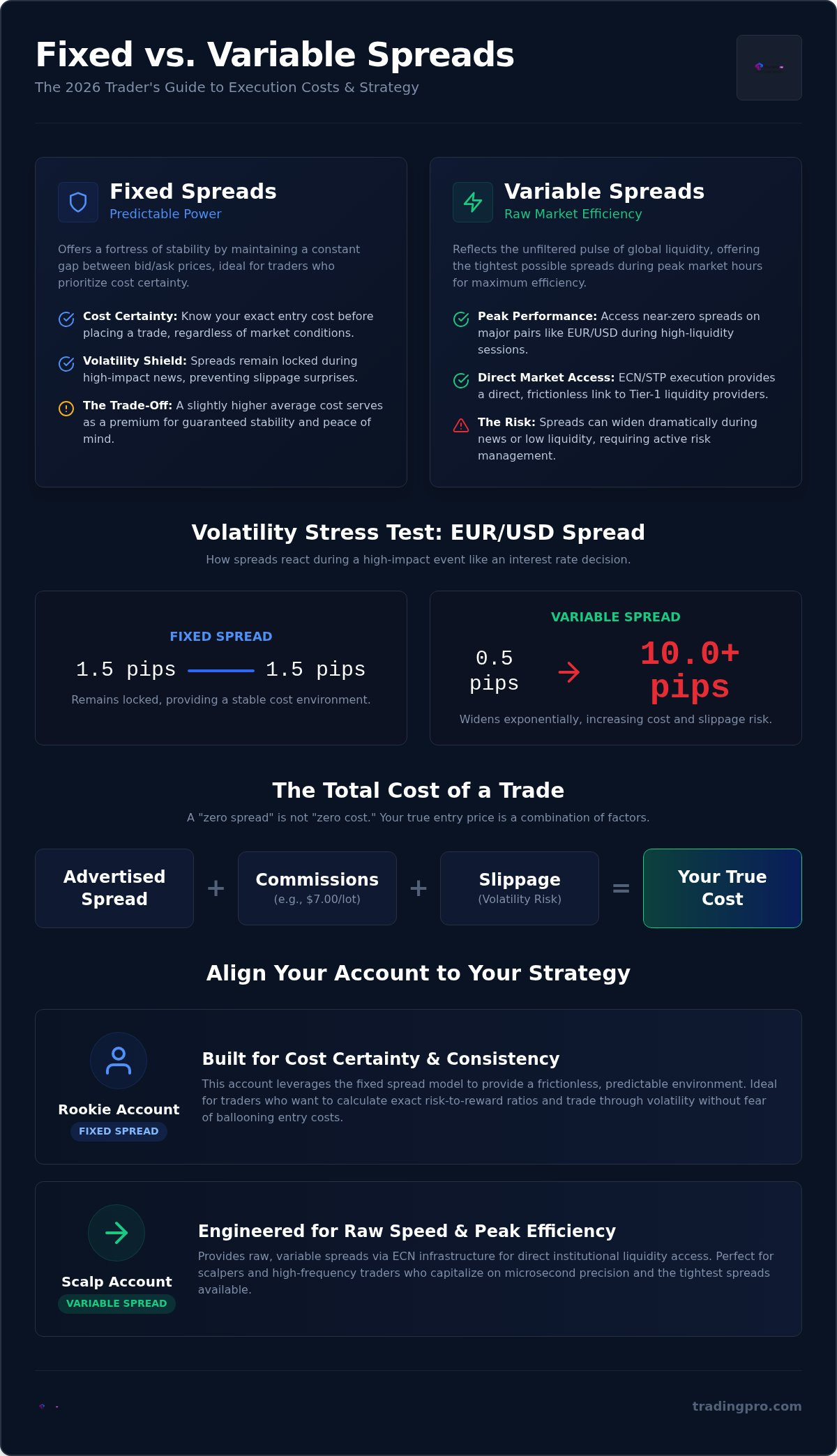
Fixed spreads offer a fortress of stability in a chaotic market. Under this model, the broker acts as a market maker, maintaining a constant gap between the bid and ask prices regardless of external liquidity shocks. This infrastructure is designed for traders who prioritize cost certainty. When high-impact news breaks, most variable spreads widen exponentially. Fixed spreads remain locked. This provides a critical safety net for budget-conscious professionals who need to calculate their exact risk-to-reward ratio before the order is even placed.
The trade-off is straightforward. You pay a slightly higher average cost for this total peace of mind. It's a premium for protection against the unknown. Our Rookie Account leverages this model to empower those who demand a frictionless, predictable environment where "slippage surprises" are a thing of the past. You gain the confidence to trade through volatility without the fear of your entry costs ballooning when the market moves fast.
The Variable Spread Model: Raw Market Efficiency
Variable spreads reflect the unfiltered pulse of the global financial system. These prices fluctuate in real-time, driven by Tier-1 liquidity providers through ECN or STP execution models. During peak sessions in London and New York, liquidity is massive. This causes spreads to compress to near-zero on major pairs like EUR/USD. This environment is built for the elite. It rewards those with the precision to time their entries when the market is at its tightest.
Raw Spreads are the direct, frictionless link to institutional liquidity without any markups from the broker. This model is high-octane and requires a proactive mindset. While you can capitalize on incredibly low costs during calm periods, you must be prepared for spreads to widen instantly during black swan events or low-liquidity gaps. For those demanding peak efficiency, our Scalp Account provides the raw variable infrastructure needed to dominate the charts with microsecond precision.
Performance Comparison: Cost vs. Consistency
Your bottom line cares about the total cost of trade, not just the advertised spread. In 2026, execution technology has evolved to provide microsecond fills, but the choice between a fixed vs variable spread broker still determines how much of your profit stays in your pocket. You must account for slippage, commissions, and the reliability of your entry price during high-impact events. A low spread is meaningless if you can't get filled at that price when the market moves. Relying on raw data is the only way to protect your margins and maintain a competitive edge.
Volatility Handling: Fixed vs. Variable
Market volatility is the ultimate stress test for any infrastructure. During central bank interest rate decisions, variable spreads on EUR/USD can widen from 0.5 pips to 10.0 pips in a heartbeat. This expansion often triggers stop-losses prematurely. It's a risk that can derail a well-planned strategy. Fixed spread models provide a shield against this chaos. By maintaining a consistent gap, they offer the reliability needed to navigate news cycles without the fear of artificial price gaps. While variable accounts often boast faster execution speeds due to direct ECN routing, the trade-off is the risk of extreme widening. Institutional-grade setups prioritize stability to ensure your strategy remains intact during black swan events.
The Hidden Costs: Commissions and Re-quotes
Don't be fooled by "Zero Spread" marketing. In 2026, most raw accounts charge a commission, often around $3.50 per side, totaling $7.00 per standard lot round-trip. This is a fixed cost you must add to the variable spread to calculate your true entry price. Conversely, fixed spread models can suffer from re-quotes. When the market moves too fast, the broker might not honor the fixed price, leading to a missed entry. Fractional pips also play a role; even a 0.1 pip difference impacts high-frequency strategies significantly over thousands of trades.
Understanding these mechanics is a core part of professional risk management. The CFTC Forex Consumer Advisory highlights the importance of recognizing these operational risks before committing capital. If you demand elite precision, you need an infrastructure that matches your ambition. It's time to stop settling for inconsistent fills and start trading with a partner that values your execution speed. You can audit our execution benchmarks by opening a professional profile today to see how precision impacts your results.
Strategy Alignment: Which Account Fits Your Style?
Selecting a fixed vs variable spread broker isn't a binary choice between "cheap" and "expensive." It's a strategic decision that determines whether your strategy survives the friction of the market. High-frequency traders and long-term investors have fundamentally different infrastructure requirements. If you're entering the market fifty times a day, a fraction of a pip is the difference between a winning month and a losing one. Conversely, if you're holding positions for weeks, entry precision is secondary to long-term stability. You need to align your account type with your operational frequency to maximize your trading edge.
Your execution style dictates your cost structure. Passive traders who avoid high-volatility news events might find comfort in the predictability of fixed costs. Active professionals who demand the lowest possible friction will always gravitate toward raw market access. In 2026, the gap between retail and institutional tools has closed, but the responsibility to choose the right environment remains yours. Don't let a mismatch in infrastructure become the reason your strategy fails to scale.
Scalping and High-Frequency Execution
Scalpers live and die by the spread. Every millisecond counts. Our Scalp Account is engineered for this high-octane environment, offering raw variable spreads that mirror institutional liquidity. In 2026, execution speed benchmarks are tighter than ever, and variable models allow you to enter when spreads compress to near-zero during the London-New York overlap. This is where your profit margin is built. However, you must stay vigilant. Trading during low-liquidity sessions, such as the "dead zone" after the New York close, can lead to a "spread trap" where variable costs balloon. Precision requires discipline and the right tech stack to avoid these liquidity gaps.
Social Trading and Portfolio Replication
The most overlooked factor in spread selection is its impact on copy trading. If you're mirroring a "Master" trader, your infrastructure must synchronize with theirs to avoid performance drift. A 0.5 pip difference at entry might seem small, but it compounds over a portfolio of hundreds of replicated trades. This is why Mastering the Social Feed: How to Choose a Trader to Copy is essential for anyone looking to build a passive income stream.
For many followers, fixed spreads provide a more stable environment for replication. They eliminate the variance caused by market-driven spread widening, ensuring your returns closely track the original strategy. Use the Trade Hub to monitor real-time execution and verify that your costs aren't eroding your mirrored profits. Consistency is the foundation of institutional success. You should never let infrastructure gaps undermine your portfolio's growth.
Decision Framework: Choosing Your 2026 Broker Infrastructure
Success in 2026 isn't about luck. It's about engineering. You need a tactical framework to decide between a fixed vs variable spread broker based on your unique trading DNA. Stop chasing the lowest advertised rate and start analyzing the infrastructure that supports your specific execution style. Most traders fail because they use a scalp-heavy strategy on a fixed-cost account, or vice versa. Follow this five-step audit to secure your edge and eliminate unnecessary friction from your operations.
- Audit Frequency: Review your last 100 trades. High-frequency strategies require the raw compression of variable spreads to remain profitable over the long term.
- Stress Test: Open a Demo Account and execute during NFP or central bank interest rate decisions. Observe how your chosen model handles the sudden surge in volume.
- Run the Math: Calculate your "all-in" cost. Factor in the round-turn commission on raw accounts versus the slightly wider fixed spread of standard tiers.
- Verify Liquidity: Ensure your broker connects to multiple Tier-1 providers. This depth prevents massive price gaps during session transitions and protects your entry points.
- Match Your Ambition: Align your capital with the account tier that provides the specific tools needed for your current stage of growth.
Analyzing Your Trading DNA
Are you a news-driven "Rookie" or a technical "Pro"? Your style dictates your spread preference. If you trade volatile commodities or focus on news events, fixed spreads can prevent stop-out hunts during sudden price spikes. For major forex pairs during peak sessions, variable spreads offer peak efficiency. Use our Forex Profit Calculator to model different spread scenarios. Seeing the numbers in black and white eliminates emotional guesswork. It empowers you to choose the account that protects your margins while facilitating aggressive growth. Don't let a mismatch in asset choice and spread model erode your capital.
Infrastructure Checklist for 2026
Your setup must be bulletproof. In 2026, regulatory focus on digital resilience means your broker's tech stack is as important as their pricing. Verify Tier-1 liquidity access to ensure deep order books and consistent fills. Test your execution latency from your specific region; every millisecond matters for precision. Finally, ensure your mobile-first compatibility is seamless. You need the power to monitor spreads and manage risk from anywhere in the world. Dominance requires a frictionless experience across all devices. Register your professional account now to access our elite 2026 infrastructure and start trading with institutional precision.
TradingPRO: Empowering Your Edge with Multi-Tier Precision
TradingPRO delivers an institutional-grade environment that levels the playing field for retail participants. We don't just offer access; we provide a high-octane infrastructure designed for those who demand peak performance. Choosing between a fixed vs variable spread broker is a critical step in your professional evolution. Our ecosystem is built to support that journey with precision-engineered account tiers that reflect our status as a global leader. You need a partner that understands the stakes and provides the stability of a safe-haven while maintaining the agility of a tech-forward innovator.
Our Rookie Account is the perfect starting point for those who prioritize predictable costs. It eliminates the anxiety of widening spreads during news cycles, allowing you to focus on strategy rather than market noise. Conversely, the Scalp Account is the choice of the modern professional. It offers raw variable spreads and lightning-fast execution for high-frequency strategies. To accelerate your growth, you can leverage our Deposit Bonus to maximize your margin and take larger positions with confidence. Read more about our specialized support in our guide on the Best Broker for Rookie Traders: Dominate the Markets in 2026.
From Rookie to Pro: A Scalable Journey
Success requires a mindset that evolves with the market. Many of our most successful clients start with a Micro account to master variable spread psychology without overexposing their capital. It's a training ground for the high-stakes environment of the professional tiers. As your strategy matures, moving to the Pro tier provides institutional execution and significantly tighter margins. This seamless transition ensures your infrastructure never bottlenecks your ambition. You can scale your operations at your own pace, knowing our backend is optimized for every level of volume and speed.
The Social Trading Advantage
Our technology ensures that spreads are synchronized across the entire network, protecting your mirrored returns from unnecessary slippage. The Copy Trading ecosystem is a frictionless bridge to professional results. It allows you to replicate the precision of elite performers while you refine your own edge. Maintaining this level of synchronization is vital for long-term portfolio growth. Don't let inferior tech undermine your potential. It's time to align yourself with a global leader that prioritizes your success and values your time. Register Now to select your ideal infrastructure and start trading with the precision your capital deserves.
Master Your Execution in 2026
Your success depends on the infrastructure you choose today. We've decoded the mechanics and analyzed the performance gaps that define a fixed vs variable spread broker. You now have the framework to audit your strategy and align it with the correct cost model. Whether you demand the predictability of fixed costs or the raw efficiency of institutional liquidity, your setup must be bulletproof. Precision isn't just a goal; it's the baseline for survival in a high-octane environment.
TradingPRO provides the tools you need to excel. Our multi-tier account infrastructure and institutional-grade execution speed ensure you're never held back by technical friction. You can also leverage our global Social Trading network to replicate elite results while you scale your own edge. The path to dominance is clear. Don't let indecision erode your margins. It's time to take control of your execution and join a community of high-performance professionals.
Join the Elite: Open Your TradingPRO Account Today and secure your future in the global markets. Success is waiting for those bold enough to claim it.
Frequently Asked Questions
Is a fixed spread broker better for beginners?
A fixed spread broker is often the superior choice for beginners because it provides total cost predictability. By locking in the spread, you eliminate the stress of fluctuating prices during market entry. This stability allows new traders to calculate risk-to-reward ratios with absolute precision before committing capital. Our Rookie Account is specifically designed to offer this "safe-haven" feel, ensuring you focus on mastering strategy without worrying about sudden liquidity shifts.
Do variable spreads widen during major news events?
Variable spreads definitely widen during major news events like NFP or central bank interest rate announcements. When market liquidity drops or volatility spikes, the gap between the bid and ask price expands to reflect real-time risk. For example, EUR/USD spreads can jump significantly from their 0.5 pip average. If you trade during these high-impact windows, a fixed vs variable spread broker comparison becomes vital to protect your stop-losses from artificial triggers.
Which account type is best for scalping strategies?
The Scalp Account is the premier choice for high-frequency scalping strategies. It utilizes a variable spread model to provide the tightest possible pricing during peak market hours. Scalpers require microsecond execution and raw market access to capture small price movements effectively. By using a variable model, you benefit from spreads that often compress to near-zero during the London and New York sessions, maximizing your profit potential on every trade you execute.
Can I switch from a fixed to a variable spread account later?
You can switch between account types seamlessly as your trading strategy evolves. We've built a multi-tier infrastructure that allows you to move from the predictable Rookie Account to the high-performance Scalp Account. This flexibility ensures your broker environment always matches your current level of expertise and capital. Simply access your dashboard to adjust your settings and transition to the infrastructure that best supports your next phase of aggressive market growth.
Are there hidden commissions in fixed spread accounts?
There are no hidden commissions in our fixed spread accounts; the cost is entirely built into the spread itself. This "all-in" pricing model simplifies your bookkeeping and ensures you know exactly what you're paying before you hit the buy or sell button. While the spread might be slightly wider than a raw account, the absence of per-lot commissions makes it an efficient and transparent choice for many retail professionals who value simplicity.
How do spreads affect my copy trading results?
Spreads directly impact your copy trading results by creating "performance drift" between your account and the Master trader. If your spread is wider than the strategy you're mirroring, your entry and exit prices will be less favorable. This friction compounds over hundreds of trades, potentially eroding your returns significantly. Utilizing our synchronized Social Trading network ensures your infrastructure matches the Master, maintaining the precision needed for consistent and scalable portfolio growth.
What is a "Raw Spread" and who should use it?
A Raw Spread is a direct price feed from institutional liquidity providers without any broker markup. It's designed for elite professionals and high-frequency traders who prioritize the lowest possible entry costs. These spreads can reach 0.0 pips on major pairs but typically involve a small commission per lot. If you demand peak execution speed and have a strategy that scales with high volume, the Raw Spread model is your ultimate tactical tool.
Does TradingPRO offer negative balance protection on all accounts?
Yes, we provide negative balance protection across our entire multi-tier account infrastructure. This institutional-grade safeguard ensures you can never lose more than your initial deposit, even during extreme black swan events. It acts as a critical safety net for your capital, allowing you to pursue ambitious goals with the confidence that your personal finances are protected. We prioritize your security as much as your performance in every market condition.


