




- Published on: 2026-08-07 05:47:52
Common Trading Mistakes: 2026 Survival Guide

Statistics show that up to 90% of retail traders fail; yet the 2026 elimination of the Pattern Day Trader rule has unleashed a new wave of ambitious investors into a high-stakes arena. If you've experienced the gut-punch of a rapid account drawdown or the mental drain of revenge trading, you aren't alone. It's easy to feel paralyzed by information overload or blinded by the lure of high leverage. Elite performance isn't about avoiding every error; it's about building a frictionless infrastructure where common trading mistakes for beginners don't lead to total extinction.
You're here because you want more than just survival. You demand consistency and capital preservation. This survival guide provides the definitive blueprint to identify and eliminate the psychological and technical blunders that drain rookie accounts. We'll show you how to leverage institutional-grade tools and social trading insights to build a foundation that scales. From navigating the new 2026 tax reporting requirements to refining your execution speed, this is your clear path from rookie status to professional-grade dominance. Let's turn your volatility into a calculated advantage.
Key Takeaways
- Identify the psychological triggers of the "90-Day Trap" to avoid the early capital drain that claims 90% of new participants.
- Master risk management by identifying and eliminating common trading mistakes for beginners, such as over-leveraging and trading without a stop-loss.
- Neutralize emotional sabotage by purging FOMO and revenge trading from your routine to ensure consistent, professional-grade execution.
- Construct a bulletproof 2026 trading plan that defines your specific market edge and non-negotiable exit protocols.
- Accelerate your growth using the high-speed infrastructure and social trading insights of the TradingPRO Rookie Account.
The 90-Day Trap: Why Most Beginners Stumble Early
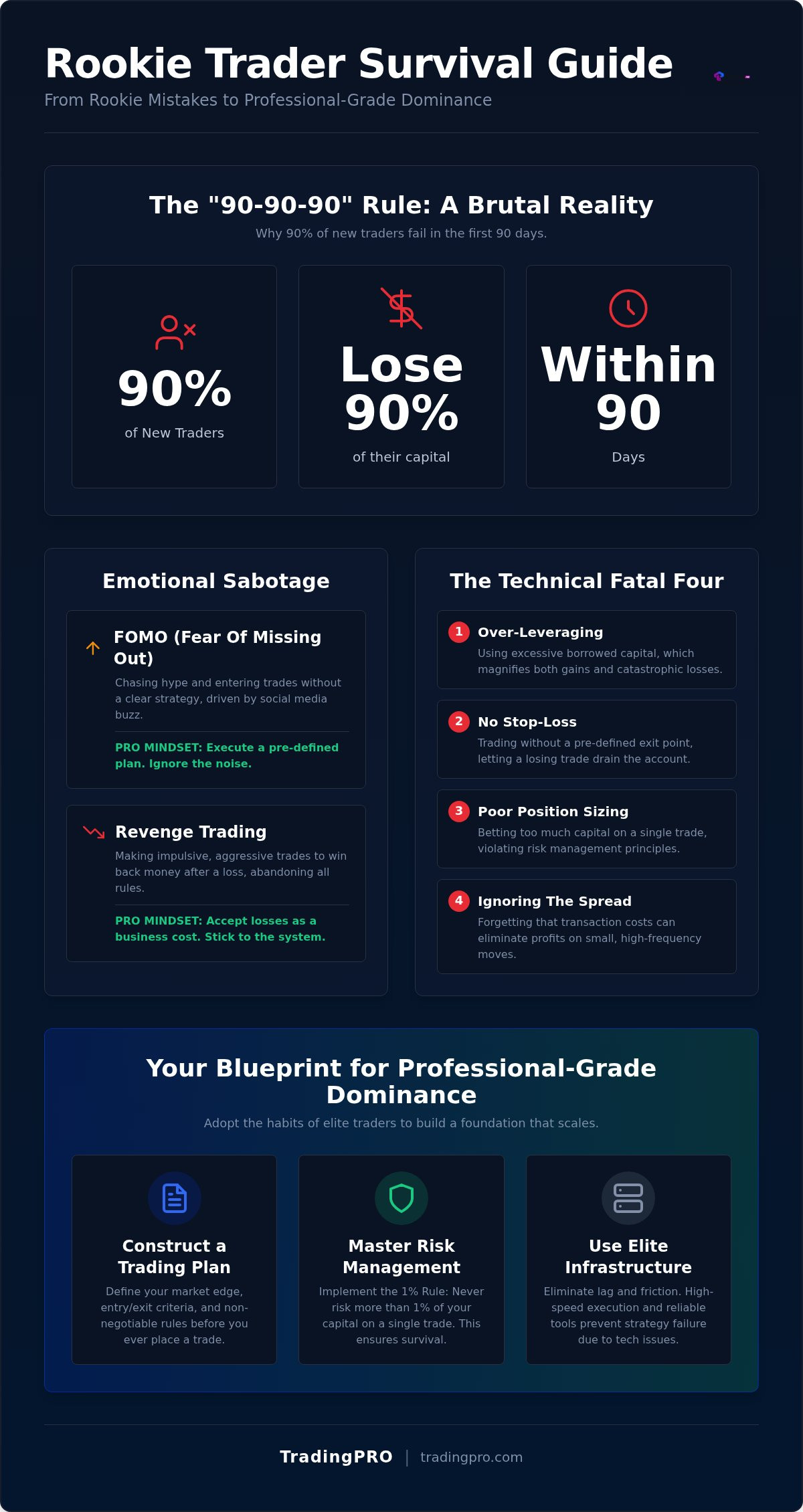
The industry calls it the "90-90-90" rule. It's a brutal reality where 90% of traders lose 90% of their capital in just 90 days. This isn't a coincidence; it's a systematic filtration of those who lack discipline and professional infrastructure. Most rookies enter the market with a "demo dopamine" high. They've seen green numbers in a risk-free simulator and expect the same results in live markets. But the moment real capital is at stake, the psychology of investor behavior takes over. Anxiety replaces logic. Fear drives decisions. This is exactly where common trading mistakes for beginners turn into account-killing disasters.
With the 2026 elimination of the Pattern Day Trader rule, the barriers to entry have vanished, but the risks have intensified. Institutional Stability is the missing piece for most retail participants. You're competing against high-frequency algorithms and seasoned pros. If you're using retail-grade tools to fight institutional-grade battles, you've already lost. Survival requires a safe-haven approach that prioritizes security and high-speed execution. You need an environment that minimizes friction while you build your expertise.
The Illusion of Easy Gains
Social media has weaponized the "lifestyle" trader image. It suggests that wealth is just a few taps away on a smartphone. This creates a gambling mindset rather than a professional one. Trading is about precision, not luck. You must treat every position like a surgical strike. Precision requires a deep understanding of market mechanics and a refusal to chase hype. If you're still grasping the basics, the Forex Trading for Beginners Guide provides the foundational knowledge you need to stop guessing and start executing. Master the multi-asset landscape with a focus on consistency, not just the next big win. Your goal is long-term dominance, not a one-hit wonder.
Infrastructure Failure vs. Strategy Failure
You can have the best strategy in the world, but it won't save you from a slow execution speed. In the fast-moving 2026 market, a few milliseconds of lag can turn a profitable entry into a losing trade. This is what we call "friction." High-performance environments are designed to eliminate these technical bottlenecks. When you trade in a frictionless ecosystem, you remove the hidden variables that cause strategy failure. Don't let a poor connection or platform lag be the reason your account draws down. Visit the TradingPRO Blog to learn how to optimize your setup and stay ahead of market shifts. Success is built on a foundation of reliability and elite technical support.
The Technical Fatal Four: Mismanaging Leverage and Risk
Technical proficiency is the armor that protects your capital from market volatility. While psychological discipline sets the stage, technical mismanagement pulls the trigger on account failure. In the 2026 market, where U.S. margin debt surged by 38.7% year-over-year as of March, understanding the mechanics of your trade is non-negotiable. Many common trading mistakes for beginners stem from a fundamental misunderstanding of how high-performance infrastructure actually functions. If you don't respect the math, the market won't respect your account.
Leverage: The Power and the Peril
Leverage is a high-octane tool designed for rapid growth, but it demands absolute respect. Within a Rookie Account, you gain access to significant buying power that can accelerate your path to "Pro" status. However, this is a double-edged sword. Utilizing 1:500 or 1:1000 leverage requires surgical precision because every price fluctuation is magnified. A small pip movement against your position can rapidly deplete your margin. A Margin Call is the definitive signal that your equity has fallen below the required level to maintain open positions, effectively terminating your market participation to prevent further loss.
Beyond leverage, the "Fatal Four" includes the "No Stop-Loss" sin. Hope is not a trading strategy. Entering a position without a hard exit point is simply gambling with your future. Position sizing errors are equally destructive. Betting the house on a single "sure thing" ignores the reality of market randomness. Finally, rookies often ignore the spread. In high-stakes environments, high-frequency moves can be completely eaten by transaction costs if you aren't accounting for the gap between the bid and ask price.
Risk Management as a Competitive Edge
Elite traders treat risk management as their primary competitive advantage. You should adopt the 1% Rule: never risk more than 1% of your total account balance on any single trade. This protocol ensures that even a string of losses cannot threaten your account's existence. Precision is vital here. Use the Trade Hub to calculate your risk-reward ratios in seconds before you commit capital. This tool provides the institutional-grade data required to make decisive moves under pressure.
Security remains your safe-haven in a volatile landscape. Our infrastructure includes Negative Balance Protection, ensuring you never lose more than your initial deposit. This safety net allows you to pursue ambitious goals with the confidence that your downside is capped. When you're ready to trade with institutional stability, secure your professional-grade account and start executing with precision. Consistent success is built on ironclad risk protocols and frictionless execution.
Emotional Sabotage: Overcoming FOMO and Revenge Trading
The market is a mirror. It reflects your impatience, your greed, and your fear back at you with brutal clarity. Psychological discipline is the ultimate separator between those who scale and those who stall. Emotional sabotage is among the most common trading mistakes for beginners, often manifesting as FOMO, the Fear Of Missing Out. When you see a green candle surging on a 5-minute chart, the impulse is to jump in. But chasing price usually leads to buying the top right before a reversal. You aren't participating in a move; you're becoming the liquidity for the pros who are already exiting.
Revenge trading is the ultimate account killer. It's a purely emotional response to a financial sting. You lose a trade, your ego takes a hit, and you immediately try to "punish" the market by doubling down to win it back. This is where common trading mistakes for beginners become fatal. You abandon your risk management protocols. You ignore the 1% rule. Suddenly, you're overtrading, scratching an "itch" to be active rather than being effective. You start suffering from confirmation bias, filtering out bearish signals because you're desperately long. This isn't trading. It's a frantic scramble for survival that usually ends in extinction.
In light of these high failure rates, some traders look for alternative ways to master their discipline; exploring platforms like Reverse Trading and their Simulated Trading Challenge Entry Fees can provide a unique perspective on managing the psychological pressure of market participation.
The Psychology of the Winning Mentor
Elite trading is a high-octane hunt, not a frantic scramble. You wait for the perfect alignment of factors before you strike with precision. This requires a "Safe-Haven" mindset. You stay calm when volatility peaks because your plan is already set. You don't react to the market; you respond to your protocols. Success is found in the silence between the trades, where discipline outweighs the urge for action. To see how professionals maintain this level of grounded execution, explore the Best Broker for Rookie Traders. You must value your capital more than your need to be right.
Automating Discipline through Copy Trading
If the emotional burden feels too heavy, leverage the power of automation. Copy trading allows you to follow the lead of seasoned experts who have already mastered the psychological game. It removes the hesitation and the panic that often plague newcomers during high-volatility events. By observing the Social Trading Feed, you can witness disciplined execution in real-time. This institutional-grade ecosystem provides a buffer against rookie panic. You aren't just copying trades; you're absorbing a professional-grade methodology. Let the infrastructure handle the discipline while you focus on scaling your vision and preserving your mental energy.
Building a Bulletproof Trading Plan for 2026
Elite trading is an architectural feat. You don't build success on a whim; you engineer it through a bulletproof trading plan. In the 2026 landscape, volatility is your fuel, but only if you have the engine to process it. Identifying common trading mistakes for beginners is only half the battle; the other half is building the walls that keep those mistakes out. Your plan is the non-negotiable contract you sign with yourself before the opening bell. It's the difference between a professional operation and an expensive hobby. Avoiding common trading mistakes for beginners requires moving beyond reactive behavior into proactive architecture.
- Step 1: Define Your Edge. Determine your operational tempo. Are you a high-frequency scalper, a daily strategist, or a long-term swing trader? Your edge is where your personality meets market opportunity.
- Step 2: Establish Entry and Exit Protocols. Never click "buy" without knowing exactly where you'll click "sell". A "mental stop-loss" is a lie we tell ourselves to justify staying in a losing trade.
- Step 3: Log Every Move. A trading journal is your most valuable asset. It captures the "why" behind the trade, revealing psychological patterns that raw data misses.
- Step 4: Continuous Optimization. Use Trade Hub tools to review performance metrics. High-performance traders treat their stats like a flight recorder, constantly looking for ways to trim friction and boost efficiency.
Defining Your Trading Style
Your operational style dictates your infrastructure. A ScalpX Account is built for the high-velocity precision of a scalper, requiring razor-sharp execution and low-latency tools. Conversely, the Rookie approach focuses on building a stable, multi-asset foundation. Don't fall into the trap of "everything, everywhere, all at once." Master one asset class first. In 2026, information is infinite, but your focus is finite. Investopedia calls it "homework," and it's the price of admission to the elite tier. This means analyzing AI-driven market sentiment and understanding the 2026 tax implications for your specific assets before you place a single trade.
The Checklist of an Elite Trader
A pro-grade routine starts before the charts even move. Check the economic calendar for high-impact news. Volatility is an opportunity, but unscheduled chaos is a risk. You must know when the big players are entering the room. Apply the "Sleep Test" to every position. If you can't sleep because a trade is open, your position size is a liability, not an asset. Scale back until your logic outweighs your pulse. Precision is always better than size. Consistency is the ultimate superlative. It's the difference between a lucky week and a decade of dominance. When you're ready to transition from hope to high-performance, register for your professional-grade account and start building your legacy with institutional stability.
How the TradingPRO Rookie Ecosystem Minimizes Risk
TradingPRO serves as the ultimate safe haven for those navigating the high-stakes environment of 2026. We've engineered an ecosystem specifically designed to neutralize the common trading mistakes for beginners that lead to account exhaustion. Most brokers offer a generic platform; we provide a high-performance infrastructure tailored to your growth trajectory. By merging institutional-grade tools with a supportive community, we transform the rookie journey from a gamble into a calculated pursuit of excellence. Institutional stability is the foundation of every successful career. While competitors offer empathy, TradingPRO offers a frictionless environment where technical blunders are minimized by the platform itself.
Our multi-asset brokerage, founded in 2017, has perfected the balance between speed and security. We understand that your time is valuable. Every feature in our ecosystem is designed to accelerate your transition from "Rookie" to "Pro" status with maximum efficiency. By removing the technical barriers that often trigger common trading mistakes for beginners, we allow you to focus on what matters: consistent execution and capital preservation. This is the professional-grade support you need to thrive in a volatile landscape.
The Rookie Account Advantage
The Rookie Account is your entry point into elite markets. It eliminates "Extinction Risk" by allowing deposits as low as $1, giving you the space to refine your execution without risking a life-changing sum. You gain access to professional-grade tools that were once reserved for institutional desks, but without the overwhelming complexity. This is about precision and accessibility. Speed is your primary defense. Our high-performance execution eliminates the "Slippage Mistake," ensuring your orders fill at the price you see, not the price the market moves to. When you're ready to secure your edge, visit the Secure Register Page to begin your journey with total confidence.
Copying Success: The Social Trading Safety Net
Don't trade in a vacuum. Social Trading is the ultimate buffer against the emotional sabotage discussed earlier. By identifying "Elite Mentors" on the TradingPRO platform, you can replicate proven strategies while you learn the nuances of the market. This partnership mindset reduces the "Learning Curve" mistake by providing a direct window into real-time pro execution. It's about empowerment through observation. The social trading feed acts as a corrective lens. When you see a mentor wait for a setup rather than chasing FOMO, it reinforces the discipline we outlined in our survival guide. Stay ahead of market shifts by utilizing the TradingPRO blog for ongoing education. We don't just provide a platform; we provide a clear path to professional-grade dominance.
Dominate the 2026 Market Landscape
You've identified the psychological triggers and technical traps that claim most rookie accounts. Success in the 2026 market demands more than just a strategy; it requires an elite foundation. By mastering risk management and automating discipline through social trading, you move from a state of reactive panic to proactive dominance. Every trade is now a calculated move toward long-term consistency. You have the blueprint to eliminate the friction that stalls most journeys.
Our multi-asset infrastructure has delivered global scale and institutional stability since 2017. We secure your ambition with Negative Balance Protection, ensuring your downside is always capped while you pursue significant growth. You now have the tools to eliminate common trading mistakes for beginners and build a legacy of precision. The high-stakes environment of 2026 rewards those who prioritize security and high-speed execution. Don't leave your capital to chance when you can trade with the gravitas of a global leader.
Open Your TradingPRO Rookie Account and Start Trading with Precision
The markets move at the speed of thought. Step into your role as a high-performance trader today and claim the success you've engineered.
Frequently Asked Questions
What is the most common mistake beginners make in Forex trading?
Lack of risk management is the most frequent blunder. Many rookies treat the market as a casino rather than a business, neglecting stop-losses and over-leveraging their positions. This lack of discipline turns potential success into a rapid account drawdown. Addressing these common trading mistakes for beginners requires a shift toward institutional-grade protocols and a refusal to trade without a pre-defined exit strategy.
How much money do I need to start trading without making a 'capital mistake'?
You can start with as little as $1 in a Rookie Account to learn the mechanics without risking significant capital. The real "capital mistake" isn't starting small; it's risking money you can't afford to lose. Precision is more important than the initial deposit size. Starting small allows you to build a professional-grade foundation and master execution before you scale your operations.
Is high leverage always a mistake for a beginner?
High leverage is only a mistake if you lack the surgical precision to manage the increased exposure. While it amplifies buying power, it also magnifies losses. Beginners should use leverage conservatively until they have a proven edge and a deep understanding of margin requirements. Treat leverage as a high-performance tool that requires absolute respect and ironclad risk management protocols to avoid extinction.
How do I stop revenge trading after a big loss?
Stop trading immediately and step away from the charts to neutralize your emotional state. Revenge trading is a purely psychological response that ignores market logic and prioritizes ego over capital. Implement a "max daily loss" rule that dictates when you must close your platform. This creates a safe-haven for your remaining capital and prevents a single loss from becoming a fatal blow.
Why is a trading plan more important than a 'good tip'?
A trading plan provides a repeatable framework for success, whereas a tip is a one-off gamble without a long-term edge. Tips lack context, entry protocols, and exit strategies. A bulletproof plan ensures you react to data, not hype. Consistency is the ultimate superlative in this industry. A professional plan builds that consistency, while chasing tips eventually destroys your account.
Can social trading help me avoid beginner mistakes?
Yes, social trading allows you to replicate the execution of elite mentors who have already conquered common trading mistakes for beginners. You observe professional-grade discipline and strategy in real-time. This partnership mindset reduces the learning curve and provides a buffer against the typical "90-day trap" that claims most retail participants. It is a powerful way to absorb professional methodology while preserving your capital.
What should I do if I hit a margin call?
Liquidate your losing positions or deposit more funds immediately to meet the minimum margin requirements. A margin call is the market's final warning that your equity is insufficient to cover your leverage. Use this as a decisive signal to re-evaluate your risk management and position sizing. Never ignore a margin call; it is the definitive barrier between survival and total account extinction.
How often should I review my trading journal?
Review your trading journal weekly to identify behavioral patterns and technical inefficiencies. Monthly deep dives are also essential for long-term optimization and strategy refinement. Your journal is a flight recorder for your career. If you don't analyze your past moves, you're doomed to repeat the same blunders. Continuous optimization is the only clear path from rookie status to professional dominance.


