




- Published on: 2026-10-04 12:10:50
Choosing a Broker in an Unregulated Country: A 2026 Due-Diligence Guide

A broker’s country label can be reassuring or alarming, but it doesn’t tell you which company will hold your account or what recourse you’ll have. Choosing a broker in an unregulated country means looking beyond the address, the licence number on a website, and headline trading terms. Verify the legal entity named in your account agreement and check any claimed authorisation against the regulator’s official records.
It’s reasonable to weigh attractive spreads or flexible account options against concerns about fund handling, complaints, and withdrawals. But appealing terms aren’t a substitute for safeguards you can verify. If important information is unclear, treat that as a reason to pause.
This guide gives you a practical due-diligence framework. You’ll learn how to identify the entity behind your account, assess client-fund protections and complaint routes, compare costs, and understand withdrawal rules before depositing. You’ll also learn how to distinguish verifiable evidence from sales claims, so you can make a considered decision or walk away when key details don’t add up.
Key Takeaways
- When choosing a broker in an unregulated country, distinguish the country where it operates from the legal entity that will hold your account.
- Use official regulator records to check whether the broker’s company details, website, and claimed authorisation match.
- Compare client-fund arrangements, complaint routes, trading charges, and withdrawal terms in the documents that apply to your account.
- Use a go, pause, or walk-away checklist. Treat mismatched details, unclear terms, or pressure to deposit quickly as reasons to stop.
- After completing your due diligence, review account options such as TradingPRO’s Rookie Account on their stated terms, not as evidence of regulatory protection.
What does choosing a broker in an unregulated country really mean?
Choosing a broker in an unregulated country means assessing a brokerage whose local oversight may be limited, unclear, or different from the authorisation claimed for the company serving you. A jurisdiction is the country whose laws or rules may apply; a legal entity is the company you contract with; and a financial regulator is the authority that supervises certain financial activities. These concepts are related, but they aren’t interchangeable.
The country where a broker operates, its registered office, and the company named in your client agreement can all differ. A brand may use separate legal entities for clients in different regions, so its general website or global reputation won’t necessarily tell you which terms apply to your account. Start with the agreement, then check whether the relevant regulator’s official register lists the named entity and the services it claims to provide.
A country label alone doesn’t prove that a broker is trustworthy or unsuitable. The practical question is what oversight and recourse apply to the exact entity and account relationship. For a basic explanation of the U.S. term, Broker-dealer describes firms that may conduct securities transactions for clients or for their own account within a U.S. regulatory framework. Don’t assume that framework applies to brokers or clients elsewhere.
Country, company, and regulator: why the distinctions matter
Start with the exact company name in the client agreement, not just the brand name or the country shown on a website. Compare that name and any registration details with the relevant regulator’s register. Where available, check that the website domain and contact details also match official records. A licence number displayed by the broker is a claim to verify, not proof by itself. Records and permissions can change, so consult current official information before deciding.
What regulation can and cannot tell you
Authorisation can indicate that an entity is subject to oversight for specified activities. It doesn’t eliminate trading losses, counterparty risk, or every possible dispute. Complaint routes, compensation arrangements, and client-fund protections also vary by jurisdiction and account terms. Check what applies to your residence and the contracting entity, including where a complaint can be raised and what remedies may be available.
That distinction is central to choosing a broker in an unregulated country: assess the relationship documented for your account, not the country label in isolation. If the entity, claimed oversight, or applicable terms remain unclear, pause before comparing costs or trading features.
How to verify a broker’s legal entity and regulatory claims
Use a repeatable process before sharing documents or funding an account. A logo, licence number, or screenshot can be copied, so start with the regulator’s own current records. For 2026, verify the relevant authority and consult its latest information directly. Search tools, public records, and legal interpretations vary by jurisdiction, so treat this as a fact-checking process, not a legal conclusion.
Match the broker’s website to the contracting entity
Start with the account-opening documents and client agreement. Find the full legal name of the company that will contract with you, then compare it with the broker’s website and official company or regulator records. Check registration details, listed address, contact information, and website domain where those details are available. A brand may differ from its legal name, but unexplained mismatches between the brand, domain, and contracting company are a reason to pause.
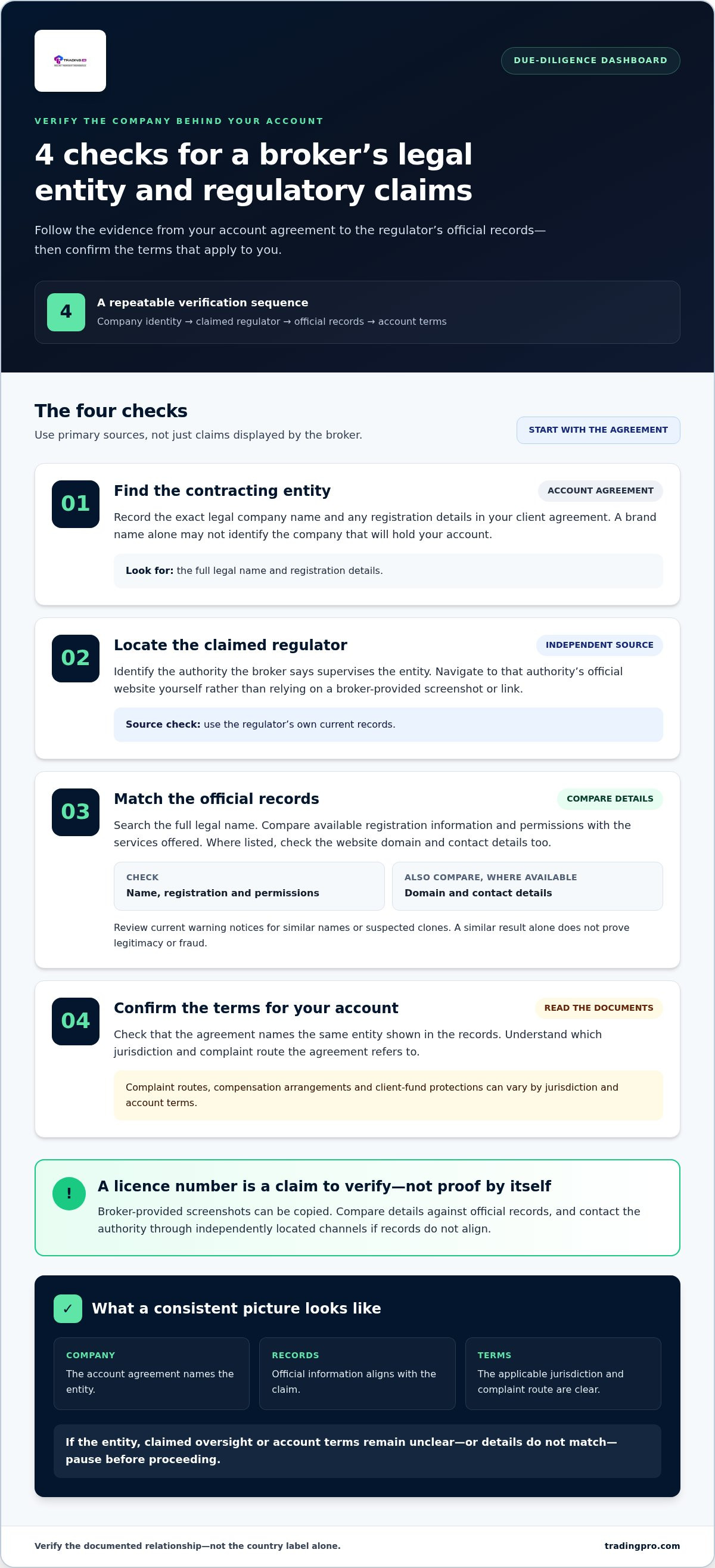
Work through these checks in order:
- 1. Find the entity. Record the exact legal name and registration details in the client agreement.
- 2. Locate its regulator. Identify the authority the broker says supervises the entity, then navigate to that authority’s official website yourself.
- 3. Match the records. Search the exact name and compare available registration information, permissions, domain, and contact details. Don’t rely on a broker-provided screenshot or licence number alone.
- 4. Review the terms. Confirm that the agreement names the same entity and understand which jurisdiction and complaint route it refers to.
Check authorisation through primary sources
Search the relevant regulator’s official register using the full legal name, not only the trading brand. Check whether the listed permissions appear relevant to the services offered, and review current warning notices for similar names or suspected clones. A similar result alone doesn’t prove that a broker is legitimate or fraudulent. Compare the details carefully, and contact the authority through independently located channels if the records don’t align.
For U.S.-related checks, FINRA’s Choosing an Investment Professional guide explains why registration and background checks matter. FINRA BrokerCheck can help with research, while the relevant authority’s own records remain essential for confirming the specific firm and activity. Access and rules differ across jurisdictions, so verify the sources that apply to your residence and contracting entity.
Move forward only when the company identity, official records, and account terms form a consistent picture. Once you’ve completed those checks, you can review the TradingPRO account registration process as a separate step. Account access itself isn’t evidence of regulatory protection.
Compare practical safeguards, costs, and withdrawal terms
Once you’ve identified the contracting entity, compare what its documents actually say with how you expect to trade and access your money. Client-money arrangements, complaint routes, and dispute remedies depend on the entity and the terms that apply to your account. Don’t assume general statements on a broker’s website apply to every client or location.
Written withdrawal rules matter because funding a trading account is not the same as withdrawing funds. Read the withdrawal process before depositing, then compare it with the broker’s broader claims about access and support.
Compare the details side by side
| Area | What to compare | Where to check |
|---|---|---|
| Entity | Which company contracts with you, and does the name match your account documents? | Client agreement and account-opening documents |
| Oversight | What regulator and permissions are stated for that entity? | Official regulator register and account terms |
| Fund handling | How do the documents describe the handling of client funds? Note conditions, exclusions, and any stated segregation arrangements. | Client-money or fund-handling disclosures |
| Complaints | How do you submit a complaint, and is an external escalation route described? | Complaints policy and client agreement |
| Withdrawals | Which methods are available, what conditions apply, and what identity checks may be required? | Withdrawal policy and payment terms |
| Trading charges | How are spreads, commissions, financing, inactivity charges, and other applicable fees explained? | Current fee schedule and product terms |
Check protections, costs, and access to funds
Look for precise wording on client-money treatment rather than relying on a broad claim such as “funds are protected.” Check whether negative balance protection or compensation arrangements are mentioned, then verify any such claim for the specific entity and account. These protections aren’t universal. The agreement should also explain the broker’s complaint process and any external body or escalation route available under its terms.
Keep trading costs separate from payment conditions. Spreads, commissions, and financing affect the cost of trading; deposit and withdrawal rules govern how money moves to and from the account. Review possible inactivity charges and other fees in current documents. For withdrawals, check the available methods, processing conditions, identity-verification steps, and any limits or restrictions. A promotional statement is not a substitute for a written term.
When choosing a broker in an unregulated country, an unclear answer in any row is a reason to pause. Look for clarity in the documents that apply to your account before funding it.
Use a decision checklist before opening a trading account
Turn your research into a clear decision: go only when the documents align and you understand the account; pause when an important detail needs clarification; walk away if the broker won’t provide clear answers or pressures you to act. This framework helps keep verifiable information ahead of marketing claims.
A five-point broker due-diligence checklist
- Confirm the contracting entity. Make sure the legal name in your account agreement matches the company information you checked.
- Verify stated authorisation. Search the relevant regulator’s official register and compare the records with the broker’s claims.
- Understand fund handling and complaints. Read how the terms describe client money, and identify the stated complaint process and any external escalation route.
- Know the costs and withdrawal process. Be able to explain the applicable trading charges, payment conditions, withdrawal steps, and identity checks in your own words.
- Keep your evidence. Save copies of the agreements, policies, and official records that informed your decision. They give you a reference if terms or circumstances change.
Before funding, test your understanding: Can you name the company you’re contracting with? Can you explain how to request a withdrawal and where to take a complaint? If not, pause. For broader beginner criteria, read Best Broker for Rookie Traders: Dominate the Markets in 2026, then apply the same document-first approach.
When should you pause or reject an offer?
Pause if company details don’t match, oversight or withdrawal terms remain unclear, or key policies are difficult to locate. Ask for clarification through the broker’s documented channels, and don’t deposit while material questions remain unanswered.
Walk away from pressure to deposit quickly, unverifiable promises of guaranteed profits, or requests to bypass ordinary account procedures. These are no substitute for evidence. Consider whether the risks fit your circumstances and risk tolerance, and seek qualified independent advice about rules in your jurisdiction.
Choosing a broker in an unregulated country calls for a decision you can support with documents, not confidence borrowed from an advert. If you’ve completed your checks and want to review account-opening details, you can view TradingPRO account registration. Registration itself doesn’t establish regulatory protection, so base your decision on the entity-specific terms you’ve reviewed.
Make an informed account choice with TradingPRO
Account selection comes after due diligence, not before it. First understand which legal entity would serve your account and what oversight, safeguards, charges, and withdrawal conditions apply. Then compare account information with your experience and trading approach. A label such as “Rookie” can indicate an account category, but it doesn’t establish suitability or regulatory protection.
Choose an account that fits your experience and approach
TradingPRO offers a Rookie Account as one account option. Review the Rookie Account details alongside the applicable account terms, and assess whether the stated conditions fit your needs. Don’t infer minimum deposits, features, eligibility, or protections from the account name. A forex trading for beginners guide can help you build familiarity with basic concepts before comparing account information.
Use the same evidence-first approach for any account: read the terms that apply to your contracting entity, understand the costs, and make sure you can explain how withdrawals and complaints work. Account categories help organize choices; they don’t replace your own review.
Take the next step only when the details are clear
Before registering, run one final check. Confirm the entity named in the agreement, verify any stated oversight through official records, and review fund-handling terms, complaint routes, charges, and withdrawal procedures. If any material point remains unclear, pause rather than treating registration as a way to resolve uncertainty.
Choosing a broker in an unregulated country calls for a deliberate account decision grounded in the documents that apply to you. Once you’ve completed your checks, you can visit TradingPRO account registration. Registration itself doesn’t guarantee a particular outcome, trading result, or protection.
Make Your Next Move With Clear Evidence
Choosing a broker in an unregulated country calls for more than weighing a country label or attractive trading terms. Identify the company named in your agreement, verify any claimed authorisation through official records, and read the terms covering fund handling, complaints, costs, and withdrawals.
Make your decision only when those details are clear and consistent. If key information is missing or pressure replaces evidence, pause. A deliberate decision, including walking away, is stronger than rushing into an account you don’t fully understand.
TradingPRO has operated since 2017 and offers Rookie, Micro, Pro, and Scalp account tiers. Include the terms that apply to your account in your due diligence. When you’re ready to review the next step, review the registration details and take your next step.
Stay focused, verify the details, and move forward at your own pace.
Frequently Asked Questions
Is it safe to choose a broker in an unregulated country?
There’s no blanket way to call it safe. The phrase can mean local oversight is limited, or that the broker’s contracting entity isn’t regulated for the services it offers. When choosing a broker in an unregulated country, identify the exact entity in your agreement and verify any authorisation independently. If safeguards, complaint options, or withdrawal rules are unclear, pause before depositing.
Can a broker be regulated in a different country from where I live?
Yes. A broker may contract with you through an entity authorised in another country. That doesn’t automatically mean the entity’s permissions cover your account or that protections in your country apply. Check the legal entity named in your agreement, confirm its details and permissions in the relevant regulator’s official register, and read the terms for your residence. If you’re unsure how local rules apply, seek qualified independent advice.
How do I check whether an online broker is regulated?
Find the broker’s exact legal name in its account agreement, then search for that name in the relevant regulator’s official register. Compare the listed company details, website domain, contact information, and permissions with the broker’s claims. For example, U.S. investors can use FINRA BrokerCheck for broker background information; the FCA and ASIC also maintain official registers. Don’t treat a website logo, licence number, or screenshot as verification on its own.
What happens if a broker in an unregulated country refuses a withdrawal?
Your options depend on the contracting entity, account terms, payment method, and authorities with jurisdiction. Keep copies of account statements, withdrawal requests, correspondence, and relevant policies. Submit a formal complaint through the broker’s stated process and check whether the terms identify an external escalation route. You can also ask your payment provider about its dispute process. Recovery isn’t guaranteed, so be wary of anyone demanding payment to retrieve funds.
Does a broker’s licence guarantee that my money is protected?
No. A licence may indicate oversight for particular activities, but it doesn’t guarantee profitable trades, prevent a broker from failing, or promise that every client can recover funds. Client-money arrangements and any compensation scheme depend on the legal entity, applicable rules, your residence, and the account terms. Verify each protection claim with the relevant authority and read the conditions and exclusions before relying on it.
What should I check before depositing money with an offshore broker?
Confirm the contracting entity and independently verify any claimed authorisation. Read the account terms for client-fund handling, complaint routes, withdrawal methods and conditions, identity checks, spreads, commissions, financing, and other applicable charges. Make sure the company details match across the agreement, website, and official records. Save copies of the documents. If a key term is missing, unclear, or inconsistent, don’t deposit until you understand the implications.
Should beginners choose a broker in an unregulated country?
Beginners should be especially cautious and avoid choosing based only on an account name, promotional offer, or low headline cost. First make sure you understand the legal entity, available recourse, account charges, withdrawal process, and trading risks. An account labelled “Rookie,” including TradingPRO’s Rookie Account, doesn’t by itself establish suitability or protection. If material terms remain unclear, pause and consider seeking qualified independent advice.


