




- Published on: 2026-08-16 10:30:29
Best Time to Trade Forex in My Timezone: The 2026 Golden Hour Guide

You're likely losing money because your clock is out of sync with the market's heartbeat. Most retail traders burn capital during the "dead zones" of low liquidity, fighting wide spreads and stagnant price action while the real institutional moves happen while they sleep. It's an exhausting cycle of missing high-volatility breakouts and suffering through DST shifts that throw your entire strategy off balance. You know that timing is everything, but finding the best time to trade forex in my timezone shouldn't feel like a guessing game.
We're going to fix that right now. This 2026 Golden Hour Guide cuts through the noise to show you exactly when global liquidity peaks in your local time. You'll learn how to align your trading schedule with the most profitable market overlaps, specifically the high-octane London-New York window that commands nearly 40 percent of daily turnover. We'll explore which currency pairs move during their local hours and how a Scalp account provides the precision needed for these volatile sessions. Plus, we'll reveal how Social Trading can automate your success while you're away from the desk. It's time to trade with institutional-grade timing and reclaim your edge.
Key Takeaways
- Stop trading during low-liquidity "dead zones" and learn why market timing is the ultimate differentiator for professional performance.
- Identify the best time to trade forex in my timezone by mastering the London and New York overlap, where global volume and volatility peak.
- Navigate the complex 2026 Daylight Savings Time shifts with a precise framework to ensure your local clock always aligns with global hubs.
- Match your trading infrastructure to market conditions by deploying a Scalp Account during high-velocity sessions for elite execution speeds.
- Leverage Social Trading to replicate expert strategies across different timezones, capturing market moves while you are away from your screen.
The 24/5 Myth: Why You Can't Trade Effectively at Any Hour
The 24/5 market is a seductive trap. While the global foreign exchange market technically never sleeps, your capital definitely should. Precision timing separates elite performers from retail statistics. If you're hunting for the best time to trade forex in my timezone, accept one hard truth: most hours are a waste of your resources. Trading isn't about being present; it's about being present when the money moves.
Institutional titans drive every major trend. When the heavy hitters in London and New York step away from their desks, liquidity vanishes. This creates a "Dead Zone" between the New York close and the Sydney open. Trading during these gaps is a high-risk gamble. You're fighting against stagnant price action and predatory spreads that can swallow your profit margin before the trade even develops. Successful traders wait for the institutional footprint to appear before committing a single dollar.
The Hidden Cost of Low Volatility
Spreads destroy your edge. When liquidity evaporates, brokers widen spreads to mitigate their own risk. A trade that costs you 1 pip during a liquid session might cost 5 pips in the off-hours. You start every position at a massive disadvantage. Low volume also triggers "fake-outs." These are deceptive price moves that look like breakouts but lack the institutional momentum to follow through. Without a clear institutional footprint, price action becomes erratic and unpredictable. Your stop-loss is vulnerable to random spikes and slippage because the market lacks the depth to fill orders efficiently at your desired price.
Defining Your "Active Trading" Window
Differentiate between monitoring and executing. Staring at a flat screen for hours breeds fatigue and leads to impulsive, low-quality decisions. Successful traders operate within a strict, high-performance window. Market Liquidity is the capacity of the market to handle large volume transactions without significant price impact, primarily driven by institutional bank participation. Narrowing your focus preserves your mental energy for the moves that actually matter. You'll master the best time to trade forex in my timezone by syncing your desk time with these power sessions. For those just starting, using a Rookie Account allows you to learn these session dynamics in a controlled, professional environment without unnecessary exposure.
Mastering the 4 Major Sessions and the Power of Overlaps
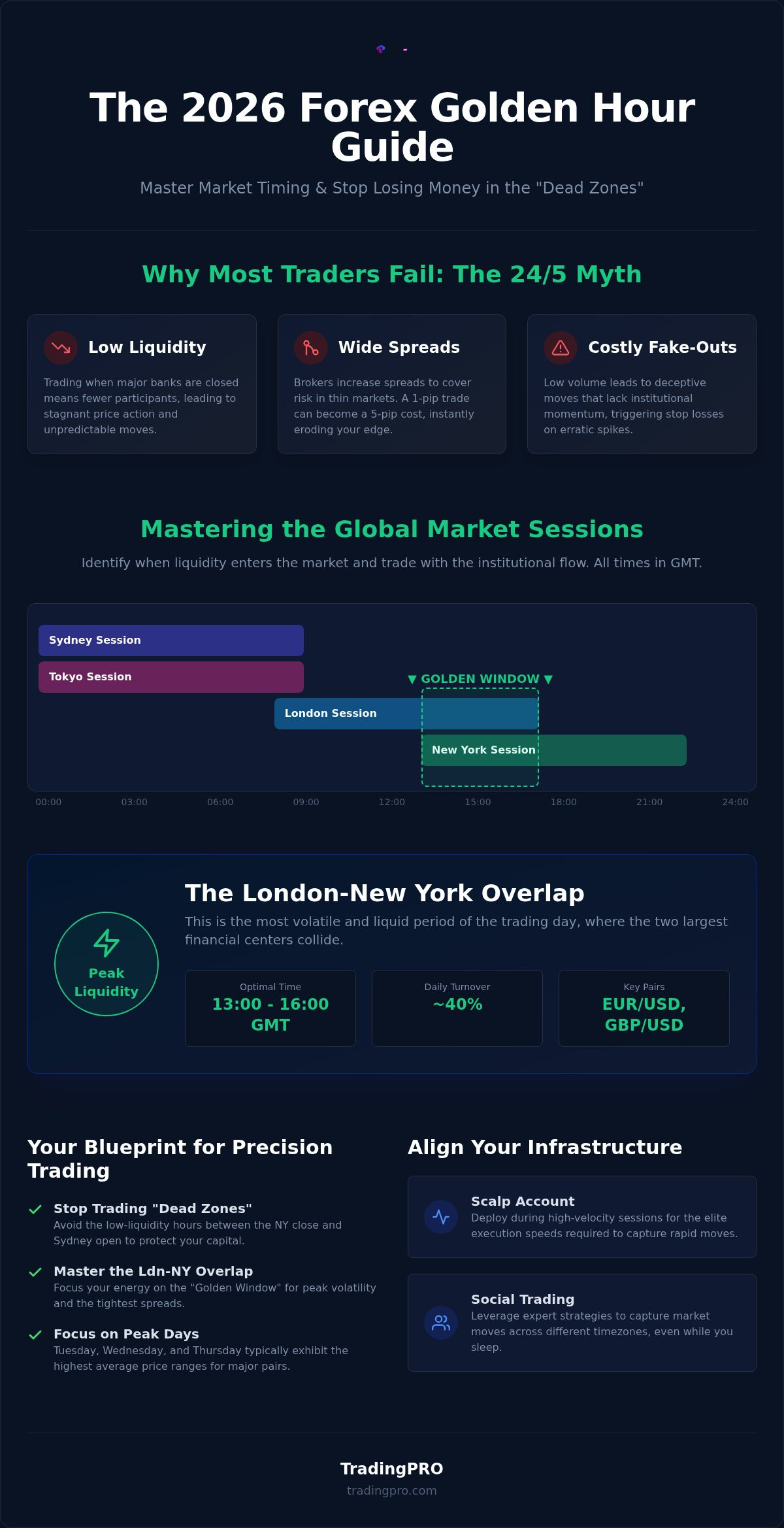
Global liquidity doesn't flow in a steady stream. It hits the market in massive, predictable waves. To find the best time to trade forex in my timezone, you must understand the "Big Four" financial hubs: Sydney, Tokyo, London, and New York. While each session has its own personality, the real magic happens during overlaps. When two major centers are active simultaneously, the sheer volume of orders creates the high-probability environments that professional traders demand. You aren't just looking for an open market; you're looking for an active one.
Statistical data confirms that volatility isn't random. The London session is the undisputed heavyweight, accounting for roughly 35-40% of global daily forex turnover. When London opens, the market wakes up. If you're hunting for significant pip movement, Tuesday, Wednesday, and Thursday are your primary targets, as these days typically exhibit the highest average price ranges across major pairs.
The London-New York Overlap: Global Liquidity Peak
The window between 1:00 PM and 4:00 PM GMT is the most explosive period in the financial world. This is the "Golden Window" where the world's two largest trading centers collide. During these three hours, liquidity peaks, spreads tighten to their absolute minimum, and volatility surges. It's the best time to trade forex in my timezone if your strategy relies on high-speed breakouts or heavy volume.
Focus your energy on the "Majors" during this window. EUR/USD, GBP/USD, and USD/CHF see their most decisive moves here. The velocity of price action requires elite execution. You can't afford slippage when the market is moving at institutional speeds. Precision is your greatest asset during this overlap.
The Asian-Pacific Sessions: Stability and Trends
The Tokyo and Sydney sessions offer a different rhythm. While often less volatile than the London-NY crossover, the Asian session provides critical trend-continuation opportunities. This is the prime time for pairs involving the Japanese Yen (JPY) and the Australian Dollar (AUD). It's a cleaner, more rhythmic environment that lacks the chaotic noise of the New York open.
Traders who prefer surgical, fast-paced entries often utilize a Scalp Account during these hours. Its infrastructure is designed to capture the quick, incremental moves characteristic of the Tokyo/Sydney overlap. Spotting a trend continuation before London traders even have their first coffee can give you a massive psychological and financial head start. Success is about preparation and positioning. Secure your spot at the front of the global queue by opening your professional trading account today.
Calculating Your Local Golden Hours: A Step-by-Step Framework
Stop relying on generic web converters that don't account for the nuances of institutional bank hours. To dominate the markets, you need a personalized framework that translates global liquidity into your local reality. Determining the best time to trade forex in my timezone isn't a one-time calculation; it's a strategic habit. Professional trading requires you to operate with the same clock-work precision as the major banks in London and New York.
Start by establishing your base. Institutional platforms and economic calendars almost exclusively use UTC (Coordinated Universal Time) or GMT (Greenwich Mean Time) as their anchor. This isn't for convenience. It's a global standard that prevents catastrophic scheduling errors during cross-border execution. By aligning your desk clock with UTC, you eliminate the confusion of jumping between different regional times and focus purely on the session overlaps that generate profit.
Converting UTC to Your Local Clock
Your local offset is the most critical number in your trading plan. If you're in Dubai, you're at UTC+4. If you're in New York, you're at UTC-5 during standard time. The formula is simple: Local Time = UTC +/- your regional offset. While manual math works, elite traders use automated tools to ensure they never miss an opening bell. For those in "difficult" timezones like Southeast Asia or Africa, this conversion often reveals that the best time to trade forex in my timezone occurs during the late evening or early morning. Embracing this reality is the first step toward a professional schedule.
The Daylight Savings Trap: March and October Shifts
Daylight Savings Time (DST) is a volatility killer for the unprepared. In 2026, the US and UK clocks will be out of sync for several weeks, creating a dangerous gap in session timing. The US shifts to DST on March 8, 2026, while the UK and Europe don't follow until March 29, 2026. This three-week window alters the "Golden Window" overlap by 60 minutes, potentially causing you to enter the market when liquidity is still ramping up or already fading. A similar disconnect happens in the autumn, with the UK shifting back on October 25 and the US on November 1. DST is the primary cause of beginner scheduling errors because it shifts the market's heartbeat without changing the time on your local wall clock.
Don't leave your timing to chance. You can automate this entire process by setting up precision session alerts through the TradingPRO Trade Hub. This tool provides real-time market analysis and ensures you're notified the moment the institutional footprint appears in your specific region. Whether you're trading the Tokyo open from Lagos or the New York overlap from Singapore, staying synchronized is your only path to consistent execution.
Account Alignment: Matching Your Schedule to Your Infrastructure
Don't make the mistake of using a generic account for every session. Your choice of account type is just as critical as finding the best time to trade forex in my timezone. High-volatility sessions, particularly the London and New York peaks, demand institutional-grade execution that can handle rapid price fluctuations. If your infrastructure lags, your strategy fails. Precision timing requires a platform that matches the market's velocity.
The Sydney session often traps traders who use spread-sensitive strategies. Because liquidity is lower during these early hours, spreads naturally widen. This creates a hostile environment for scalpers or high-frequency traders who need tight pricing to remain profitable. Conversely, the London/NY overlap provides the deep liquidity needed to keep costs low, but only if you're using a Scalp Account. This specific account tier is engineered for the "Golden Window," offering the raw execution speeds required to enter and exit positions without being eaten alive by slippage.
Scalping in the Eye of the Storm
Precision is non-negotiable when the New York market opens. This is the eye of the storm. Volatility can spike instantly following major economic data releases, such as the US GDP or FOMC minutes. During these high-impact events, a zero-spread environment becomes your primary competitive advantage. You need ultra-low latency to ensure your orders hit the market at the exact price you see on your screen. Managing slippage risk during these peak hours is the difference between a winning day and a blown account. High-speed execution isn't a luxury; it's a requirement for survival.
Building Confidence in the Rookie Account
If you're still mastering the best time to trade forex in my timezone, the Rookie Account is your most valuable asset. It provides a safer entry point to practice session transitions without the extreme pressure of the London/NY overlap. Start your day in the relatively stable Tokyo session. This allows you to perform technical analysis in a "quiet" environment before the chaos of the London open. As you grow more comfortable with the market's rhythm, you can transition to more volatile windows. For a deeper dive into these fundamentals, consult our Forex Trading for Beginners Guide to solidify your knowledge before moving to high-stakes overlaps.
Ready to align your infrastructure with the market's heartbeat? Register your professional trading account and take control of your timing today.
The Global Edge: Trading When You Can’t Be at Your Desk
Identifying the best time to trade forex in my timezone is only half the battle. The other half is being physically and mentally present to execute. Professional traders know that exhaustion is a performance killer. If your local "Golden Hour" occurs at 3:00 AM, your decision-making will inevitably suffer. You don't have to sacrifice your sleep or your primary career to capture institutional-grade moves. Modern technology has bridged the gap between your local clock and global liquidity.
Social Trading solves the timezone dilemma by allowing you to outsource your execution to experts who are already active during peak sessions. Instead of fighting your biology, you can replicate the trades of high-performance masters who live and breathe the London or New York overlaps. This automation ensures your capital stays productive while you're offline. It transforms the market's 24-hour cycle from a scheduling burden into a continuous opportunity for growth. Your edge no longer depends on your physical presence at a desk.
Leveraging Social Trading for Timezone Freedom
Success in the TradingPRO Copy Trading ecosystem requires a strategic approach to selection. Don't just look at raw profit percentages. Analyze a master trader's performance based on their active session. If you need coverage for the London open while you're asleep in Sydney, choose a specialist who dominates the European morning. This allows you to build a diversified portfolio that captures volatility across all major hubs.
You can effectively hedge your timezone risk by following multiple specialists. Assign a portion of your capital to a Tokyo trend-follower and another to a New York breakout artist. This multi-session strategy ensures you maintain a robust presence across different 2026 market cycles. For a comprehensive breakdown of how these systems operate, read our guide on Social Trading vs Copy Trading to find the platform that fits your lifestyle.
Final Checklist for Your 2026 Trading Schedule
Before you commit your capital to the next major session, run through this final operational audit. Precision is the result of preparation. Ensure your plan is airtight by verifying these three pillars of market timing:
- Confirm your local start time: Double-check your UTC offset against the 2026 DST shifts to ensure you aren't entering the market 60 minutes too late.
- Audit your account infrastructure: Verify that you are using a Scalp Account for high-volatility overlaps or a Rookie Account for learning session transitions.
- Synchronize your tools: Use the Trade Hub to set alerts for session opens so you never miss the institutional footprint.
The market waits for no one. Your timing is your edge, and your infrastructure is your weapon. Take the final step toward professional-grade execution. Register your TradingPRO account today and secure your place in the global financial landscape.
Dominating the 2026 Market Clock
Mastering the best time to trade forex in my timezone isn't just about reading a chart; it's about deploying the right infrastructure at the peak of global liquidity. You now possess the framework to navigate the explosive London-New York overlap and the expertise to avoid the capital-draining traps of low-volume "dead zones." Success in this fast-moving landscape requires more than just presence. It demands the perfect alignment of your local schedule with institutional-grade technology.
Whether you're executing surgical entries during the Tokyo open or capturing volatility while you sleep, we provide the tools to sustain your edge. Our multi-tiered infrastructure ensures you have the right account for every style, supported by institutional-grade execution speed that eliminates the friction of slippage. If your local clock doesn't align with the "Golden Window," our award-winning Social Trading ecosystem allows you to replicate global masters with ease. The market's most profitable hours are within your reach.
Start your journey with a TradingPRO Rookie Account today and take command of your financial future with the confidence of a global leader.
Frequently Asked Questions
What is the absolute best time to trade forex if I am in Asia?
The absolute best time for Asian traders is during the Tokyo-London overlap, typically between 06:00 and 09:00 GMT. This window provides the initial surge of European liquidity alongside active Japanese Yen markets. However, for maximum volatility, the late evening hours in Asia coincide with the London-New York overlap. This is the best time to trade forex in my timezone for those targeting major pairs with the tightest spreads and highest pip movement.
Does the best time to trade forex change during the summer?
Session times shift significantly twice a year due to Daylight Savings Time (DST). In 2026, the US moves to DST on March 8, while the UK follows on March 29. These staggered shifts create a three-week window where the London-New York overlap changes by 60 minutes. You must adjust your local schedule in March and October to ensure your trading window aligns perfectly with peak global liquidity. Staying synchronized with these institutional shifts is non-negotiable.
Can I trade forex on the weekends when I have more free time?
The global forex market is closed to retail trading on weekends, shutting down at 22:00 GMT on Friday and reopening at 22:00 GMT on Sunday. While the market is inactive, successful traders use this time for backtesting and weekly analysis. If you cannot trade during the week, use Social Trading to replicate the moves of professional masters. This allows you to capture high-volatility sessions without needing to be physically present at your desk during the week.
Which currency pairs are the most volatile during the London session?
The most volatile pairs during the London session include GBP/JPY, GBP/USD, and EUR/USD. London accounts for roughly 35-40% of daily global turnover, driving massive movement in "The Cable" and EUR/USD. Crosses like EUR/GBP also see significant institutional volume. Traders seeking high-speed execution during these explosive moves should utilize a Scalp Account. This infrastructure minimizes costs and allows you to capitalize on the rapid pip fluctuations that define the European morning and its transition into New York.
How many hours a day should a beginner spend trading forex?
Determining the best time to trade forex in my timezone as a beginner means focusing on quality over quantity. Spend no more than two to three hours per day actively trading during major session overlaps. Staring at the screen during low-liquidity periods leads to mental fatigue and impulsive errors. Use a Rookie Account to practice during the first two hours of the London or New York opens. This disciplined approach preserves your mental capital for profitable price action.
Is it better to trade during the London or New York session?
London is technically the superior session for pure liquidity, handling nearly double the volume of New York. However, the four-hour overlap between the two hubs is the ultimate environment for any strategy. This window provides the highest probability for trend continuation and breakout success. Your choice should depend on your specific availability; New York offers high-impact news releases, while London provides the most consistent trend-setting momentum. Both sessions require institutional-grade execution to capture peak pip movement.
What happens to the market during the 1-hour gap between sessions?
Liquidity drops precipitously during the gaps between major sessions, such as the period between the New York close and the Sydney open. This "Dead Zone" causes spreads to widen significantly as major banks withdraw from the market. Price action often becomes erratic or completely stagnant, making it a high-risk time for retail orders. Professional traders avoid these gaps, as the lack of an institutional footprint makes technical analysis unreliable and execution costs prohibitively high.
How do I use a forex market clock to avoid missing the New York open?
Sync your market clock to UTC or GMT rather than your local time to avoid missing the New York open. This provides a universal anchor that remains consistent across all global regions. You can automate this process by using the TradingPRO Trade Hub to set real-time alerts for session openings. This ensures you're at your desk exactly when the institutional footprint appears, allowing you to execute trades with elite precision and institutional-grade speed.


