




- Published on: 2026-10-15 01:40:46
Best Social Trading Network in 2026: How to Find the Right Fit

The best social trading network isn’t necessarily the one with the most followers or the biggest headline returns. A busy leaderboard can help you discover traders, but it won’t show whether a platform suits your trading style, region, or tolerance for risk.
Rankings and past performance can be useful comparison points, but popularity isn’t proof of reliability. Nor is social discussion the same as automatic trade copying. Social trading lets participants share ideas and analysis; copy trading is a specific feature that replicates another trader’s positions. In either case, results remain exposed to market and execution risks.
This guide explains how social trading networks work and what to compare before choosing one. You’ll learn how to assess access, transparency, performance history, and risk information, and how to distinguish community tools from trade replication. We’ll also cover common limitations, so you can weigh your next step carefully. TradingPRO brings social and copy trading together in its ecosystem, alongside account options including the Rookie Account.
Key Takeaways
- Choose the best social trading network by comparing transparency and risk information, not just visibility or popularity.
- Understand where trader discovery ends and automated trade replication begins before deciding how to participate.
- Compare networks against your experience, available time, preferred market exposure, and account needs.
- Use a risk-aware approach: copied trades can lose value, and past results don’t predict future performance.
- Consider how TradingPRO’s social and copy trading ecosystem and Rookie, Micro, Pro, and Scalp account tiers fit your needs.
What makes the best social trading network worth considering in 2026?
The most visible network isn’t automatically the best fit. A large community and prominent trader profiles can make it easier to discover ideas, but they don’t tell you whether information is clear, trading tools match your needs, or features support informed decisions. First identify what the platform connects, then compare the functions that matter to you.
A social trading network combines trader information or interaction with access to trading services. A standalone trading account provides trading access without necessarily including that social layer. Networks differ in what they offer. One may focus on market discussions and profiles, while another may also let users automatically replicate selected traders’ activity. Don’t rely on the label alone: distinguish community features from trade execution tools.
What does a social trading network do?
Trader profiles, shared market views, and visible activity can help you discover different approaches and follow market conversations. Treat them as context, not a verdict. A profile may show activity or results, but a snapshot can’t fully explain the strategy, risks taken, or whether the approach suits your goals.
Educational discussion can help you become more familiar with trading concepts, but it isn’t automatically a recommendation or individualized financial advice. Following a trader also doesn’t mean their strategy suits your circumstances, experience, or tolerance for risk. Evaluate other participants’ views as information, not instructions.
For a wider overview of the concept and its distinctions, see What is Social Trading?. The practical difference is simple: social interaction can inform your thinking, while copy trading is a form of automation that replicates another trader’s activity. A network may offer one or both.
What could change in social trading during 2026?
Instead of assuming every platform is adopting the same tools or rules, focus on what you need to assess a network effectively. Clear performance histories, useful discovery filters, and understandable risk information can help you compare traders beyond headline returns. Treat these as useful evaluation criteria, not guaranteed industry-wide developments.
Automation can make trade replication easier to access, but convenience doesn’t replace oversight. Copied positions can behave differently in your account, and a trader’s approach may change. Before participating, identify what the platform shows about trader activity and performance, understand what copying means in practice, and decide which choices remain yours.
In 2026, the best social trading network for you is one that makes its limitations as clear as its capabilities. Compare the actual tools and information, not the follower count. TradingPRO’s social and copy trading ecosystem lets clients engage with other market participants, alongside Rookie, Micro, Pro, and Scalp account tiers within its brokerage offering.
How social trading networks connect discovery, decisions, and trade replication
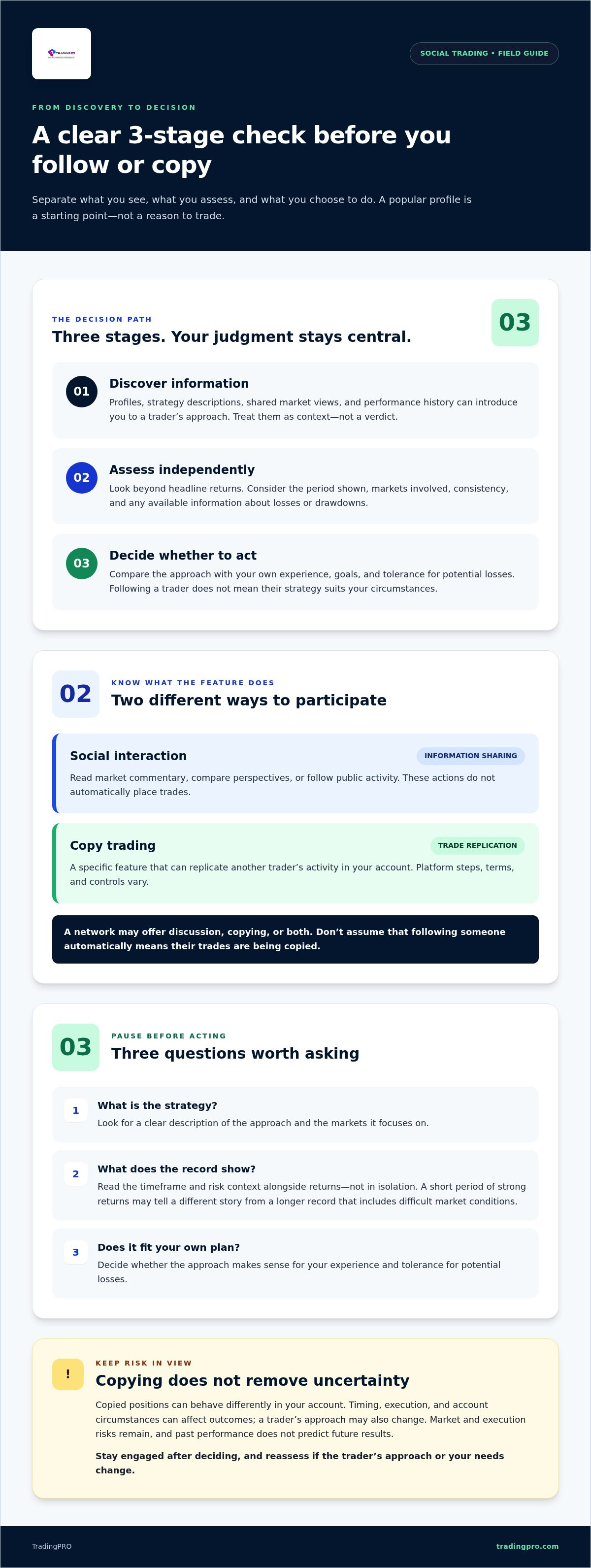
Finding a trader is only the beginning. A useful way to approach a social trading network is to separate the process into three stages: discover information, assess it independently, then decide whether to act. This helps prevent a popular profile or persuasive post from becoming an automatic reason to trade.
From trader discovery to an informed decision
Profiles, strategy descriptions, shared market views, and performance history can offer an initial picture of a trader’s approach. Use these details to form questions, not conclusions. A short period of strong returns, for example, may tell a different story from a longer record that includes difficult market conditions.
Put performance in context. Consider the period shown, markets involved, consistency of the approach, and any available information about losses or drawdowns. Rankings can help organize discovery, but a high position isn’t an endorsement or proof that a strategy fits your goals. Popularity measures attention, not suitability.
Before acting, pause and check:
- What is the strategy? Look for a clear description of the approach and the markets it focuses on.
- What does the record show? Consider the timeframe and risk context alongside returns, rather than reading returns in isolation.
- Does it fit your own plan? Decide whether the approach makes sense for your experience and tolerance for potential losses.
How trade replication differs from social interaction
Social interaction shares information. You might read market commentary, compare perspectives, or follow a trader’s public activity without automatically placing trades. Copy trading is different: it can replicate another trader’s activity in your account. A network may offer discussion without copying, copying without a prominent discussion feature, or both.
The process may involve reviewing a trader’s information, deciding whether to follow or copy, then using the platform’s tools to make that choice. Steps, terms, and controls vary by platform. Don’t assume that one network’s copying process applies elsewhere, and don’t treat an informational follow as permission to trade automatically.
Replication doesn’t remove market risk or guarantee that your results will match the trader’s. Timing, execution, and account circumstances can affect outcomes. Stay engaged after deciding, and reassess if the trader’s approach or your needs change. For more detail, use the article’s Social Trading vs Copy Trading guide as a companion to this section.
TradingPRO brings social and copy trading together in its ecosystem for engaging with other market participants. To explore the brokerage’s trading environment, you can begin with a TradingPRO account.
How to compare the best social trading networks for your needs
Start with your own priorities, not a universal ranking. A network that suits someone looking for market discussion may not fit someone seeking copy-trading access or a particular type of market exposure. Compare the same criteria across platforms, using current information relevant to your account and region.
Which platform details deserve a close comparison?
Use this framework to see what each network makes clear and how its offering matches your needs. Review current platform information for instruments, fees, account arrangements, and regional eligibility before drawing conclusions.
| Criterion | What to compare |
|---|---|
| Transparency | What trader profiles, strategy descriptions, activity, and performance history can users see? |
| Risk information | How are losses, drawdowns, risk context, and performance periods presented alongside returns? |
| Instruments | Which markets and instruments are available, and do they align with your preferred exposure? |
| Usability | Can you find relevant information and understand the difference between social features and trade replication? |
| Account fit | Do the available account arrangements and trading services suit how you intend to participate? |
| Fees and eligibility | What charges apply, and is the service available to users in your region under current terms? |
Compare like with like. For performance, note the period covered and whether losses and risk information appear in the same context as returns. Review fees and eligibility in current platform materials, since terms and access can differ by account and region.
Historical performance describes past results; it can’t establish what a trader or strategy will deliver in the future. Keep this in mind even when a profile shows a long record or strong recent returns.
Match network features to your trading approach
Prioritize criteria according to your experience, available time, and preferred market exposure. A beginner may value plain-language profiles, clear risk information, and an easy-to-understand distinction between discussion and copying more than a long feature list. Understanding matters more than the number of tools.
Active traders may give more weight to relevant instruments, usable research, and whether community insights complement their own process. Social tools should add perspective, not replace independent analysis. If a platform’s strengths don’t match your priorities, popularity alone won’t make it the right choice.
To compare the best social trading network for your situation, write down your priorities, assess each platform against the same criteria, and note when you reviewed its information. Avoid declaring an overall winner without defining the user profile and evidence behind that judgment. A consistent comparison makes it easier to see which trade-offs matter and which features are simply noise.
What are the risks of social trading, and how can you stay in control?
Copying another trader doesn’t remove the possibility of loss. It gives you a way to replicate trading activity, not protection from changing markets or a guarantee that your account will match someone else’s results. Past performance, a large following, and positive community sentiment provide context, but none can show what will happen next.
Why a copied strategy can still lose
Markets change, and a position may be opened or closed at a different time in your account. Execution can vary, too. Even when trades are replicated, differences in timing or account circumstances can affect the outcome. A strategy’s successful period doesn’t mean it will perform well in a different market environment.
Understand drawdown when reviewing performance: it’s a decline in an account or portfolio from a previous higher value. A record that shows returns without enough context about losses can make a strategy appear less risky than it is. Review the full history available, and don’t assume a shallow past drawdown rules out a larger future decline.
Rankings and community approval have limits. A trader may be popular for reasons that don’t reflect your priorities, and a strategy that worked previously may face different conditions ahead. Treat these signals as prompts for further review, not proof of reliability.
A practical risk-awareness checklist
Before deciding whether to copy a trader, slow down and check the basics. This educational checklist can help you assess the decision without treating another person’s trading activity as individualized advice:
- Understand the strategy. Identify the approach, instruments, and available history. If you can’t explain what you’d be exposed to, pause before proceeding.
- Review losses and exposure. Consider how the strategy has behaved during difficult periods and whether the possible decline fits your own loss tolerance.
- Check for changes. Revisit the trader’s activity and strategy information over time. A material shift may mean your original reasons for following them no longer apply.
- Understand platform controls. Review the platform’s terms and available monitoring or stopping controls. Don’t assume every network offers the same options or that a control prevents losses.
- Set personal limits. Make decisions within your financial capacity and risk tolerance. Don’t use popularity, copied performance, or community opinion to decide what you can afford to risk.
Staying in control means understanding what you’re following, reviewing whether it still makes sense to you, and accepting that losses remain possible. To explore TradingPRO’s social and copy trading ecosystem, create a TradingPRO account and assess the trading services with these risk questions in mind.
How TradingPRO’s social trading ecosystem fits your next step
Your comparison should lead to a platform that fits how you want to engage with markets, not simply the one with the loudest profile or the most features. TradingPRO is a multi-asset brokerage with social and copy trading in its ecosystem, bringing trader interaction and trading services together. Apply the same criteria you used for other networks: clarity, risk information, available markets and services, and how the account structure fits your plans.
Where TradingPRO fits in a network comparison
TradingPRO offers four account tiers: Rookie, Micro, Pro, and Scalp. These are account options within its brokerage offering, not guarantees of a particular outcome or substitutes for understanding trading risk. Compare the terms and information for the account you’re considering alongside the social and copy trading services you plan to use. Social features support engagement with other market participants; copy trading involves replicating trading activity and carries market risk.
If you’re exploring the Rookie option as a possible starting point, review the Rookie Account details as part of your research. Consider the information provided and whether the published terms align with your objectives. An account name alone doesn’t define its features or determine whether it suits you.
Make your review concrete. Before deciding, note what you understand about:
- Trading services: How social trading and copy trading fit the way you want to participate.
- Account options: Which of the Rookie, Micro, Pro, or Scalp tiers you’re assessing, and the published terms that apply.
- Risk and markets: The instruments and risks relevant to your intended trading activity, using current platform information.
Take a considered first step
The best social trading network for you is one you can assess clearly and use with a realistic understanding of potential loss. Before registering, revisit your objectives, available time, and risk tolerance. Make sure you understand the trading services involved, and don’t treat another participant’s activity as a promise of similar results. The decision should remain yours.
TradingPRO has operated since 2017 and offers a social and copy trading ecosystem alongside its account tiers. If that combination matches your comparison criteria, register with TradingPRO. Review the relevant account and trading information before deciding how, or whether, to participate.
Make your next move with clarity
The best social trading network is one you can approach with a clear purpose and realistic expectations. Before acting, write down what you want the platform to help you do, what would make you pause, and how you’ll review your decision over time. A simple framework keeps your next step grounded in your priorities rather than pressure to follow a trend or act quickly.
You don’t have to make every decision at once. Take time to understand the account options and trading services, then decide whether participation aligns with your objectives and comfort with risk. A measured start gives you room to learn, reflect, and choose deliberately.
Ready to explore TradingPRO’s social and copy trading ecosystem? Explore your next step with TradingPRO, and make each decision with your goals and risk tolerance in mind.
Frequently Asked Questions
Is social trading suitable for beginners?
Social trading can give beginners a way to observe how other market participants discuss and approach trading, but it doesn’t remove the need to learn. Use social features to explore different viewpoints, then make sure you understand the risks before considering any trading activity. If you can’t explain how a strategy might lose money, take more time to learn before deciding whether to participate.
Can social trading guarantee profits?
No. Social trading and copy trading can’t guarantee profits, and a trader’s record or popularity can’t promise future results. For example, a strategy that performed well during a rising market may struggle if conditions change. Treat performance information as historical context, not a forecast. Consider participating only if you understand that trade values can fall and you can tolerate potential losses.
What is the difference between a social trading network and copy trading?
A social trading network is the broader setting where users can access trader information or interact around markets. Copy trading is a specific activity that may automatically replicate another trader’s positions. You might read a trader’s market commentary without copying any trades. If you enable copying, trading activity may be replicated according to the platform’s process and terms.
How much experience do I need before using a social trading network?
There’s no single experience level that makes participation appropriate for everyone. Before using a network, learn the basics of the instruments and trading approach you’re considering, and make sure you understand that losses are possible. You should also be able to judge whether a trader’s strategy makes sense to you, rather than relying on a ranking or someone else’s explanation to make the decision.
What happens if a trader I follow changes their strategy?
A change in approach can alter the risks and market exposure you originally considered. Review updated profile or activity information and compare it with your reasons for following the trader. If you copy their trades, review the platform’s current process and terms for managing or ending that arrangement. Don’t assume a follow or copy setting will automatically adapt to your preferences when a strategy changes.
Can I lose money when copying another trader?
Yes. Copied trades can lose value, and your results may differ from the trader’s because timing and execution can vary. If a copied position moves against the market, your account may experience a loss even if the trader later changes course. Before copying, consider the possible downside, your financial capacity, and whether you can tolerate losing the amount you choose to put at risk.
Do social trading networks offer the same markets and features in every country?
No. Available markets, account arrangements, and platform features can differ by location. A network’s general website may describe services that aren’t available to every user, so look for current information that applies to your country and account. Review the platform’s published terms before relying on a particular feature. Don’t assume another user’s access or experience will match yours.


